A tag read by torchlight, four owners later
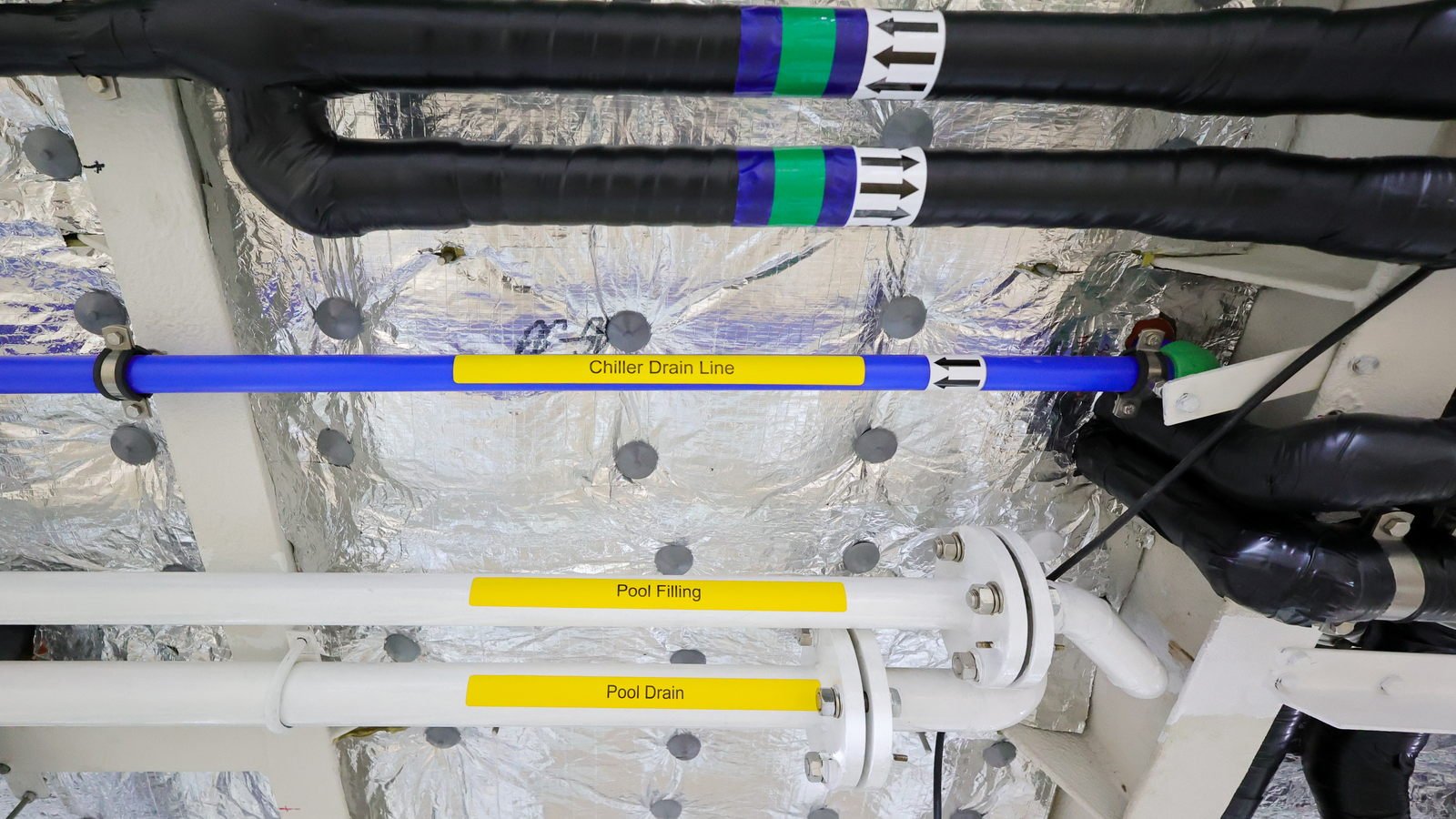
Somewhere nobody planned on stopping, an engineer has an inspection cover off in a machinery flat, a torch in one hand and a tag held against the sheet that is supposed to describe it. The tag is legible. He cannot read it, and the man who wrote it is four owners ago.
Whether the marks exist, whether they are accurate and whether they were drawn are ordinary scope questions, settled here already: both ends of every line, the service named, the direction of flow. Which language they are written in is not asked at all.
The second record, and no clause names it
A refit contract names a language of record for the paper, and that argument is made in full elsewhere. A refit writes a second record on the boat rather than in the file: line tags and flow arrows, switchboard legends and breaker labels, the printed notice screwed to a board. No clause names the language of any of it.
One writer, and readers who cannot ask him anything
A line tag is written once, at first fix, by the fitter who pulled that run, in the one hour when he is the only person who knows where both ends of it go. He printed it before lunch, in the language he thinks in.
Sorting a mark from a document takes one question: does anybody hold a revision number for it? A tag is not issued, not numbered and not superseded, and nothing on it says how old it is or whether it has been checked since.
One writer, for one hour; then an open-ended set of readers, none of whom can put a question to him, one of whom is the engineer with the torch.
Permanence, and the default it produces
The fitters here work in Turkish. An owner's team, a captain and a rotating crew usually do not. What that means for the paperwork we issue is a settled question. A mark is not paperwork: it goes on saying the same thing long after this refit is somebody's old file.
None of this is a problem with Turkish or with English. Where the specification is silent, the language of the permanent marking is decided at the printer by whoever queues the job, in the language he thinks in. Silence produces a default, and the default is not a fault. It is only unexamined.
The clause that is usually missing
The fix is early, which is what makes it small: settle the language of the permanent marking before first fix and name it in the specification. Four lines cover it.
- which language the permanent marking is written in, named as a single default;
- which marks carry two languages, stated as a rule and not left to judgement;
- that tag text is identical to the as-built text, not a translation of it;
- that any later relabelling is raised as a drawing revision, and who raises it.
A specification that names the system, the verb, the standard, who supplies and what is handed over still does not name the language of the marks the work leaves behind. Before first fix this is a sentence in the scope. Afterwards it is stripping and reprinting runs that were already correct, and a tag reprinted after close-out is a revision to a set already issued and aboard.
Where a second language earns its place
Not everything earns two. Mark twice where the mark is safety-bearing: a stop, an isolation point, a valve that must not be shut or must not be opened, a notice on a switchboard whose ways look like every other breaker on it. One instance is already published here: a 24-volt section carrying the smoke and bilge alarms and three automatic bilge pumps under a printed instruction in two languages. That is already the practice on one switchboard; the clause decides it earlier, and for more than one.
A tag carrying everything twice is too long to read at arm's length, and a plate small enough to sit on a valve body cannot be engraved twice, so doubling is rationed to marks where a misreading changes what somebody does with his hands.
Identical, not translated
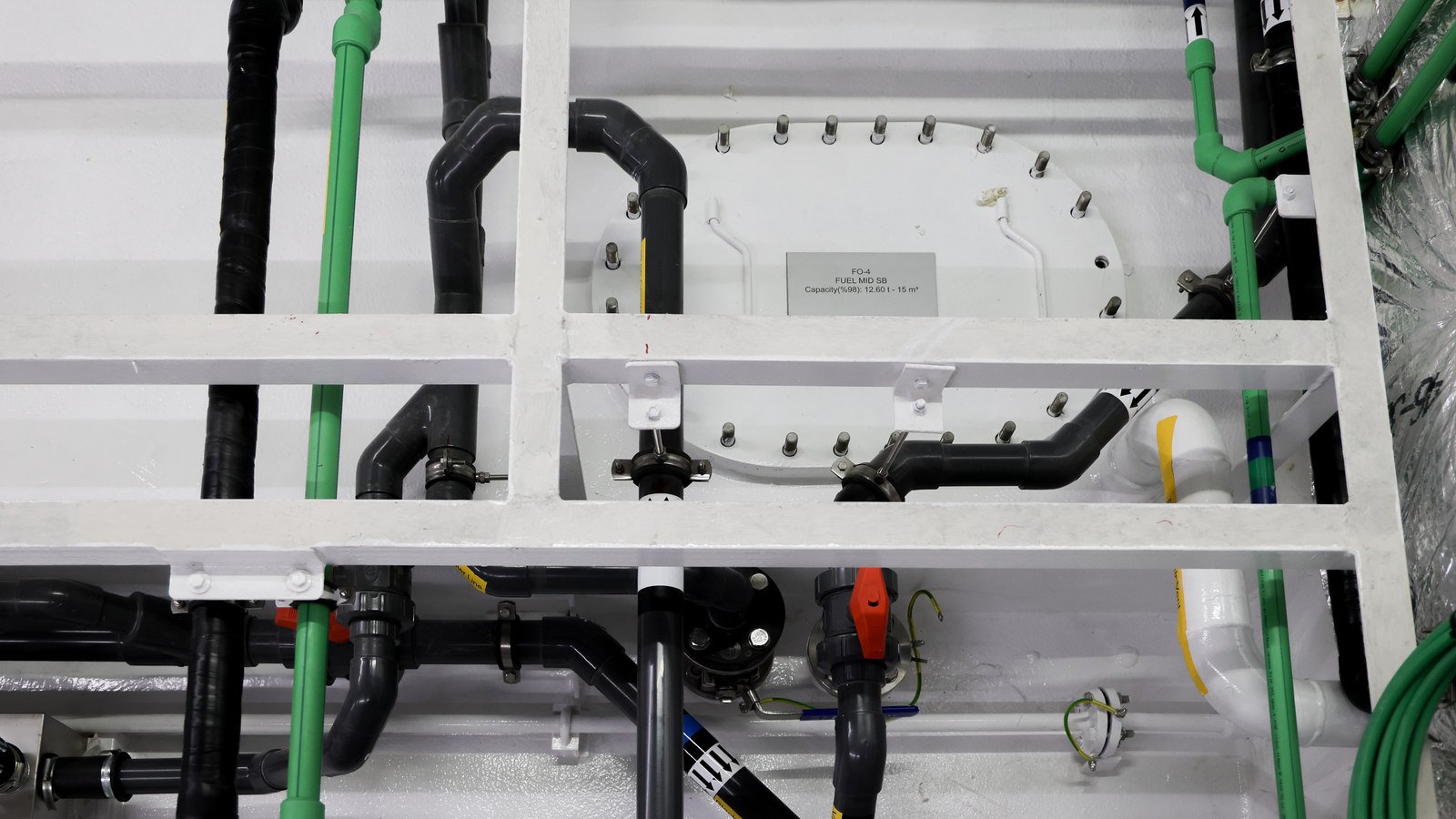
The text on the tag should be character for character the same string as the text on the as-built sheet. Not a translation of it: the same characters in the same order. Matching then becomes a shape operation instead of a reading one: somebody who reads neither language well can hold the sheet against the pipe and see whether the two agree. Translate the tag and you destroy exactly that.
We have written that what goes back is labelled at both ends and drawn as built. Identity is the next question along: whether the two strings are the same characters. The failure lives in the drawing office. A tag carrying Turkish characters, transcribed onto a sheet without them, is no longer the same string, and the comparison stops working. That is a correspondence problem, not a language one, and it is fixed at the desk. The valve chart in our tank systems work is verified valve by valve, which settles whether it is true; identity settles something else.
Abbreviations, units and the medium
Two people reading the same English tag can disagree about it: FW and SW, bar against kPa, tonnes against cubic metres. A shared alphabet is not yet a shared vocabulary, so settle the abbreviations and the units in the clause that settles the language.
The medium bears on it too. An engraved plate or a stencilled band outlives the adhesive label beside it and cannot be quietly corrected. Durability protects the right word and preserves the wrong one for just as long.
A relabelling is a drawing revision
Years into her life a crew will relabel something in their own language, to make the boat workable on their watch. That is a reasonable act. It also alters her correspondence with the set that was walked and redrawn as she actually is as surely as moving the valve would, in one place that goes unrecorded.
So raise it: a revision number against the drawing it changes, with the superseded text kept, not overwritten. The machinery exists for work, and as far as we can find it has never been pointed at a mark. The other version is not a lie. It is tidying, and tidying is how a set and a boat come apart without anybody doing anything wrong. Raise it even for one valve, a thousand miles from the yard.
What a label does not prove
A label records what somebody intended the line to be, not what it is. Following the line, or testing it, is the only thing that proves it, and a yard that lets a label stand in for a trace has replaced an uncertainty with a confident error, which is the harder of the two to find.
Written at the yard in Tuzla. What is described here is this yard's own practice for the marks we make and the sets we issue.
If there is no marking clause, that is the usual answer
The four lines above are printed in this post, and they can be lifted straight into a specification without asking us first. If you would rather have them written against your own system list, write to info@revivarefit.com and ask for that. It is one question, and it needs no document.
START A REFIT