Water entering a hull does not spread out. It runs to the lowest point of the compartment it got into and stays there, and a drainage circuit follows from that: a suction at that low point, at the angle she will be lying at, and a path overboard the water cannot travel back down. A yacht bilge and fire system refit makes both true again where alterations have made them false.
Where the suction sits when she is down by the stern
A bilge suction lifts nothing once the water is below the mouth of its strum box. On a hull trimmed by additions aft, or listing on a part-full wing tank, the low point has moved and the suction has not. What is left is a mopping job, and it is water against the foot of a switchboard.
The strainer is the other half. A strum box blocks with what the compartment produces, which after a refit means insulation fibre, dust and cable ties. That does not stop the pump, it starves it: the pump draws air with the water, loses its prime and moves nothing while the panel light says it is running.
The valve that passes a visual inspection
A non-return valve fitted the wrong way round looks right. In a horizontal run behind a lining the body reads the same from either side, the cast arrow faces the frame, and once the run is lagged nobody sees the arrow again. Orientation is not only end for end either: a swing check needs gravity to seat its flap, and one in a vertical downward run will not close.
The failure has a signature. A check valve leaking in a discharge riser lets the column of water above it drain back into the well each time the pump stops. The float lifts, the pump runs, and she has a bilge pump short cycling all night on the same few litres. The pump is not the faulty item.
Direction of flow also separates a drainage line from a flooding path. Pump a flooded compartment through a bilge main shared with a dry one and the water arrives under pressure, its easiest route to atmosphere down the branch into the dry space unless that branch's non-return holds. One failed valve turns a system draining one compartment into one filling two. The same holds at the shell, where a discharge below the waterline is an inlet as well: the hull stops at the face of the valve on the skin fitting, and its bonding and means of closing answer to her class rules rather than to us.
The compartments nobody stands in
The spaces that flood are rarely the ones people occupy. They are voids: stabiliser compartments, shaft spaces, the structure around a thruster tunnel, each holding a penetration and a seal, several with no suction of their own. Their mechanical end belongs with everything below the waterline; the venting, drainage and alarm belong here.
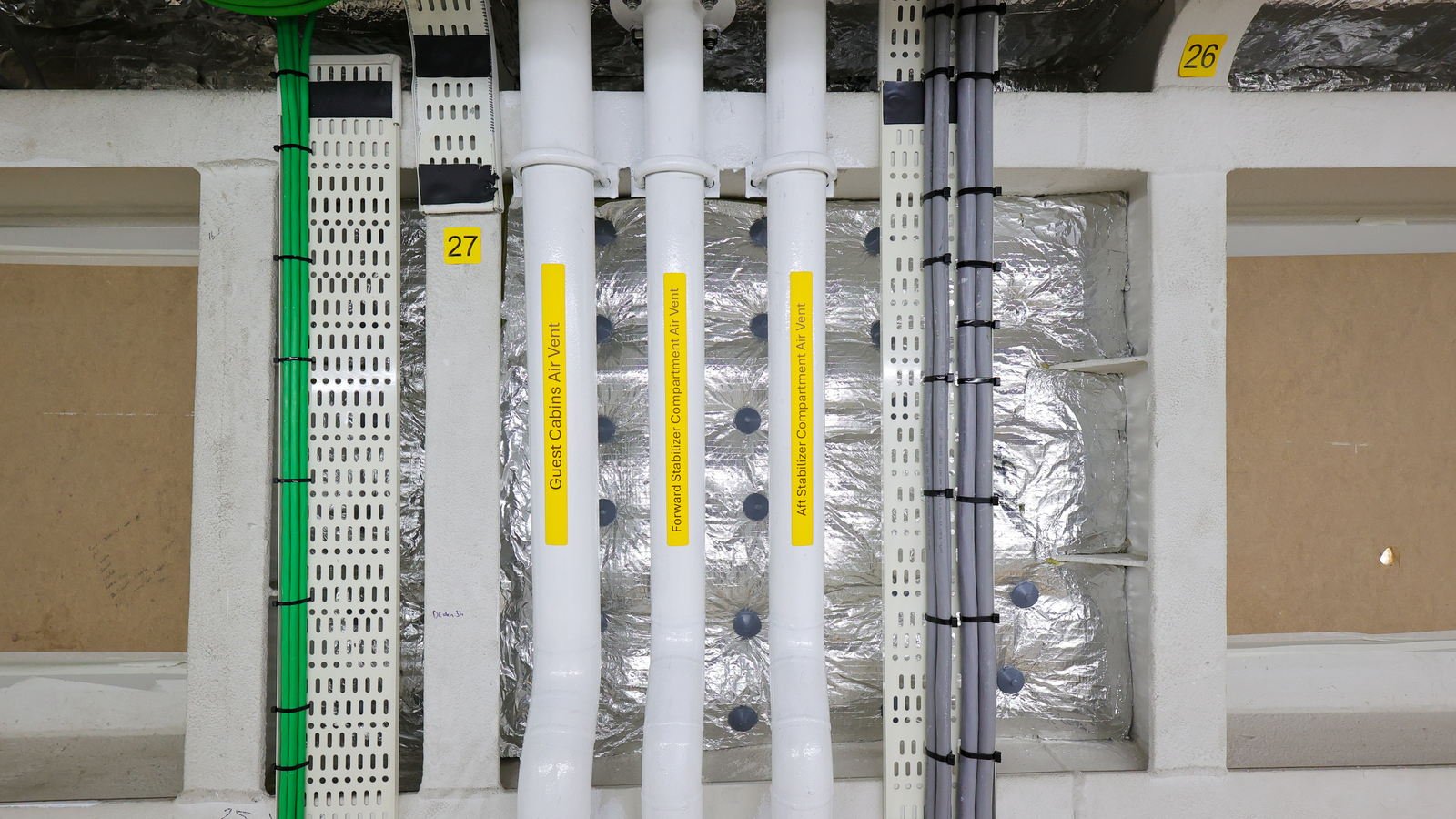
The vent risers in the photograph below, labelled for the guest cabins and the two stabiliser compartments, are the bulkhead end of that. A compartment that cannot breathe cannot be pumped, since a pump drawing on a sealed void stalls, and where a vent terminates decides whether the space takes water from a deck that is occasionally awash.
An alarm float is a pivot, a float and a switch sitting in oily water, and the pivot is what dies. Two levels earn their keep, a low one meaning go and look and a high one meaning act now, because one level set high enough to avoid nuisance alarms only reports a problem already large.
The ways that are meant to be left switched on
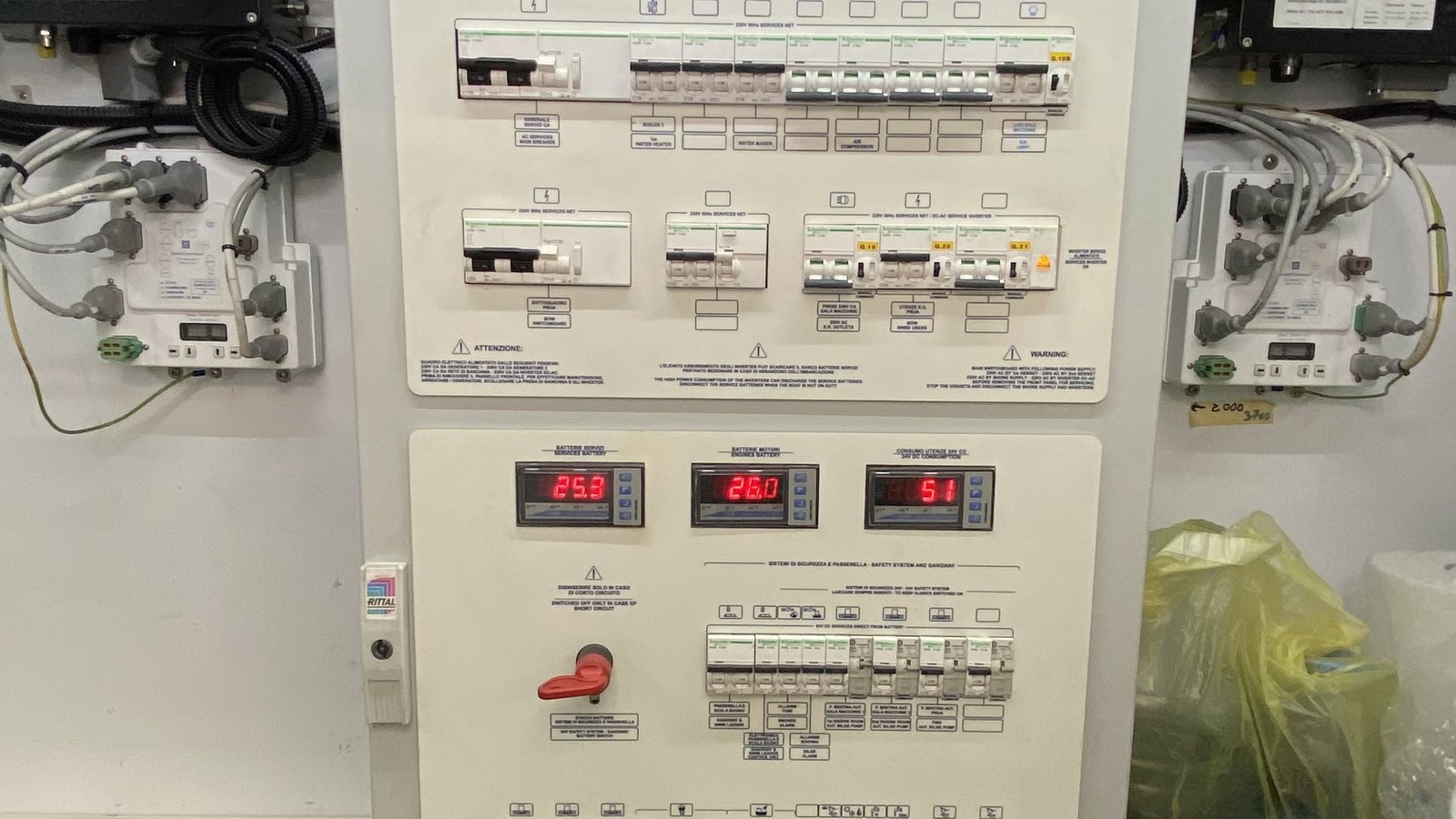
A bilge pump and a smoke head are only as good as the supply behind them, and that supply is unlike every other aboard. The panel at the head of this piece was photographed as found: breakers fed at 24 volts direct from the battery, carrying the smoke alarm, the bilge alarm and three automatic bilge pumps, under a printed instruction in two languages to leave them always switched on.
That instruction is printed on the panel because those ways look like every other breaker on it. An automatic bilge pump is two devices in series, a float and a breaker, and the breaker reports nothing when it trips. Two ways carry blank labels, and each is traced to what it feeds and labelled, or proved dead. Afloat this section stays live through the works, and what stands in for it otherwise belongs to an hour after the last spark.
Detection zones, and the bulkhead that moved under them
A smoke head covers an area of deckhead, and that coverage assumes it is open. Put a new bulkhead or a deep beam under it and one head covers two smaller spaces badly instead of one properly, and behind a new lining there is no head at all.
The zoning is the sharper problem. A zone that was one compartment can end up spanning both sides of a boundary, so the panel tells a watchkeeper something is alight without saying which side of the division it is on. None of that shows in a system tested head by head, because every head is working. What catches it is a list written from the compartment rather than the loop: this space, these heads, this zone, and the words the panel puts up.
What has to close before a release does anything
Fixed extinguishing holds a concentration inside a volume for a hold time, and the volume is real only if the openings into it shut: ventilation flaps and fire dampers, the fans, the quick-closing fuel valves and the doors, all worked from a release station outside the space. A supply fan still running takes the concentration below design, and a damper painted into its frame during a repaint will not fall. Penetrations opened through that boundary go back to the rating of the division they cross, a discipline belonging with the joinery closing over them.
One limit is worth stating. Where a refit changes the volume of a protected space, whether the installation is still correct is not ours to decide: that calculation belongs to its approved designer, accepted by the attending society. Our part is the fitting, the routing, the making good as approved and the record. We cannot sign off somebody else's concentration figure.
What costs money, and what costs only attention
Stroking closures from their stations and forcing alarms point by point is trials work, set out in the trials programme. What no programme can do is move a suction, turn a check valve round or unpick a zone straddling a boundary. Those are settled while the compartment is open or not at all.
Some of that is money: a skin fitting and its valve renewed, a zone recabled, a suction cut in where there was none. The rest costs only attention.
- which compartments have a suction of their own and which have only an alarm
- where every vent terminates, and against which waterline
- when each bilge float was last lifted by hand, and who wrote down the result
Written at the yard in Tuzla. What any particular vessel's bilge, flooding and fire arrangements have to satisfy is settled in her class file, and the judgement on her own circuits belongs to the owner's surveyor and the attending class surveyor.
What to send about her bilge and fire systems
Send the bilge and fire main piping diagrams as they were last stamped, the fire control plan with the detection zone list as the panel actually holds it rather than as the drawing set has it, and the fixed extinguishing data sheet with the volume it was calculated against. Add the compartments that have no permanent suction, the date any bilge alarm float was last lifted by hand, a list of her skin fittings with the compartment each one serves, and a general arrangement marked up with any bulkhead, duct or void that has moved or been added since she was built, because that last answer decides how much of the detection zoning has to be reworked rather than reprinted. What comes back is written compartment by compartment rather than system by system: for each space, whether it has a suction of its own, which detection zone the panel actually puts it in, and what would have to be opened before either can be priced. Send it to info@revivarefit.com.
START A REFIT