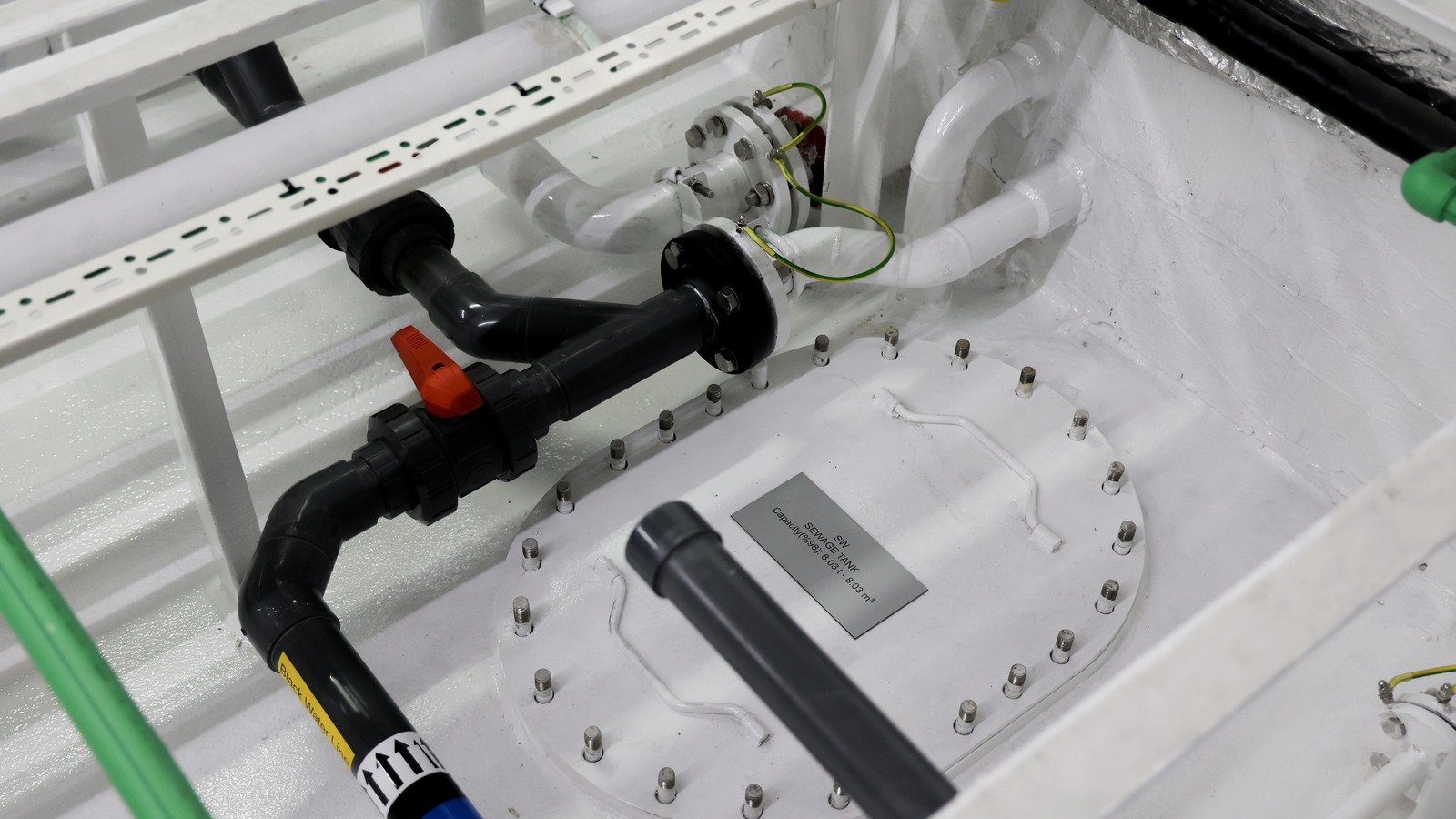
Nobody aboard sees the inside of a tank between one survey and the next. What the crew see is a number on a panel, and a yacht tank systems refit is judged on that number: a tank that holds product and cannot be measured is half a tank.
The structural work, from gas-freeing and weld repair through the tightness test to blasting and coating, is taken apart in what the torch finds, which also sets out how quantities like these are priced. Assume it all done, and still nothing tells the chief engineer how much fuel he has.
Sounding, gauging and the calibration table
Level is read off a rod down the sounding pipe against a calibration table, which converts depth into volume at a stated trim, and off a float or hydrostatic sender on a display.
Both fail quietly. A striker plate goes missing, and the rod lands on the bottom plating in the same place every sounding and thins it. A part-blocked air pipe puts a hydrostatic sender under the wrong pressure. A sender is renewed, nobody re-runs the table, and the display is precise and wrong.
A proven gauge is only proven in the condition it was proven in. The table holds at the trim and list it was taken at, and between the measured points the line is assumed.
Vents and overflows
A vent has to pass air as fast as the fill pump moves liquid, so its area is checked against her class rules. A fuel vent over the topsides is not a paint repair but an oil discharge: the SOPEP comes out, it is reportable, and the afternoon ends with a port authority. Air pipes terminate on open deck over a save-all tray, the overflow running to a dedicated tank with a high-level alarm.
The fuel side of a yacht tank systems refit
Fuel is a system rather than a store: fill lines, transfer pump and manifold, cross-fill, suctions standing off the bottom. A crossover left open transfers by gravity under way and puts a list on her.
Filtration does one job ahead of the engine and another at it. Primary water-separating filters go in as a duplex set with a changeover, an alarm in the bowl and a vacuum gauge on the housing. The engine maker's secondary element sits downstream of them and is not changed under way. Fuel polishing is separate again, a loop drawing from the true low point at one end and returning at the far end to sweep the bottom.
Microbial growth is the lay-up problem, and whether she lies full turns on the fuel: road-grade EN 590 carries FAME and holds water in suspension. Biocide is no free answer. The dose kills the biofilm, the dead mass goes to the filters, and the passage after treatment is the worst one unless the tank is polished afterwards. Where that loop takes and returns is decided with the sole up, and what the joinery closes in covers the rest of that argument.
The potable chain, end to end
Water is judged at the tap, not the tank, so the scope is the whole chain: an internal finish with a potable approval, WRAS or NSF/ANSI 61; the watermaker, its feed away from any discharge and its salinity probe and dump valve proven by test; treatment, ultraviolet or dosing; the calorifiers; the pressure set; and the distribution beyond them.
Calorifier and tap temperatures answer to legionella. Storage at or above 60°C, at least 50°C at the tap within a minute of opening it, and the cold side below 20°C, proven at the furthest and least-used outlet. A guest bathroom branch shut off out of season sits at neither number and re-enters the system the day somebody opens the valve. Shorten the dead leg instead of dosing harder upstream.
Where the scope is really one manufacturer's package, a treatment plant inside its warranty or a watermaker serviceable only by its own network, our part is access, pipework and power, and the specialist is booked direct.
A potable result is true for the day it was sampled. What follows it is bunkering from a hose of unknown history, a winter with the day head isolated, an ultraviolet lamp run past its rated hours. The system is run by her crew from the day she leaves.
Grey and black water
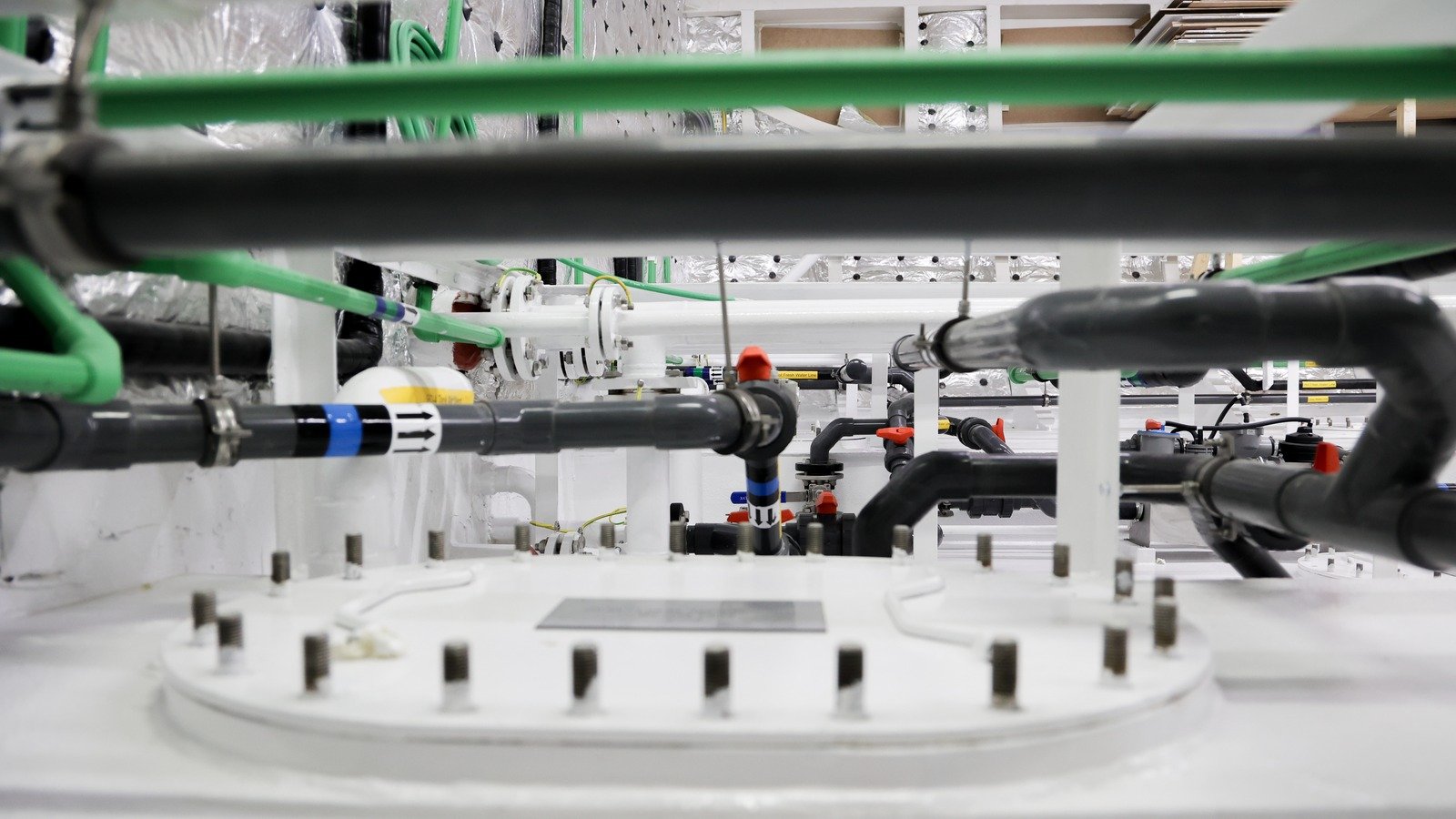
On most yachts the black water side is a vacuum system, proven by holding vacuum rather than pressure. The rest is documents: a holding tank of stated capacity with its capacity plate on the manhole, a plant with type approval, MEPC.227(64) for a recent installation, the ISPP certificate where her tonnage brings her into it, and a shore discharge connection actually fitted. The overboard discharge valve's position has to be visible, sealable and recorded, because at the ISPP check a port state control inspector will ask to see it secured and its position logged. The certificate and the plant's type approval sit in her certificate file, and the tightness test result goes into the class file.
Valves, manifolds and the chart
Labelling and as-built drawing follow the same principle here as on a loom. Tank systems need a valve chart of their own: every valve numbered to the identifier engraved on it, colour identification to ISO 14726, the running position stated, and the fill, transfer, cross-fill and emergency line-ups written out.
The fuel tank suction and filling valves that close from outside the space belong on that chart ahead of everything else. Each is operated from its remote station and proven to shut, with the result on the close-out sheet.
The chart we hand over is verified against what is actually fitted, valve by valve in the bilge, and not copied out of the drawing set. That is charged hours, and it is the only version worth having.
Commissioning: flush, disinfect, prove
- Each line is pressure tested before anything closes over it.
- The chain is flushed first for swarf and jointing compound, then disinfected at a stated dose and dwell, of the order of 50 mg/l free chlorine with every outlet drawn through, then flushed back to background.
- That order is load-bearing. Residual chlorine keeps killing organisms in the sample bottle, so a sample drawn early comes back clean from a system that is not.
- The samples are taken at the taps, into bottles dosed with sodium thiosulfate, and sent to an independent laboratory. Handover waits on that result.
- The vacuum side is pumped down, the generator isolated, and the decay read against a stated allowance.
- The gauge is proven against a measured fill on the product she will carry, or on water with the density correction applied, and the table reissued.
The last thing done is the walk. Every valve on the chart is turned by hand, its running position written down as the valve was actually found, and the chart corrected wherever the metal and the drawing disagreed.
Written at the yard in Tuzla. The tests named here are the ones we put up to be witnessed, and the records we hand over at close-out.
What to send before her tank systems can be priced
Before her tank systems can be priced we need the tank arrangement and capacity table, the sounding tables as issued, and the class-stamped piping diagrams for fuel, fresh water and waste, not the shared-drive copies. Add her tonnage and flag, the ISPP certificate and the sewage plant type-approval paperwork if you hold them, and say whether the black water side is vacuum or gravity, because that one answer changes the scope more than anything else on the list. With it: the last bacteriological result and its date, any recent fuel or bottom sample, the watermaker and treatment unit makes and models, and a note of which gauges the crew have stopped believing. If she has been laid up, say how long and whether the tanks were left full. We come back with the parts of the chain we would open before quoting, and a price for the rest on a rate against measured quantity. Send it to info@revivarefit.com.
START A REFIT