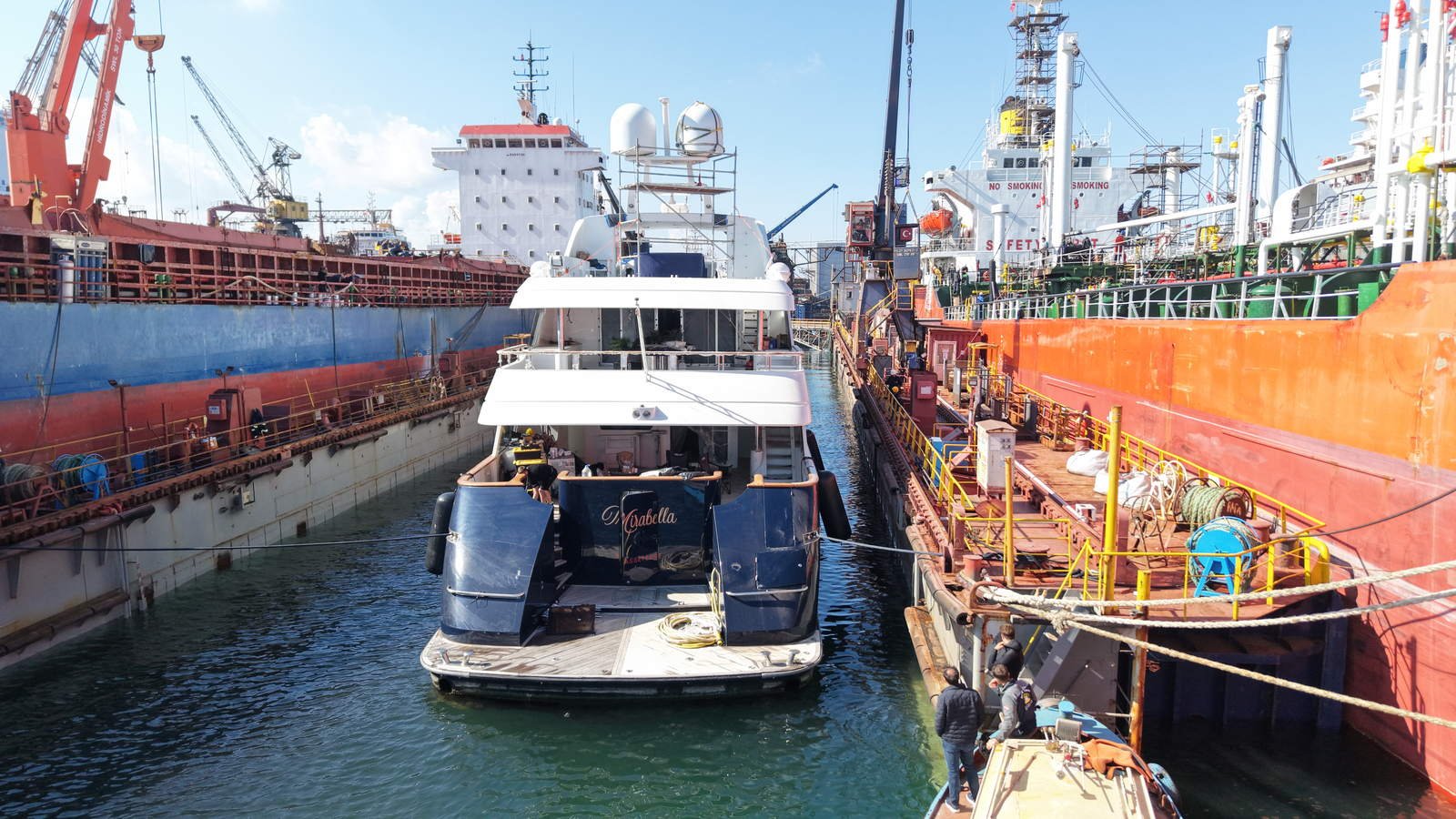
Steel is the one scope in a refit that cannot honestly be fixed at a quotation, because nobody knows its extent until the plate is off. Yacht steel repair in Turkey starts somewhere else entirely: with a boundary, a line agreed with a class surveyor and marked on the plate before anything is cut. Every number after that hangs off it.
From wastage to an agreed line
Wastage is found before it is argued about. Ultrasonic gauging by an approved service supplier gives remaining thickness across shell, frames, floors and tank boundaries. How that plan is agreed before the operator boards, and what one set of readings does and does not cover, is set out in what a thickness map tells you. The readings are a case, not a decision.
The decision belongs to class. Diminution is measured against the allowable for that member, and the surveyor and the yard walk the boundary together, scribe it on the plate and enter it in the record before a cut is made. A yard that cuts to an agreed line has a document. A yard that cuts to a generous line has an argument, and the argument surfaces in the final account, months after anyone can look at the steel.
Yacht steel repair in Turkey, and why the plate is local
In most yacht yards hull plating renewal is a subcontract. In Tuzla it is the staple, so plate is ordered against a mill certificate the surveyor will accept, and common grades and thicknesses are cut and formed on this waterfront rather than freighted onto it.
What travels less well than plate is approval. Welding procedure specifications and the qualification records behind them are held for the grades, thicknesses and positions this district works in, so a joint can usually be welded in the week the boundary is agreed, without a fresh qualification first. Where a scope falls outside that envelope the gap is a procedure to qualify, not a firm to find. A yard here saying steel is quick is not being clever. It is describing where it lives.
Cropping and inserting, and why doublers are refused
Wasted plate is either cropped out and replaced with an insert of the same grade and thickness, welded full penetration and ground flush where the coating requires, or covered with a doubler welded round its edge.
Doublers are usually refused, and not out of pride. A doubler traps moisture between two faces nobody can inspect, moves corrosion from a visible surface to a hidden one, and lays a fillet weld across a plate already thin. Class may accept one as a temporary measure with a date attached, and on a yacht that date lands inside somebody's season.
Insert plates are laid out clear of existing welds and radiused at the corners. The internals behind them — frames, bracket toes, stiffener ends — are routinely found wanting once the shell is off, and are the first place a steel scope grows.
Procedures before welders
Each joint is welded to a procedure specification supported by a qualification record — WPS and PQR — and the welder holds a certificate inside that same envelope. Low-hydrogen consumables live in an oven and a quiver, not in a bag on the staging, and preheat and interpass limits are stated and checked with an instrument.
Completed welds are proven visually, then by whatever the inspection and test plan calls for: magnetic particle or dye penetrant at the surface, ultrasonics where a full-penetration joint carries load, after the delay the material and thickness require. Those items carry dates. A witnessing item falling due on a morning the surveyor is not in the yard moves everything queued behind it.
Two clearances before the torch
Integral tanks decide the programme more often than the plate does. A fuel or slop tank is stripped, cleaned, ventilated and tested before a torch comes near it, and a competent person certifies the readings.
Two clearances are involved and they are not one document. A gas-free certificate says people may go in. Safe for hot work says a flame may be struck, and that second reading is taken in the adjacent compartments too, because heat travels through a boundary into joinery, insulation and cabling on the other side. Each expires inside a working day and is renewed after any break.
Entry is its own regime — atmosphere monitoring, a standby man, rescue arrangements — and it applies every time somebody goes back in, not once on the first morning. The fire watch that stays on after the last arc is where a yard's cover bites, and it is set out in insurance and liability.
A tightness test, then the coating
Before anything is coated, the renewed boundary is tested, method and head written into the test plan beforehand. A weep found after the coating is a tank blasted twice.
After the test it is the coating, not the welding, that owns the calendar. Surfaces are blasted to a stated standard and edges ground, because paint will not hold on a sharp arris, and what goes on is an immersion-grade system chosen for the product the tank carries.
Then the tank belongs to the data sheet. Extract ventilation runs through cure, the film is checked for holidays and pinholes on a surface nobody will look at again, and cure runs for the period stated at the temperature assumed. A tank in cure freezes the spaces around it, and the cure period is the cure period whatever the programme says.
Steel finds more steel
Steel scope grows. That is the nature of the work and not a yard's excuse: removing shell exposes frames, opening a tank exposes its internals, blasting a boundary reveals pitting a paint film had been holding together.
Almost everything else in a refit can be specified and tendered as comparable lump sums. Steel is the exception. What replaces the lump sum is rate and remeasure — a rate per kilogramme of renewed steel, a rate for staging and access, a rate for cleaning and gas-freeing — settled against what was cut and fitted. A fixed lump for an unopened tank is a number somebody already intends to reopen.
It is also where this yard answers worst. Steel is the only scope whose critical path is discovered rather than planned, so what an owner is owed is not a confident date but a growth record: each item written down, priced and agreed the day it is found. Renewed plate pushes blasting, coating and cure to the right, one behind the other, and what else has to close before the paint hall has dates of its own.
Written at the yard in Tuzla. What is described here is this yard's own practice and the class expectations it works to; the decision on any particular hull belongs to her surveyor and her class file.
What to send before steel can be priced
If steel is on her list, the first useful document is her gauging report, not a scope of work. Send that, the tank plan and general arrangement, the class status with the items falling due, and the dates she must be out of service. What comes back is which areas we would expect to put to the surveyor as renewal rather than a doubler, what the tank work does to the paint that follows it, and where the number is a rate rather than a promise. Send it to info@revivarefit.com.
SEND HER THICKNESS REPORT