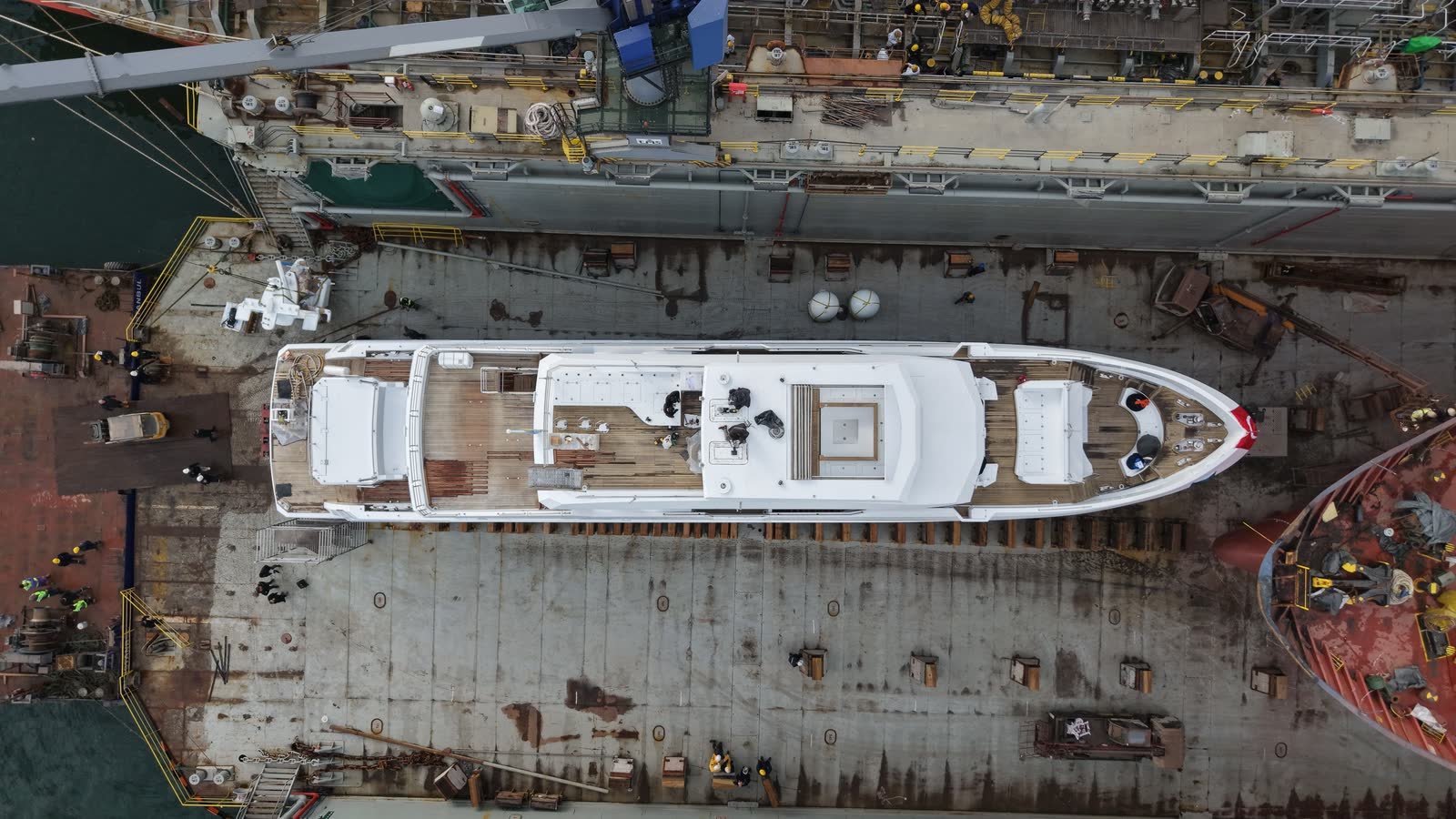
A machinery space is open for a matter of weeks and closed for a decade. Everything renewed in it is reachable while the sole is up and the insulation is out, and only through a hatch afterwards. That is why systems work is scheduled against what will cover it, and why the tests carry dates. This is what yacht refitting looks like below decks.
Whether the engines come out at all
A machinery space is open for a matter of weeks and closed for a decade. Everything renewed in it is reachable while the sole is up and the insulation is out, and only through a hatch afterwards. That is why systems work is scheduled against what will cover it, and why the tests carry dates. This is what yacht refitting looks like below decks.
In an engine room refit the repower question is rarely settled by engine hours. Four things settle it: the state of the bedplate and its foundations, whether parts and factory support still exist for the units aboard, the load new units impose on circuits sized for the old ones, and the route the old unit takes to get out.
That last one governs the other three, because a unit that cannot leave the compartment cannot be replaced at any price. It comes out through a fixed set of openings, and the governing dimension is the smallest on that path, measured with the unit on its cradle rather than as a bare block on a drawing. Where that opening is smaller, the work becomes a steel job: a soft patch, a cut in classed structure and the approvals that follow. A yard that has priced a repower without walking that route has priced the engine and not the job.
Generators often set the date anyway. They run more hours than the mains, they carry the hotel load an owner notices, and a failing set books the yard period.
The shaft line, and the vibration nobody could place
Our mechanical shop takes engines, shafts and alignment. The vibration is the hard half, because it is one symptom with a long list of causes: a worn cutless bearing, a scored shaft, a coupling face out of true, a propeller out of balance, chocks that have compressed.
Shaft alignment is only meaningful with two sets of readings taken in two conditions. A hull on blocks sits differently from one held up by water, and cold figures are taken at a temperature she never runs at. Cold on the hard, then hot afloat after a run under load, against the same references. One set of figures is not a record, it is a note.
The runs that close behind the sole
Some things in a machinery space are reachable once. Sea chests, the runs behind a tank, the fuel and waste line under a sole: these come out easily while the compartment is open and not at all once it is closed.
A new run in a different alloy from the fittings it joins makes a dissimilar-metal couple, and the joint wastes from the less noble side with nothing showing on the outside. Where a tank is integral, cutting into it is a structural operation rather than a plumbing one, and the class survey decides what evidence closes it. We route fuel, water and waste so the next engineer can reach them, which sometimes costs a longer run.
A pressure test carries a date, and on a buried run that date has to fall before insulation and joinery go back. A test dated after the joinery went in was done through a hatch on a finished boat.
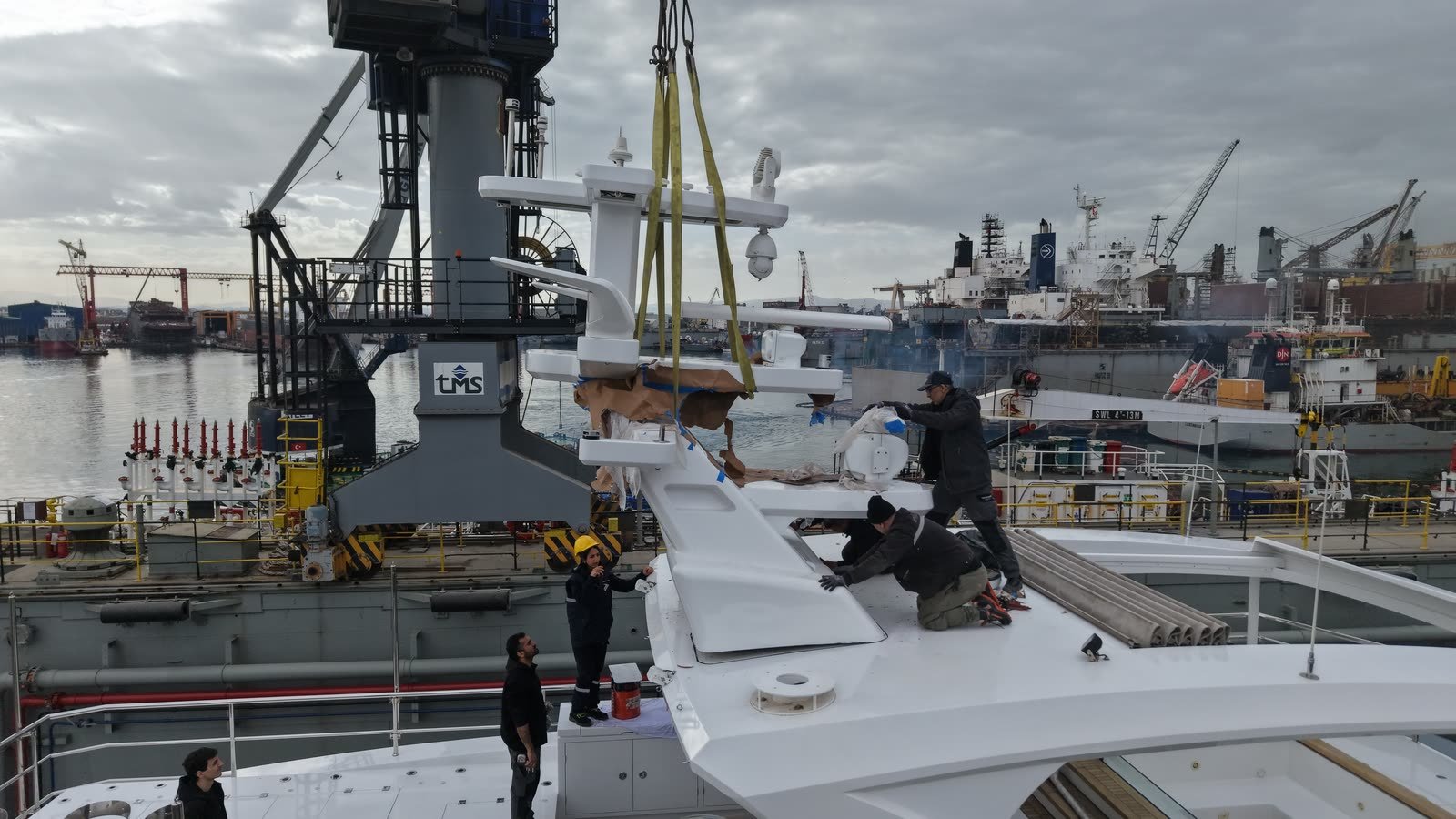
Where the cost of a rewire sits
Rewiring is the item that gets added once the panels are off. An old loom is seldom condemned along its whole length; what condemns it is that it is unlabelled, patched at both ends by people who have left, and slow to fault-find, so the hours go into tracing rather than into cable.
The load calculation comes before any of it. Every addition since she was built, and every one planned now, is set against what the switchboard, alternators and generators can carry. A change of battery chemistry drags in more than cells: charging regime, monitoring, ventilation, fire boundary, and the approval attached to all four.
What goes back is labelled at both ends and drawn as built rather than as found. A circuit that works but is not drawn has only moved the problem to the next engineer.
Cooling, and the one pump under several names
A cabin that has never been cold is often a changed heat load rather than a failed plant. Glass has been enlarged, a bulkhead has moved, or she now summers somewhere hotter than the brief she was built to. An HVAC refit therefore starts with recalculating that load, and sizes the plant for the yacht she has become rather than the one she was.
Distribution is the other half: chilled water to air handlers on a pipe circuit, or direct expansion with refrigerant at each unit. The choice decides where the noise goes and what one failure takes out.
Hydraulics are one system under several names. Where a single power pack feeds the stabilisers, the passerelle and the cranes, and on some yachts the thrusters too, one pump decision governs all of them at once. Stabiliser work arrives as a fin and seal question and turns into a power and control question.
Where systems work sits in the programme
Systems sit in the middle of the published order of work, between machinery and the electrical loom, well before insulation and joinery. The full sequence is set out in what yacht refitting actually involves. Joinery is the trade that closes access, so everything behind it has to be finished, tested and signed before it goes in, which is what the rebuild and delivery stage is organised around.
The rule governing this is that nothing is covered unseen, and it is a scheduling rule as much as a quality one. A compartment stays open until its tests are on paper, and every trade queued behind it waits with it.
Opening a machinery space is a survey as well as a job, and some of what we find was under something else. No yard, ours included, can promise that a scope written before the space was opened is the one that gets built.
Commissioning, and the sea trial in the Marmara
Snags are closed before trial, because a trial with an open snag list becomes a demonstration of that list rather than a test of the yacht. Commissioning is the methodical half: every system run, every reading logged against the figure it should hold.
The sea trial is two days in the Marmara with the owner aboard, every system run in anger and every figure logged. That is where the machinery holds at temperature and the air conditioning holds a cabin under load. She leaves with a redelivery pack: as-built drawings, the work record, manuals and spares, a crew handover and the warranty document.
The readings are taken by the same payroll that installed the systems, so whoever answers for a figure at trial is the one who fitted what produced it. Behind that sit a twelve-month workmanship warranty, a flying service wherever she is, and the first-season check, because systems faults surface over a season rather than over two days.
Written at the yard in Tuzla. The systems here are the ones our own mechanical, piping, electrical and AC shops fit, and the ones commissioning has to prove.
What to send us about her machinery space
Send engine and generator hours with the last service records, the current general arrangement and any machinery space drawings you hold, the electrical load list or switchboard schedule if one exists, and the tank arrangement. Add a note of any vibration, temperature or alarm that recurs, with when it appears and at what load, because a symptom that repeats tells us more than a work list does. If a repower is even a possibility, say which openings you think a unit would come out through, and we will walk the route before anything is priced. Send it to info@revivarefit.com.
SEND THE MACHINERY LIST