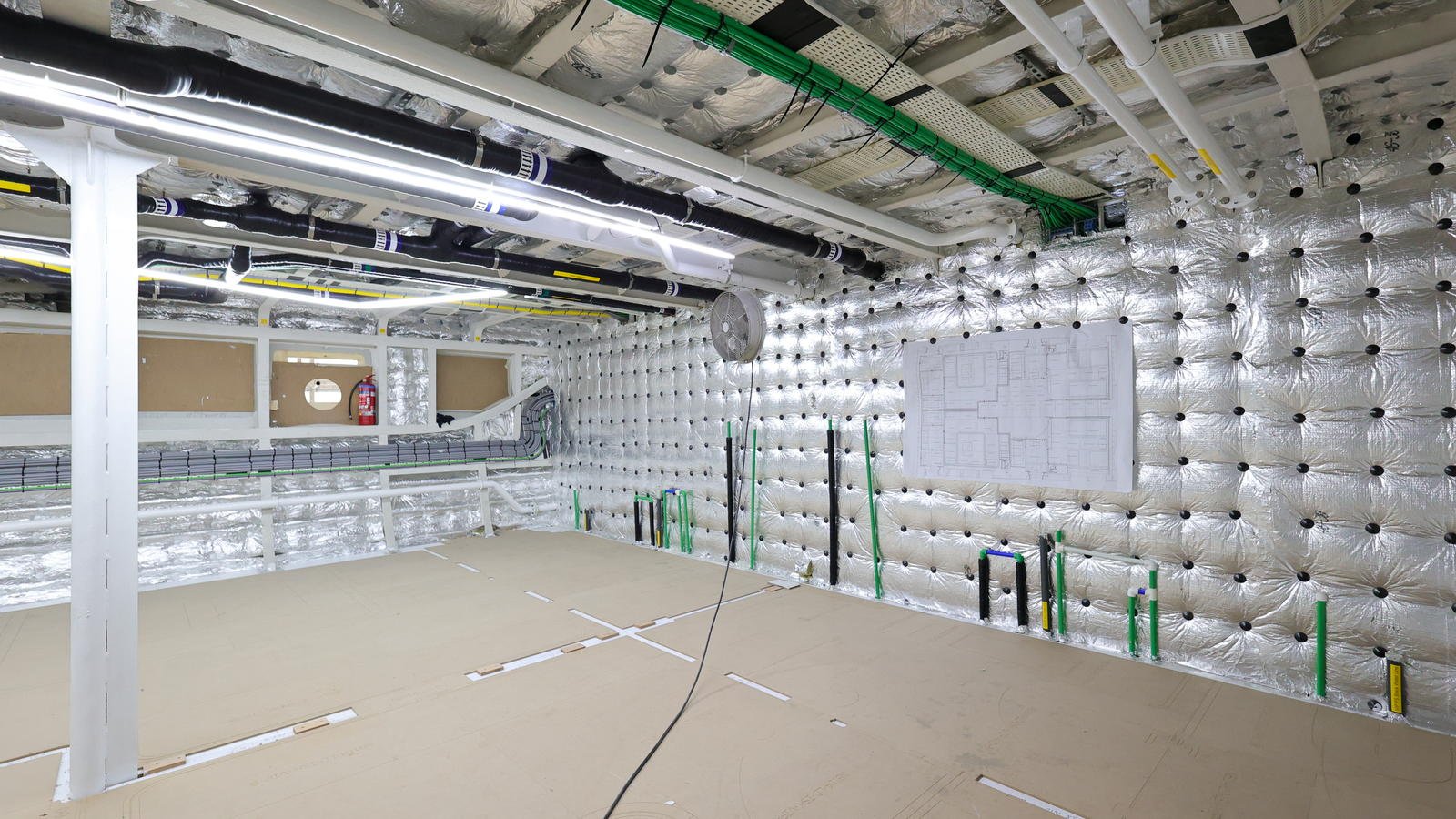
An owner decides to charter her, and discovers the decision was a refit decision taken a year too late. The gap between a privately registered yacht and a commercially registered one is not a shopping list of equipment. Very little of it is a box bought and bolted on at the end. It is a set of boundaries, closures, escapes and records, and nearly all of them live behind linings, inside compartments and in the drawings that describe them.
That is what makes converting a private yacht to charter a refit question rather than a purchasing one. Almost none of it is reachable once the lining is back. Bought afterwards, the material costs what it always cost and the access is paid a second time, which is often the larger of the two. Panels come off again, joinery is cut and remade, and a compartment is held open while one detail is corrected. The charter conversion belongs in the specification with the structural scope, in the way set out in writing a specification three yards can price, rather than in the snag list.
The list is her flag's, and never the yard's
An owner who asks a yard whether she will pass has asked the wrong party first. The code is her flag's, applied to her rather than to a yacht of her dimensions, and her attending surveyor reads the work against it, not against a yard's opinion of it.
What is genuinely ours is narrower. The structure, and what a new opening does to it. The penetration through a rated division, made good to the rating of the division it crosses. The closure that can be worked from outside the space it protects. The as-fitted drawing describing what is aboard when the lining goes back. The test record a surveyor can still read in five years. Nothing here settles what any particular vessel must satisfy; that belongs to her flag and her attending surveyor, and we would rather say so now than be quoted on it later.
A penetration is a detail with a rating of its own
A crossing through a rated division goes back to that rating, as bilge and fire systems in a refit sets out. What a conversion adds is the evidence.
The discipline is threefold. The method is specified before the run is pulled, not chosen by whoever is holding the drill. The detail is fitted to that method, fill depth and spacing included. And it is recorded: which division, what rating, what system was used, who fitted it, on what date. A crossing nobody wrote down is a crossing nobody can prove, and on a charter conversion it will be asked about.
The related point is capacity. A transit filled solid has to be opened and remade for the next cable. We would rather fit a larger transit with spare ways in it now than reopen a boundary detail for one data line in three years.
The next surveyor reads labels, not memories
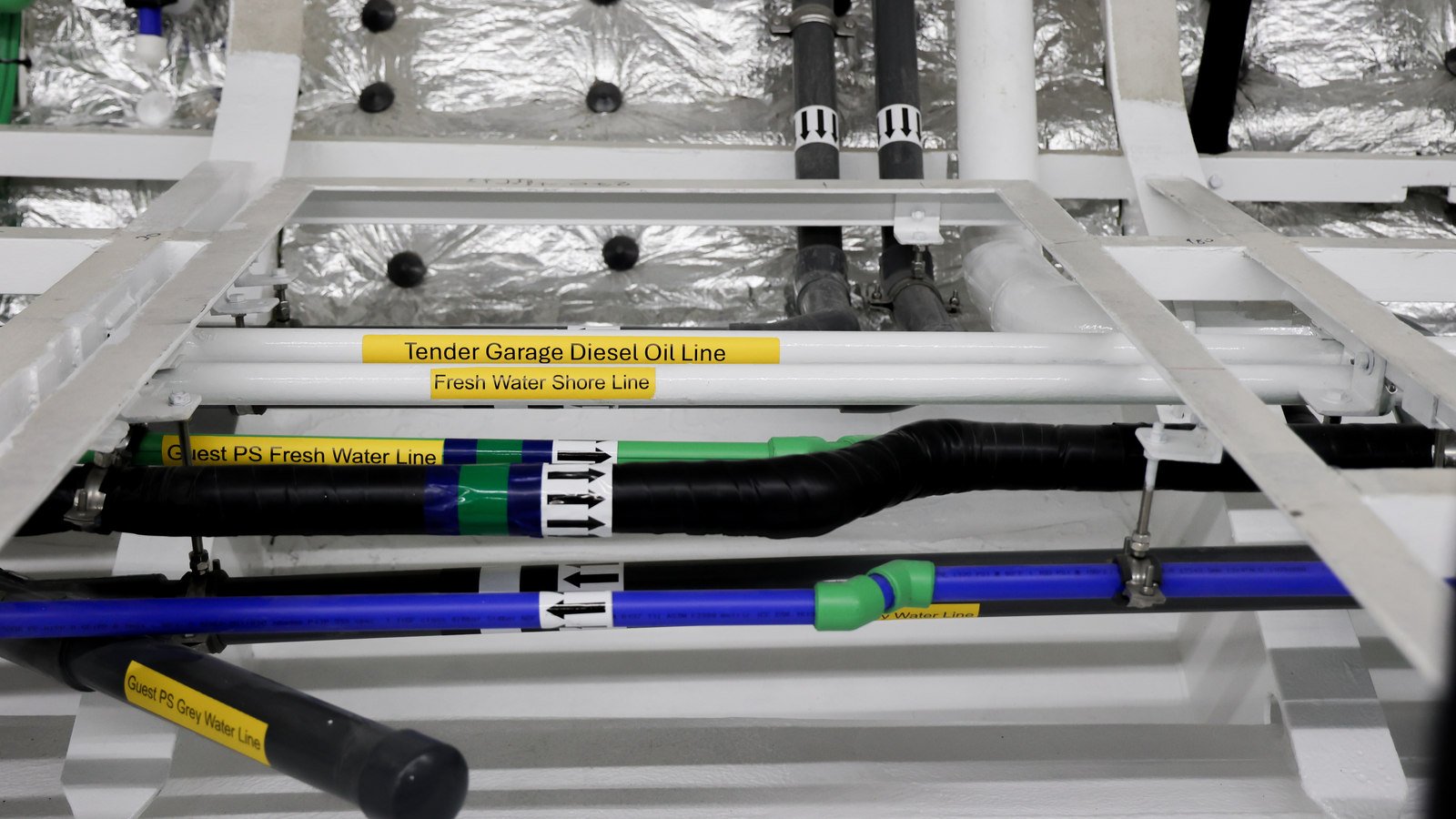
Every line that runs behind a lining should leave this yard identified. Not in someone's head, and not only in a folder in the yard office: labelled on the line itself, at both ends and wherever it becomes reachable again, with the service named, the side where a system is split port and starboard, and the direction of flow where that matters.
The reason is unsentimental. The chief engineer who watched it go in will move on, and the surveyor who attends the next renewal was not here. The yard that opens her in six years reads what is written on the pipe and nothing else.
A closure worth having can be worked from outside
The closures that matter on a conversion are the ones that have to work when the space behind them cannot be entered. The test is plain. Can this be operated from outside the space it protects, by someone who is not in the compartment, without a key, a ladder or a stored item in the way? A valve whose handle is reached by crossing the machinery space is not a closure.
Escapes read the same way. A route is only a route if it stays clear when the space is dark and full of smoke, and a second means of escape that passes through the space on fire is one means of escape drawn twice. Some of this is settled by moving a stowage or a handle. Some of it is not, and the honest answer on an older vessel may be that the arrangement will not satisfy her surveyor without moving a bulkhead, which is a structural job with a price and a programme attached. That is a naval architecture answer before it is a joinery one.
As-fitted drawings are the deliverable
As-fitted drawings and test records are half of what a conversion actually buys, and the half that survives the yard period. A general arrangement showing the boundaries as they now are. Penetration records against the divisions they cross. Pressure and function tests recorded with the date, the value and who witnessed them. It is the file logic a refit class survey runs on, and the file that makes the next condition survey a short job rather than a long one. Priced properly it is charged hours, and if a quotation shows none, it is worth asking where the drawings and records sit in it.
Three things that make an early answer possible
That a vessel going to charter and one going to sale are different specifications is the older point, made in what a refit actually involves; what is specific here is that most of the charter half is unreachable once the linings close. Three things make an early decision possible. The flag's position in writing, obtained before the specification is drafted. The boundaries and escapes drawn as they are intended to be, not as they were. And a decision from the owner, at tender stage rather than handover, on whether she is going into commercial service at all.
If the answer is genuinely not known yet, say so. We will scope the work as though it were yes: transits sized with spare ways, labels on everything behind a lining, drawings kept current as the work moves. It is a short list of line items in the specification, and the only version of this decision that can still be taken late.
Written at the yard in Tuzla. The details described here are the ones our own file has to answer when her surveyor arrives.
Send her flag position before the work list
Before a work list, send us her flag and registry, the code she is to be read against, the general arrangement with the boundaries marked as they now stand, and any as-fitted drawings you hold for the spaces you intend to open. Tell us whether the linings are coming off for other reasons, because that decides what the charter question costs rather than whether it can be answered. If the commercial decision is still open, say that too and we will scope the access as though the answer were yes. Write to info@revivarefit.com.
START A REFIT