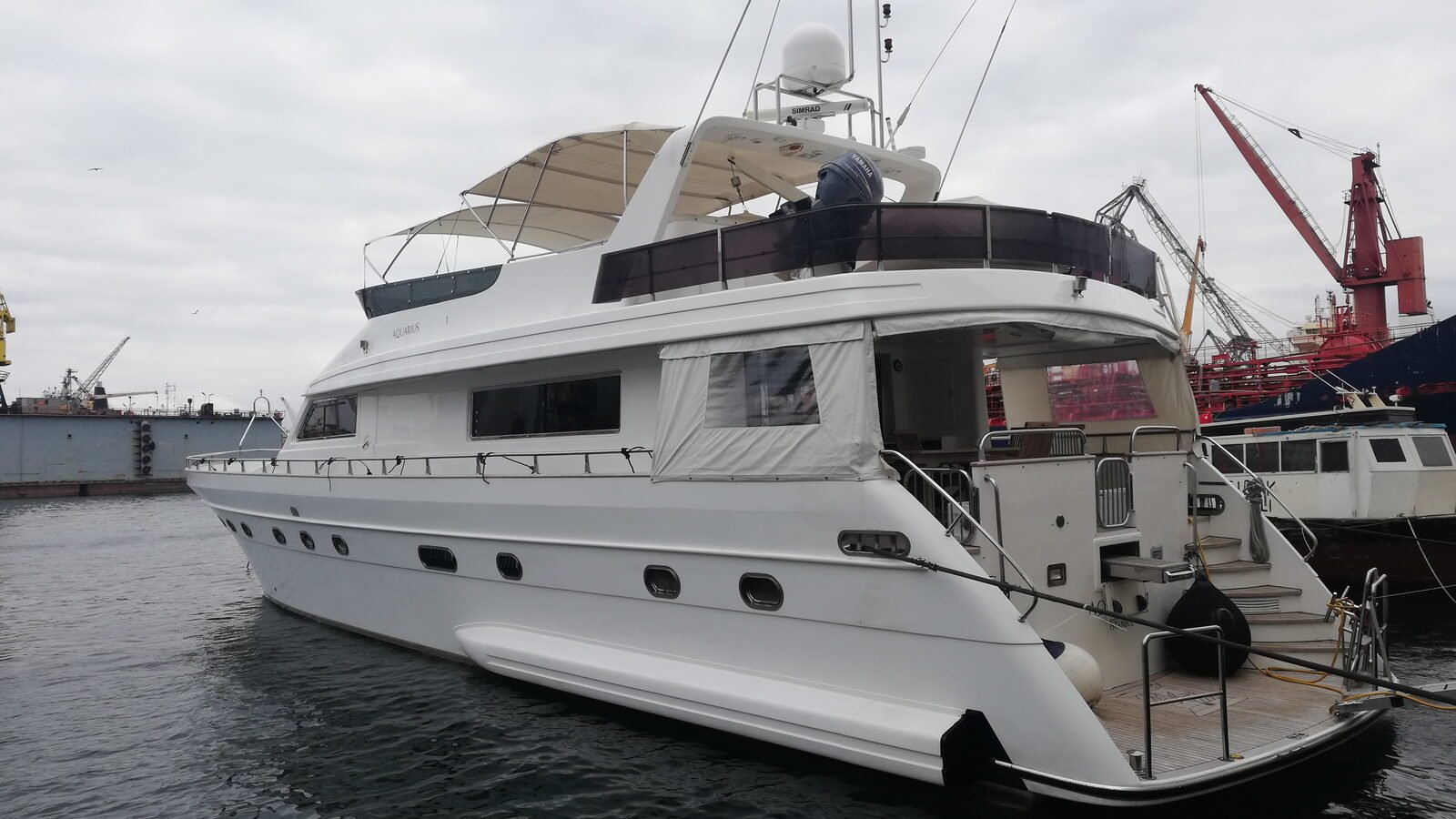
A yacht comes off her programme in October with a weep at a shaft seal, a soft area of deck core and a generator short of its next service. In April the cover comes off and the list is the same, four months older, with two entries nobody wrote down. She was not paused; she was unattended.
Owners buy a yacht winter layup in Turkey as storage, and storage is the one thing four months will not do. Where she spends them is the smaller half of the question, made already in why northern hulls winter in Tuzla. The larger half is what they do to a vessel nobody reads.
What a yacht winter layup in Turkey switches off
Cold ship is a state, and the useful version is written down: nothing aboard carries power except a named list, and everything outside it is off by decision, not by accident.
Winterising a yacht is mostly drainage. Water standing in a dead leg is a biological problem before it is a freezing one. Raw water circuits are drained, or charged with glycol to a freezing point below the coldest water the berth will see, read at the circuit with a refractometer, not off the drum.
What stays energised is the shorter list: bilge alarms and a means of answering them if she lies afloat, and whatever her makers require alive. The question in March is rarely whether the isolations were right, but whether anybody can say what they were.
Laid up afloat versus ashore protects two different things
Afloat, her underwater body stays wet. Seals and gland packing are designed damp and set hard when they are not, and a bilge alarm still has something to answer. The Marmara has almost no tide, so a mooring is tended against wind and pressure.
Ashore, the hull dries, which is what makes a moisture reading mean anything, and the shell is reachable, so a wasted plate or a seized valve gets looked at instead of inferred. The cost is months on blocks where a docking window would have given days, as the days she stands on blocks sets out.
Dehumidification during layup is a margin, not a number
A sealed ship with nothing drying it rots faster than a ventilated one: the moisture is aboard before the cover goes on. The daily swing puts it on the coldest surfaces — the shell, an uninsulated deckhead. Structure is not what shows it first. Leather and veneer are.
Ventilation works when the dew point outside is below the dew point inside, and makes matters worse when it is not. Relative humidity is the wrong number: air at four degrees and ninety per cent carries far less water than air at eighteen and sixty. A refrigerant dehumidifier loses capacity as the space cools; a desiccant machine does not. The margin that matters is between surface temperature and dew point, read hourly, as in the hourly dew point log.
What ages by standing: the bank, the tanks, the oil
Batteries do not wait. A lead-acid bank left standing loses a few per cent of its charge a month, and the sulphation that sets in at a low state of charge is not fully reversed by a spring charge, so the regime is a monthly resting voltage and a charge against it. A lithium bank wants the opposite, a partial charge in a cool space, drawing on its own cells unless it is isolated.
Whether she lies full, part-full or empty is decided in October and rarely revisited. Full leaves the least breathing volume; empty removes the fuel and not the water that condenses on the tank top. Microbial growth lives at that interface, taken apart in the gauge, the fuel and the tap.
A season's oil is mildly acidic by October, so the oil change belongs at the start of a layup, not the end. A shaft left in one position loads a bearing at one point for four months, so turning over is done at her makers' interval and logged.
A valve nobody moves for four months is the valve that will not move in May.
What attendance has to produce is a record, not a roster
Owners ask this as a service question: who walks her, who is awake at three in the morning. The answer worth anything in March is documentary: a patrol that leaves no written condition note has produced attendance, not information. Fire and security are the same: an insurer reads the log, not the roster.
What a winter regime hands back should carry dates: a finding, the compartment it was found in, the day somebody stood there, and the isolation states as they are in March, not as they were set in October.
The yard's record habit was built for a work period, a photograph-backed report every Friday. What is published for the off-season is one line, a place at Tuzla or Pendik with the crew who already know her looking after her. A dated condition note through a winter is not inside that line. It is a walk somebody makes and writes up, priced like any other work.
Where a yacht winter layup in Turkey becomes a scoped refit
The crossover from layup to refit is a survey: nothing found over a winter is a scope line until it has been measured and written down. A laid-up vessel has met most of what a survey needs — tanks down, systems isolated, access open — the list set out in what has to be open before the surveyor arrives.
Stage One runs two to four weeks with her out of the water: hauled, opened up and measured before a specification is written, with thickness maps, moisture readings and coating thickness taken, so that the scope an owner approves is the one they get. What follows does not always fit inside a winter: a maintenance period runs in weeks, a cosmetic refit in months, a rebuild in more of them, settled at strip-down, not at enquiry. Draught, beam and air draught decide which site she belongs at, as a Tuzla refit is not one gate sets out. Most of the refitting a Tuzla shipyard takes on is winter work, booked in autumn.
A layup becomes a refit on the day a finding is written down.
What a winter cannot settle
A layup does not arrest deterioration. It slows the parts somebody chose to slow, and reaches none of the compartments nobody stands in.
There is an honest cost to lying at a working yard instead of a marina: it is dusty, it is noisy, and a stored yacht sits next to work that does not stop. What that buys is proximity: a plate found wasted in February is priced in the week it is written.
Written at the yard in Tuzla. What a given yacht is left with drained, isolated or energised over a winter belongs to her makers, her chief engineer and the owner's surveyor rather than to us.
What to send before the cover goes on
Send the months she is out of programme, whether she would lie afloat or ashore, and her own winterising instructions if her makers issued any. What comes back is what a survey would have to look at inside those months, and whether Stage One is worth putting in front of the winter rather than after it. Write to info@revivarefit.com.
SEND HER WINTER DATES