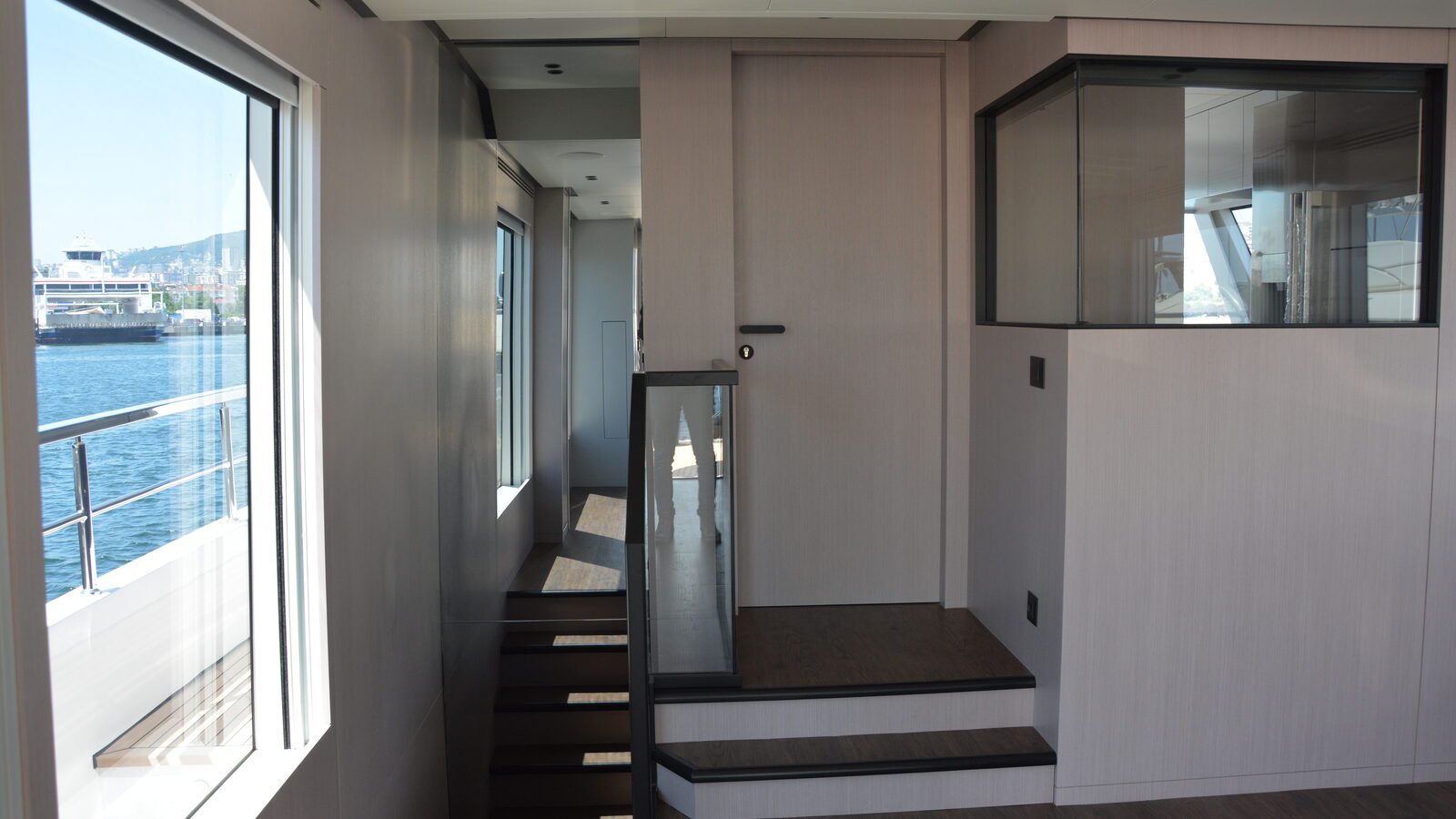
A window leaks, the bead is raked out and renewed, and the carpet stays dry until spring. Then the same corner is wet again. By the third reseal an owner is being quoted a new pane for something that was never the pane's fault.
Glazing is structure, a weathertight boundary, in some positions part of a fire division, and the thing the owner looks through. A bead of sealant addresses the second, and only on its outer face.
Water rarely enters at the window
Water does not appear where it gets in. It enters high — a handrail bolt, a coachroof seam, a mast collar — and runs down to the first horizontal it meets, often a window's inside return.
So a leak is traced by hose test in sequence, the same test that closes out a deck refit, and sequence runs from the bottom up: the lowest candidate first, everything above it masked, one opening wetted at a time for five minutes at low pressure rather than a jet, with somebody inside on a torch watching the return and the cable transit behind it. Only when it stays dry does the masking come off the next item up. Work downwards and every later test runs below a path already proven wet.
That produces an observation rather than an opinion: which opening was wetted, and what appeared inside. Whether the closure must be demonstrated formally belongs with her class survey.
What a yacht window replacement finds in the rebate
Under the old bed is a rebate covered since the last reseal, and often since she was built — what a strip-down turns up, at the scale of one window. What is in it decides whether this is a sealing job, a pane job or an aperture job.
Rebate corrosion comes first: a bed watertight across its face has held a damp film against bare metal behind it, a white bloom on aluminium, a scale on steel that jacks the frame proud before it leaks. Then an aperture no longer the shape the pane was made for, pulled by a welded repair or ground locally thin one reseal at a time. Then a failed primer, recognisable because the adhesive released from metal rather than glass.
The drainage has to end somewhere
A window frame's channel does the opposite of deck drainage: it gets water back out of a section it is already inside. What the outer seal lets past runs to weeps that return it overboard.
Two things go wrong. The weeps are filled by sealant at the last reseal, so the section now holds what it used to shed. Or the channel was cut and never given an exit, discharging into the void behind the lining ever since.
A channel holding water is a crevice, and a stainless trim on a painted aluminium rebate is a crevice first and, once the coating beneath is breached, a galvanic couple as well.
What a bonded pane asks of the rebate
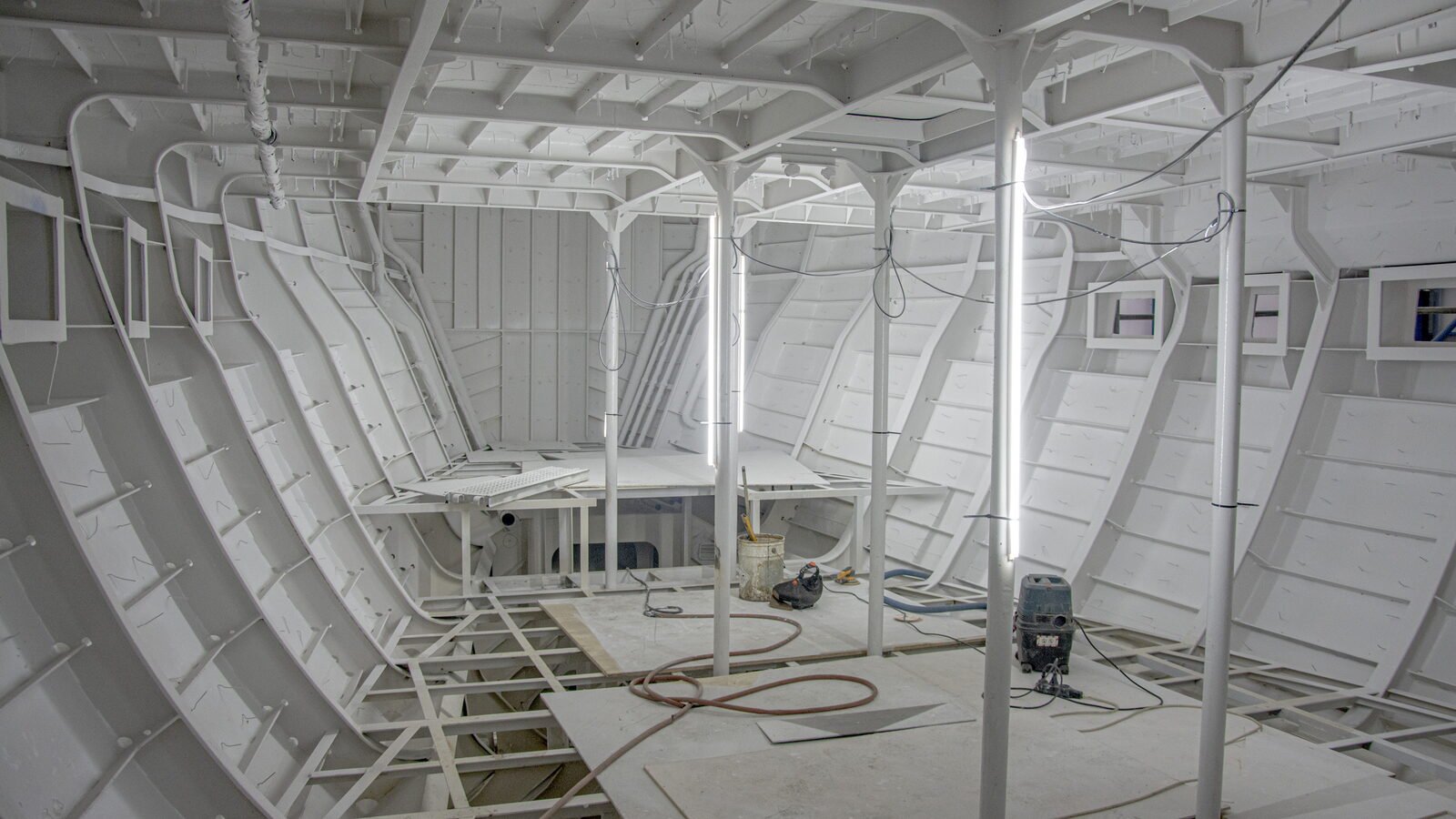
A mechanically fixed frame carries the load itself: the glass sits on setting blocks with clearance on every edge, and the aperture owes it a true, flat landing and a fastener pitch that does not dish the flange. A portlight is the same problem in a smaller casting, where the old bedding decides whether the frame goes back or is renewed.
Structural glazing has no frame to hide behind, and two dimensions set it from different sources. The bite, the width the adhesive grips, follows from the load the bond carries, against the adhesive maker's design stress. The glue-line thickness follows from the movement pane and aperture make against one another: glass and an aluminium superstructure do not expand alike, and over three metres that is millimetres rather than tenths.
The primer is substrate-specific, with a flash-off the data sheet states in minutes and an assembly window it states in hours. Bonded inside the flash-off, solvent is trapped in the bond; bonded past the window, the adhesive keys to skinned primer rather than metal. Neither shows on handover day.
The glass in a yacht window replacement is a specification
Toughened glass is in surface compression, breaks into blunt granules, and cannot be cut or drilled once toughened: a pane whose dimension is corrected afterwards is scrap, not rework.
Laminated glass in marine windows is plies bonded to an interlayer, polyvinyl butyral or a stiffer ionoplast, and it holds together broken. PVB's weakness is its edge, where it takes up water and lets go of the glass; ionoplast tolerates a wet edge far better. Haze creeping from one corner of a PVB laminate therefore sends us to the drainage before the glass, though sealant incompatibility and heat do it too, so the cause is established rather than assumed.
Surfaces are numbered from outboard in, so a solar control coating commonly sits on surface two, inside the laminate. A nominally equivalent pane in a run of six reads a different colour from the quay and leaves its cabin warmer.
A curved pane is worked to a template that can only be taken once the aperture is corrected, and toughening after bending fixes curve and size together, with both plies of a laminate bent as a pair. The lead time answers to the bending slot rather than the cutting. A yacht windscreen replacement is the clearest case: aperture trued, then templated, then ordered.
Four dates rather than four purchase orders
A bonded pane adheres to the coating, not the metal beneath it, which puts the coating system inside the structural load path. The rebate is coated to a stated build in a system the adhesive manufacturer has qualified — one engineered coating stack rather than six separate purchases — and left alone until the pane goes in.
Glazing therefore schedules against the paint programme rather than after it. The pane lands inside the overlap between the two: after the rebate coat has cured, and before the interior return closes over it. Put the order the other way round and either the bond goes onto an uncoated flange or the coating goes on over the bond.
So four trades need four dates that agree. The drawing office holds the aperture dimension, the metal shop fettles the flange to it, the paint shop schedules the rebate coat, and joinery waits on the cure, because a return closed over an uncured bond has to be opened again. Eleven trades work on this one yard, the drawing board among them and never outsourced, and the foreman who ran her refit stays the contact afterwards.
What we do not grade by eye
What is already in her apertures is not ours to grade by looking: a pane's build-up, its interlayer and any coating come from the maker's mark on the edge, the original glazing schedule, or a sample.
Nor is it ours to decide whether a position is a fire boundary. The rating belongs to the assembly — frame, fixing and glass together — not to the glass alone, on the same certification footing as interior joinery and the cores behind its panels.
Written at the yard in Tuzla. Which of her positions are rated, and what closes them, is for her class file, her flag and the attending surveyor.
Reseal, or take the pane out
Tell us first whether the pane sits in a frame or is bonded straight to the aperture, because those two fail differently and are put right differently. Then send a photograph of the wet corner inside and one of the same window square on from outside, and if it is framed, one close enough to show whether the weeps in the bottom leg are open or filled. If a hose test has been run, say what was masked while it ran, since a test with nothing masked above the opening narrows nothing. What comes back is what those photographs can and cannot settle, and which of the three — sealing, pane or aperture — they point at before anything is opened. The survey stage ends in a written condition report, an approved scope and a price that does not move. Write to info@revivarefit.com.
START A REFIT