A new handrail goes back aboard polished. By the end of the season there is a brown bloom under it, streaked down the stanchion, and the report calls it rust. Tea staining on a rail is not dirt, and it is rarely the metal failing. It is surface chemistry, and on a yacht stainless steel refit the fitting answered with an abrasive pad comes back a year later with the same bloom.
Stainless is not inert. It resists corrosion through a chromium oxide film a few atoms thick, which re-forms on its own provided the surface is clean and oxygen can reach it. Three things stop it re-forming: free iron pressed into the surface, heat tint along a weld, and a crevice where oxygen cannot get in and chloride can. Those three are what tea staining is, and a polish addresses none of them.
Iron contamination on stainless arrives on the tools, not on the sea air
Iron contamination does not blow in. It is pressed in, by us, in the shop.
A flap disc run on carbon steel carries steel in its grain, and a carbon-steel wire brush leaves filaments. A sling, a clamp or a grinder rest presses particles of ordinary steel into a surface soft enough to accept them. Those particles carry no chromium, so they rust where they sit. Across a rail, that is tea staining, and it shows on new work first, because new work has been handled most.
This is not the problem set out in sharing a ship repair district, which is blast dust from a neighbour's hull. This iron is made in our own shop, and no screen touches it.
Stainless weld heat tint is the film burnt off, not a stain over it
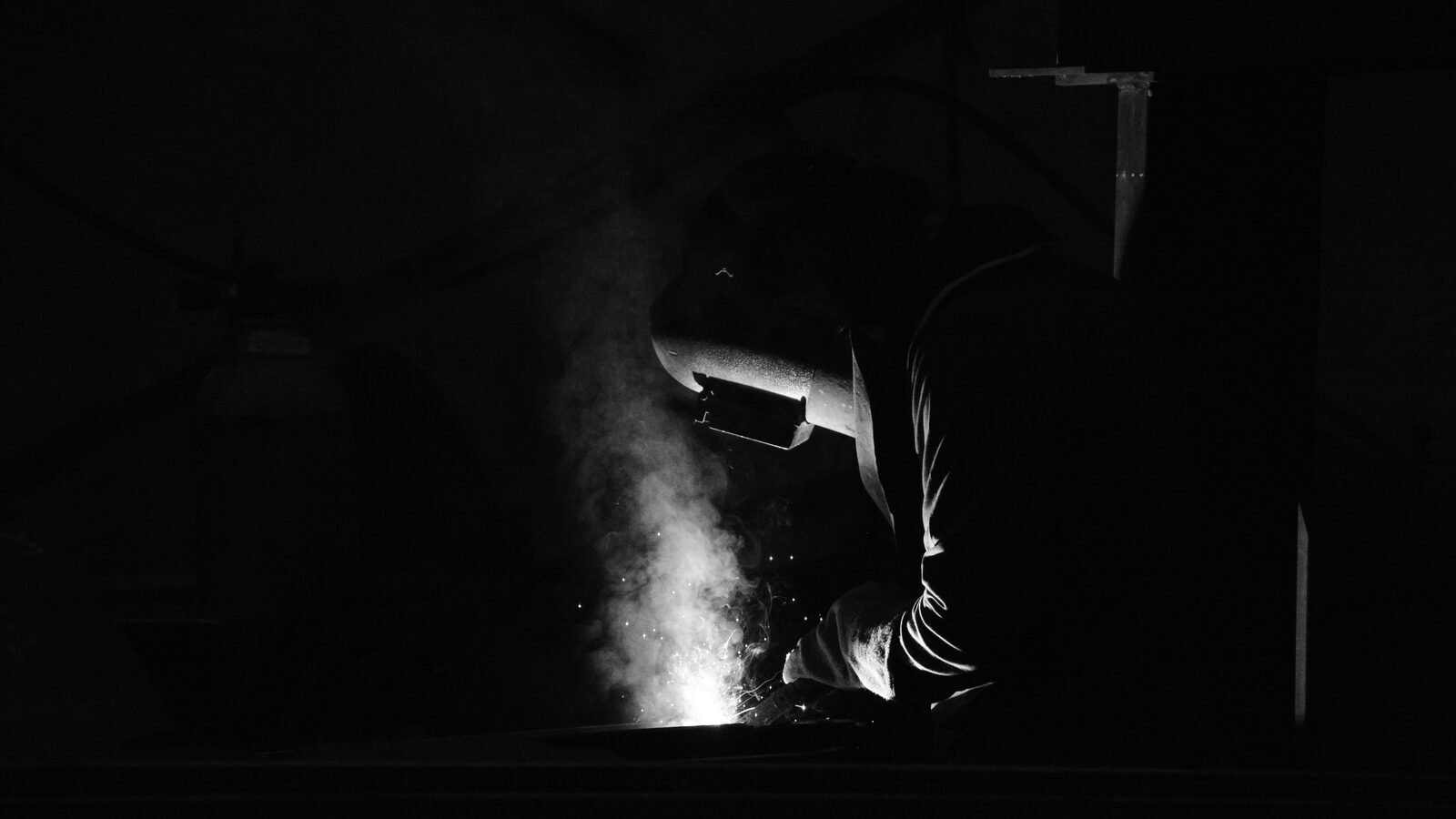
Where a stanchion base is welded, the metal either side goes straw, then blue, then grey. That banding is heat tint, routinely treated as a discolouration to be buffed away.
It is not. At those temperatures the surface chromium forms a thick, poorly made oxide, and the metal beneath is left short of the chromium the film needs. Buffing takes the colour off and leaves the depleted layer, so the fitting looks correct on the day and corrodes along the weld line later.
Two things limit how much tint forms: the root side is back purged with argon, and interpass temperature is held down. The same procedure discipline as our steel repair work applies, on thinner sections.
Tea staining without contamination: chloride where oxygen cannot reach
The third mechanism is crevice corrosion, and it needs no contamination and no welding. A gap of a few tenths of a millimetre under a stanchion base, behind a plate washer or at failed bedding holds seawater. The oxygen in it is used up and not replaced, so the film cannot re-form, chloride concentrates, and attack begins out of sight.
The detailing answer is unpopular: the joint is either fully sealed with no path in, or deliberately open and drained. A near miss is worse than either, and it meets what a deck refit has to close before the hose test.
316 vs 304 stainless, and the fastener that holds it
304 carries chromium and nickel. 316 adds molybdenum, at roughly two per cent, which resists chloride pitting. Anywhere exterior on a yacht, 316 is what is normally specified. 304 in that position stains whatever finish it was given.
Fasteners are where this is lost. A base in 316 is commonly bolted with whatever the general stores holds, often 304, and the fastener sits in the wettest, least ventilated part of the assembly. It belongs in the same family as the fitting it holds, and on a schedule.
Pickling and passivation come before the polish, not instead of it
Pickling and passivation on stainless come in a fixed order, one an owner is rarely shown quoted:
- Weld.
- Dress back the crown.
- Pickle.
- Rinse.
- Passivate.
- Rinse.
- Finish to the specified grit.
Pickling paste, nitric and hydrofluoric, removes the heat tint and a thin layer of metal beneath it, so the depleted band goes with the colour. Dwell is stated on the product data sheet against grade and temperature, commonly fifteen to sixty minutes. It is then washed off with clean fresh water, because residue is itself an attack.
Passivation follows, in nitric or citric acid, to the time and temperature the bath supplier states for the grade, dissolving free iron out of the surface so the film re-forms evenly. Finishing begins only then, ending at the grit the specification names.
Electropolishing is the other finish, and it is not ours: the fitting comes off and goes out to a tank, where metal is removed electrochemically rather than scratched away. It leaves a more even surface than a mechanical finish of the same grit, and a rail that cannot be unshipped cannot be electropolished. Where pitting has gone through the section, or a handrail has been polished thin, the answer is handrail and stanchion renewal rather than treatment.
Why stainless fabrication in Tuzla keeps its own abrasives
All of that collapses without separation at the bench. The rule is that abrasives, brushes, clamps and slings used on stainless are never run on carbon steel, so stainless work in Tuzla keeps its own discs, belts, brushes, clamps and slings.
The rule is easiest to hold where one employer runs both the carbon-steel and the stainless work, because the same foreman decides which bench a fabrication goes on. A rail bought in finished arrives clean, and the iron reaches it in handling, fitting and welding.
Where a stainless fitting lands on aluminium
The interface nobody specifies is at the bottom of the stanchion. A 316 fitting bolted to an aluminium superstructure is a galvanic couple in which the aluminium is the anode, and under a continuous salt film it wastes under the base plate, invisible until the fitting moves. The anodes and bonding that protect her underwater do not reach it: no continuous electrolyte carries that protection up the topsides.
It is answered in the joint detail: an isolating bush through each fastener hole, an insulating washer under each head, bedding across the footprint, and a fastener chosen for the joint rather than the rail.
What we cannot settle about the metal already aboard
What is already fitted to her is not ours to grade by eye. A polished surface does not say whether a rail is 316 or 304, and a supplier's word from a decade ago is not evidence. Grade is settled by a positive material identification reading on the fitting and by the mill or maker's certificate, if either survives.
Nor do we set the acceptance standard for a visible finish. What counts as acceptable, and which grit it ends at, belongs in the owner's specification, agreed before the work starts.
Written at the yard in Tuzla. The acceptance standard for a visible stainless finish, and the grit it ends at, belongs in the owner's specification rather than to us, and is settled before the work starts rather than against a rail already finished.
Three things that let us answer before she arrives
Send photographs of the affected fittings, close enough to show whether the staining follows a weld line, a fastener or the bedding at the base, because those three point at different mechanisms and different work. Send the mill or maker's certificate for the original rail if it still exists, since it settles grade without a site visit. And send a note of whether the substructure under each fitting is steel or aluminium, which decides whether isolation has to be designed into the reinstatement. What comes back is which fittings can be treated in place and which have to come off the boat. Write to info@revivarefit.com.
START A REFIT