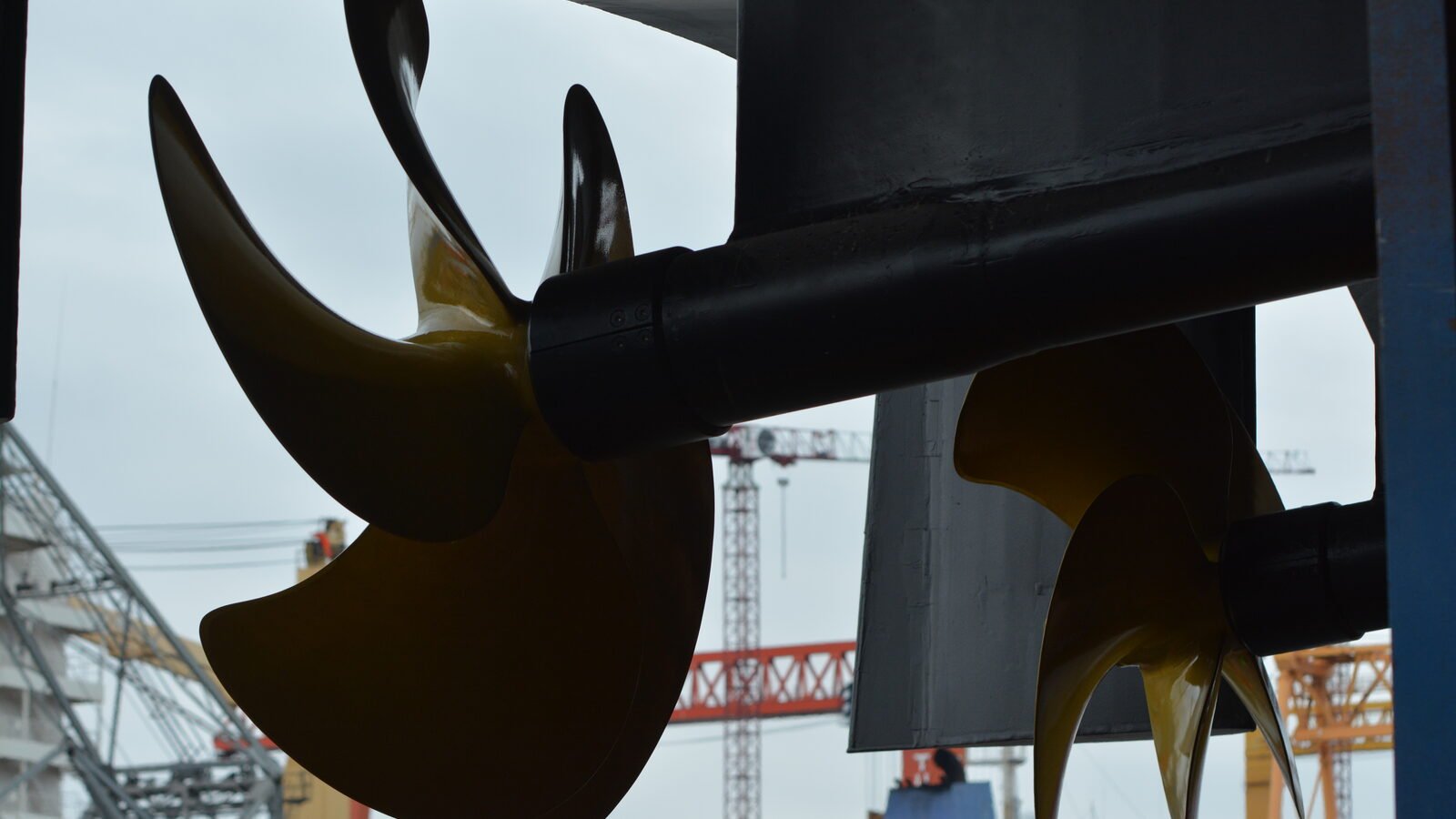
Noise aboard is usually answered with more insulation. The lining comes off, thicker material goes in, and the reading at the bunk head does not move, because insulation treats the airborne half only. Much of what is heard in a yacht's accommodation is structure-borne noise, arriving through the seating, the pipe clamp and the joinery batten. A yacht noise and vibration refit is work on the path, not the source. The source is largely fixed; the path is what a yard built.
Airborne noise is trim work, structure-borne noise is not
The airborne path runs from a machine through air, past whatever separates its space from the accommodation; mass, sealing and separation reduce it.
The structure-borne path leaves through the machine's feet, pipe connections and exhaust, and travels through plate and stiffener as bending waves, losing little over distance. It returns to the air wherever a panel is large and thin enough to act as a diaphragm, which a bulkhead lining and a deckhead both are. Hence a complaint from a cabin nowhere near the machine.
The frequencies aboard can be named before anything is opened
A vessel does not make noise in general, but a few tones at frequencies arithmetic knows before an instrument is rigged.
- The main engines' firing rate, which follows engine speed and cylinder count, not shaft speed wherever a reduction gearbox sits between the two.
- Each generator set's running speed. Held constant, it puts one unvarying tone into the structure for as long as the set runs: the machine complained about at night.
- Propeller blade rate vibration: shaft revolutions per second times blade count. A five-bladed propeller at 180 rpm excites the hull at 15 Hz and its multiples, because the blades pass through an uneven wake.
- Pump and fan coil speeds, low in level and high in nuisance. A fan coil's note tracks its motor, so a change of note can be a change of supply frequency rather than a fault.
What a yacht cabin noise measurement settles
A yacht cabin noise measurement is a spectrum taken at the complaint location: the bunk head, the bulkhead somebody leans against, the deck under a bare foot. It names which of those tones are present and, more usefully, which are not; without that a scope treats every machine as a suspect. A superyacht vibration survey done this way takes a morning, and decides what any material is for.
Why resilient engine mounts isolate only above their own natural frequency
A mount is a spring carrying a mass, and the pair has a natural frequency. Below it the mount passes nearly everything; at it, it amplifies. Only well above it does isolation begin, and everything that goes wrong with resilient engine mounts follows from that curve.
Too stiff, and the natural frequency rises into the range of the tones the mount was bought to stop. Too soft, and the machine moves: alignment drifts off the figures set while the machinery space was open, and in a seaway it runs out of travel. Sagged or bottomed, it is no longer a spring: rubber with a permanent set transmits much of what a plain steel chock would, while still appearing on the drawing as an isolator. Static deflection under each foot against the maker's rated figure settles which of the three it is.
What is flanking transmission in yacht accommodation?
Flanking transmission is any hard contact that carries a machine past its own mounts and back into the structure the accommodation is built on, so the noise arrives in the cabin by a route the isolation scheme was never drawn to close. It is why a scheme can be correct on paper and disappointing aboard, and why the work is an inspection rather than a purchase.
The list repeats itself:
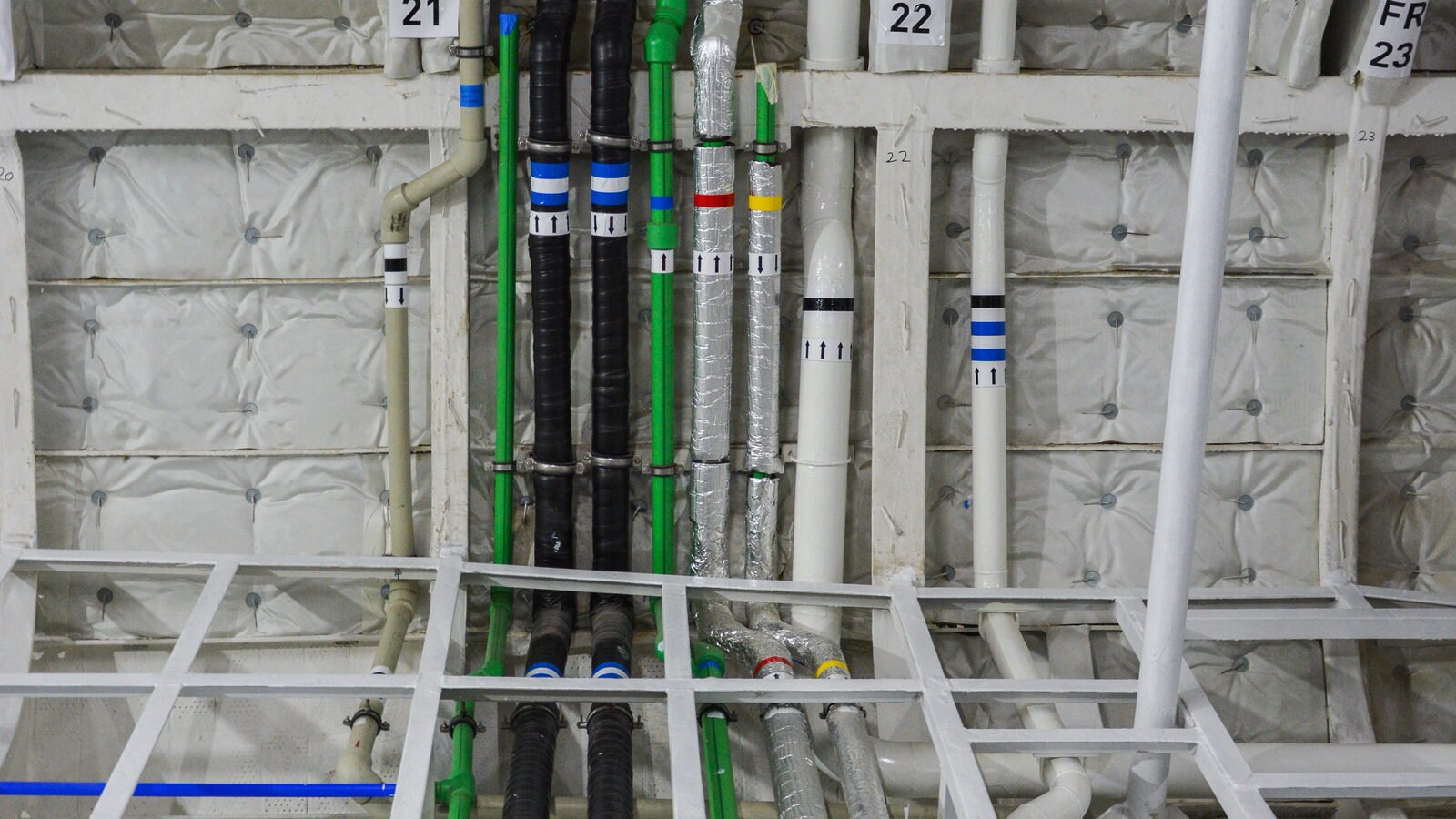
- a pipe clamped rigidly to a frame within a metre of the machine it serves
- an exhaust hanger landed on structure instead of on its own isolator
- a cable tray or a duct bridging an isolated machine to the hull
- a joinery batten landed straight on a frame
- a bellows or flexible coupling stretched to meet an awkward joint, which makes it a strut
Any one of them defeats the mounts. Most arrive after the drawing was issued, so flanking into the accommodation is found by following the structure, not the drawing. Each is small work while the lining is off, and unreachable afterwards.
What acoustic decoupling loses at the junctions
Once the structure-borne path is closed, lining work is worth doing. Not before. Mass comes first: a limp heavy layer reduces what passes through a bulkhead, and a resilient channel behind it stops that layer being driven. A floating floor in a yacht cabin does the same for a deck, on resilient pads with no rigid contact at the perimeter, which is where it is usually lost: a skirting screwed through the floating layer undoes the pads beneath it. Acoustic decoupling goes at the junctions rather than the materials, which is why what a yacht interior refit has to prove is proved at the details.
A yacht noise and vibration refit moves the frequencies
A repower changes firing rate and every order above it. That consequence rarely appears in the case for a repower, which is argued on hours, parts and emissions rather than on what the accommodation will hear. A new propeller with a different blade count moves blade rate to a frequency never in the hull before; a new generator set moves the night-time tone with it. Nothing has failed: the excitation moved and the structure did not.
A baseline vibration reading before the refit is the only reference a later reading can be argued against, and it belongs to the week the decision to strip out is taken. It is not something a condition survey opens up for unless somebody asks, because a spectrum records a running condition rather than a static one. A week later the lining is off, a machine is on the quay, and the vessel that reading would have described no longer exists.
The limit
Mount selection and its rated deflection belong to the maker, blade rate to the propeller designer, and any contractual dB(A) figure or comfort notation to the specialist who wrote it and the surveyor witnessing it. None is ours to promise.
Nor is the reading: it belongs to whoever is instrumented to take it, the owner's specialist or surveyor. The yard's part is seeing it taken at the same places before and after. Ours is narrower still: the installation, and every hard contact the yard made. Pipe, cable tray, joinery and mount are held here by one employer, so they are opened in the same week rather than by four subcontractors on four visits.
Written at the yard in Tuzla. Mount ratings, blade rate and any contractual noise or comfort figure belong to the makers, the propeller designer and the owner's surveyor rather than to us, and the reading itself belongs to whoever is instrumented to take it. The yard answers for the installation and every hard contact it made.
The reading that has to exist before the lining comes off
Send a baseline vibration reading taken at the complaint location before strip-out, with the vessel's condition stated, together with shaft revolutions and blade count, engine speed and cylinder count, each generator set's running speed, and the mount type, part number and measured static deflection under each machine. Those items separate the structure-borne half of the problem from the airborne half before any material is bought, and they cannot be recovered once the lining is off. Write to info@revivarefit.com.
START A REFIT