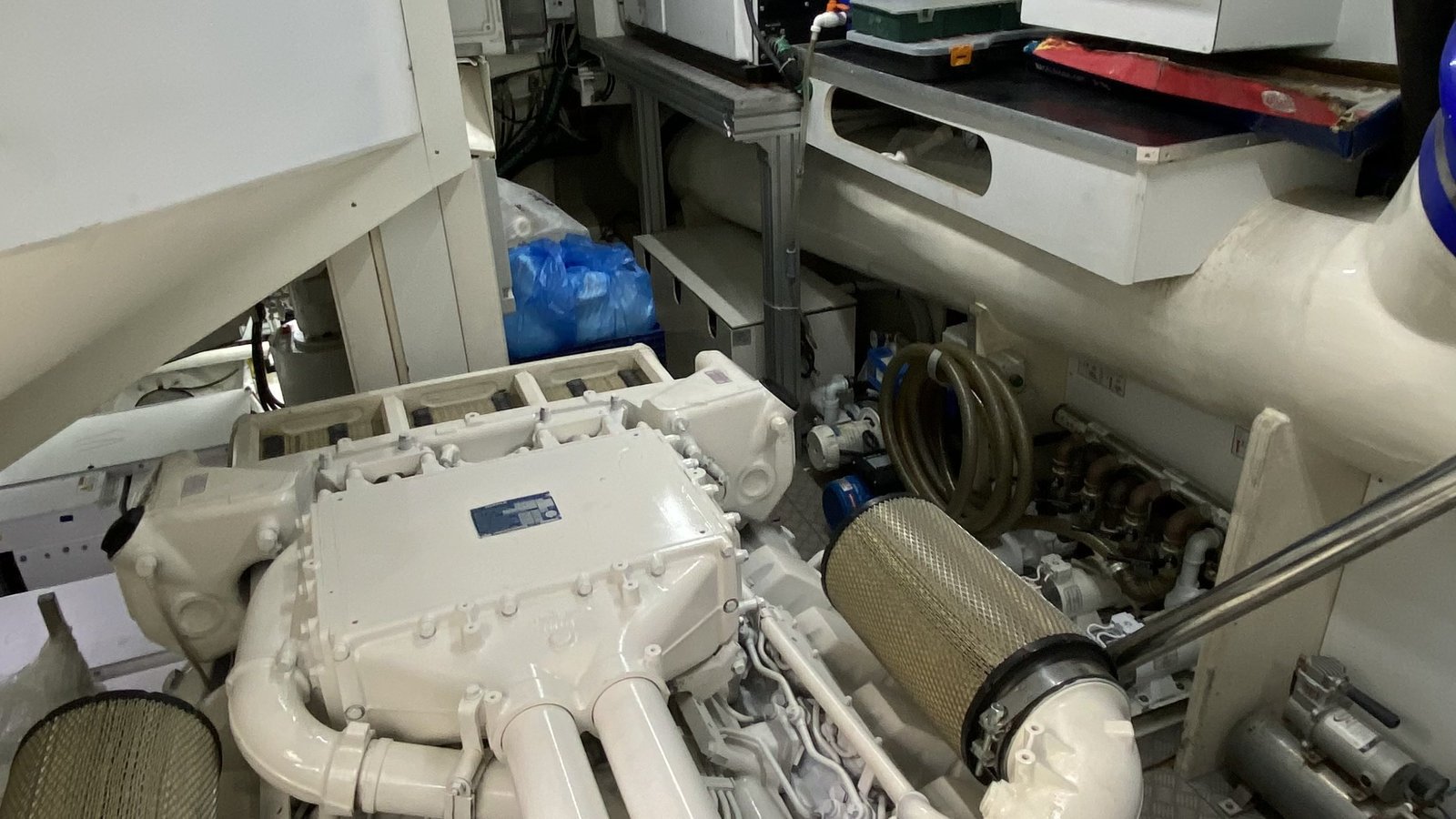
A condition survey can fail in its first hour, and it fails the same way each time. The surveyor is aboard, the chief engineer is aboard, and the three things they came to look at are under a screwed-down sole, inside a full tank, and behind a board the galley sits on. Nothing is wrong with the vessel. The day is simply not going to produce a report.
Looking is the short part. Preparing a yacht for a condition survey is an event with prerequisites: spaces opened, systems made dead, tanks emptied and made safe. They fall due weeks before anyone books a flight, and they decide how much of her ends up identified rather than described.
A pre-purchase survey and a pre-refit survey ask overlapping questions under entirely different permissions. On a vessel being bought, a seller will usually permit nothing to be opened that cannot be made good the same day, and the crew who know where she weeps are the seller's. A pre-refit survey is ordinarily under no such cap, and a panel that comes off can stay off.
Access is ordered weeks ahead, not arranged on the morning
Every opening has a trade behind it and a lead time in front of it. A sole panel over a pump flat comes up with the joiner present: fasteners seize into a hardwood ground, and a panel lifted in a hurry will not sit flush again.
A tank is the long one. Its contents go to a reception facility, with a booking, a tanker and a manifest behind them. Ordered far enough ahead, the tank is open, gas-freed and lit when the surveyor lands. Ordered on the day, the survey returns a sounding and an opinion.
Isolation, stored energy and the permit that lets a man in
Switching a breaker off is not isolation. Isolation is the supply proved dead and the means of reconnection secured: a breaker racked out or locked open, tagged, the key held by one named person, because the entry permit has to name somebody who can be asked, on the day, whether the circuit is still dead.
Stored energy is the part crews underrate. An accumulator holds its charge after the pump stops, so a passerelle ram can still move with the system dead. It is bled to a gauge and the gauge read, not assumed from the sound of it.
Then the atmosphere. A tank is washed, ventilated and tested at the bottom of the space as well as at the lid, because the vapours that matter lie in the sump. The entry permit names the space, the standby at the opening and the means of recovering somebody who cannot climb out. That last line sets the size of opening you need, which is why a tank with one manhole is surveyed differently from one with two.
A plate is an identity, and a description is not
A cylinder written up as "port ram, weeping at the gland" cannot be ordered against or compared. The stainless plate riveted to its barrel turns it into a component: the maker and the address, a product code, a serial number, a date of manufacture, the bore, the rod diameter, the stroke, the swept volume, a working pressure, a setting pressure, and the standard it was built to.
Each line does work later. Bore and rod diameter size the seal kit, ordered against those dimensions rather than the name of the machine it lives in. Working and setting pressure state what the cylinder itself was rated and set to, the figure the relief setting in that circuit is read against before anybody decides whether a ram is failing or was asked for more than it was rated to give. The date of manufacture turns "original" into a number of years.
Where two lines have rubbed illegible, as on the ram photographed here, record which are missing rather than reconstruct them; a maker will often return the build sheet against the serial alone.
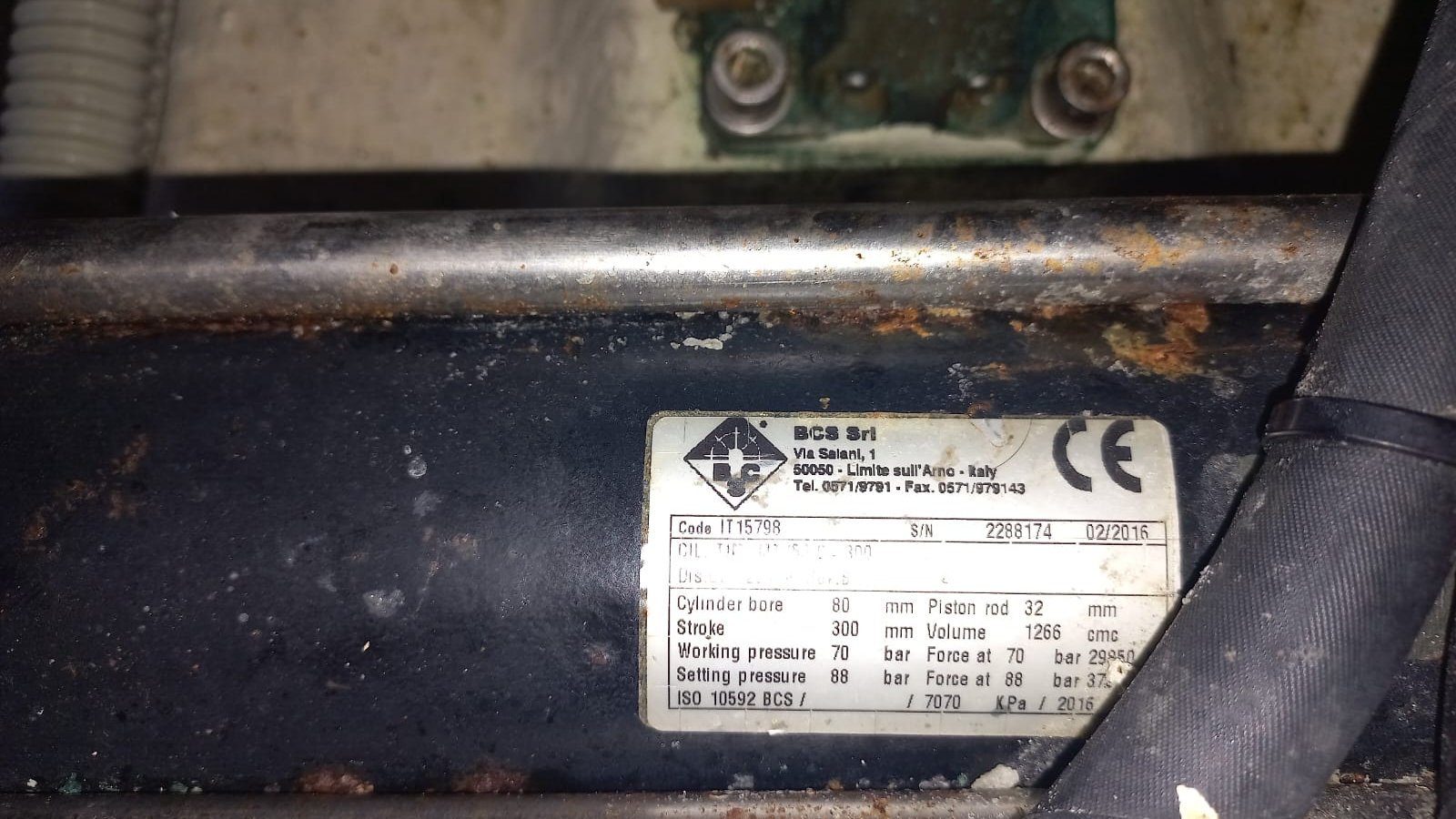
A plate still legible on metal that is going
This is the normal case, not the exception. The plate is stainless and the barrel under it is painted and rusting, so the two waste at different rates in the same air. Dried salt on the plate face is hygroscopic, holding a damp film against metal at relative humidities well short of saturation, so the surface stays wet long after the compartment is dry to the hand.
Blistered paint, pitting and green corrosion under the bolt seatings above point the same way, and what a surveyor tests next is whether salt water is arriving here, from a weeping joint, a vent, or a wash-down. The finding is not that one cylinder needs attention. Everything sharing the space is on the same clock, the fasteners and the terminations in the conduit above included, and those corrode unseen until a circuit misbehaves in a seaway.
The preparation worth refusing
Crews prepare for a surveyor as for any inspection, and one part of it should be stopped. A machinery space wiped down, bilges pumped dry, a compartment repainted the week before is a space cleaned of its own findings. The salt track down a bulkhead, the rust stain under a flange and the dried drip beneath a union record what happened while nobody was watching, and a rag removes them faster than any instrument finds them. Stores on the deck plates are another matter: moving those is access. Ask for the space to be safe, lit and open, not tidy.
Who opens the space, and who has to be standing in it
A survey day fails for want of a person more often than an instrument. On a vessel in commission most of the opening falls to the chief engineer, who cannot be in three compartments at once, so the order of spaces is settled in advance. What we book is ours: the fitter who breaks the joint, the electrician who isolates and locks off, the gas-free testing, the attendant at the manhole, and a foreman who writes down what came off and how the space was left. Eleven workshops at Tuzla are on one payroll, so the man who lifts a sole panel and the man who lays it back answer to the same foreman. That does not open her any faster; it settles who lays it back.
The answers the day cannot give
Some answers are not available at any price. What state she is in is this survey's question; what class or flag then requires is a separate attendance under separate rules. A survey afloat is also partial, because what a diving team brings back has limits set out before. What could not be reached still has to be carried in a price, a subject of its own.
What comes out is not a verdict but an account of her detailed enough that three yards price the same vessel rather than three different ones, which is what the document you send them is built on. A component identified in the report is still identified after the space has closed over it, which is more than can be said for one that was only described.
Written at the yard in Tuzla. The access, isolation and entry arrangements described here are the ones we prepare and book; what any particular finding means for a given vessel is for the owner's surveyor and naval architect to judge, and anything bearing on a certificate is the attending class surveyor's call.
Tell us what can be opened
Send her particulars and her location, and say plainly what may be opened and what may not: which tanks can be drained before she arrives, which spaces are reachable with her afloat, and who aboard is authorised to isolate a system and sign an entry permit. What comes back is the preparation we would ask for, who we would book to carry it out, and how far ahead of the survey date each item has to be ordered. Stage One ends with a written condition report, an approved scope and a price that does not move. Write to info@revivarefit.com.
START A REFIT