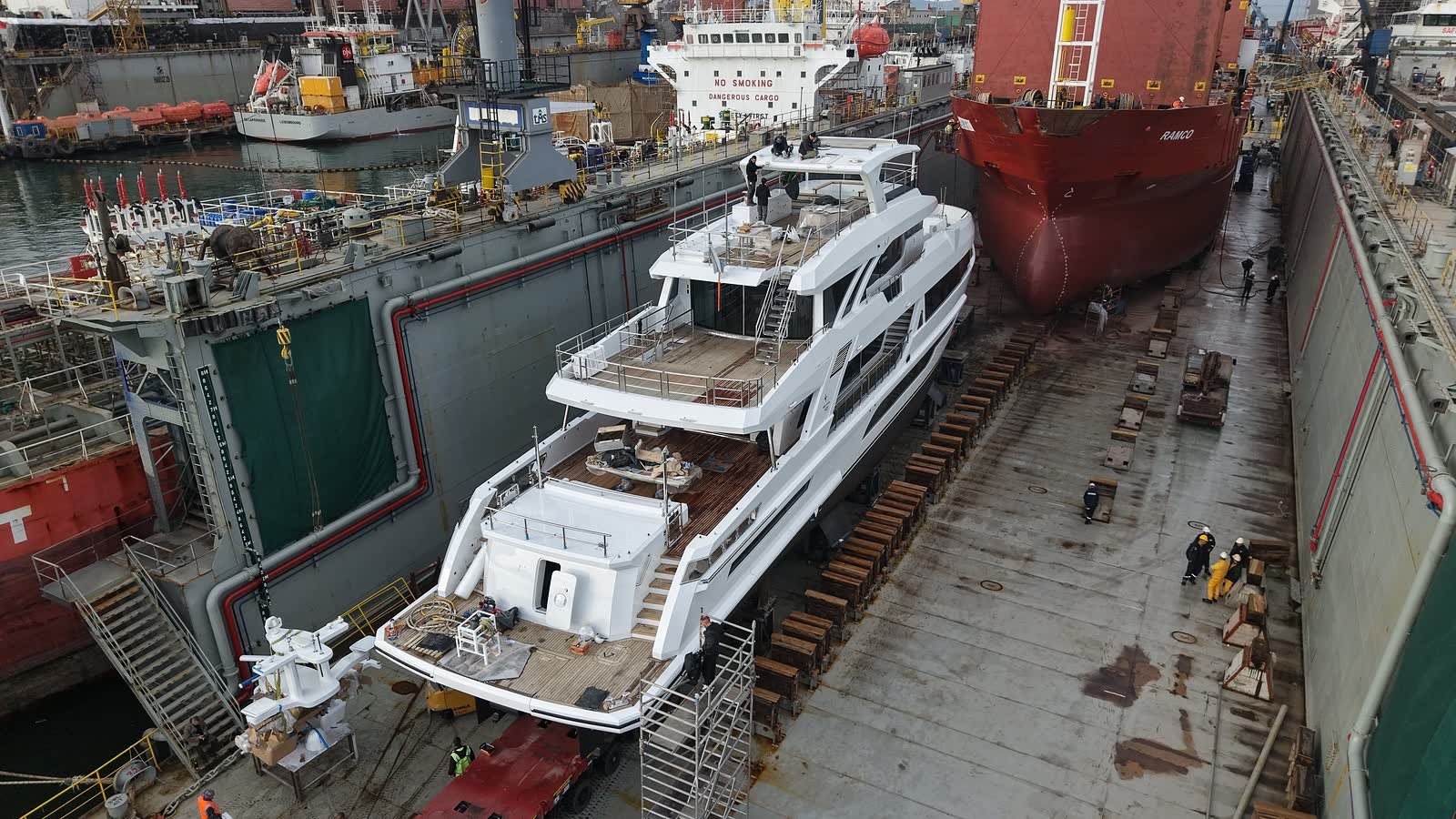
No yard publishes a yacht refit price list, and that is not commercial coyness. The unit of a refit is a yacht, not an hour or a metre of hull, and no two arrive in the same condition.
Owners rarely ask what a yacht refit costs in the abstract. They arrive with two or three figures for ostensibly the same work, differing by a third or by half, and no way to tell whether the cheap one is efficient or simply incomplete.
What can be said without inventing a figure is this. A yacht refit cost is built per vessel, out of measured labour, materials, yard services and third-party attendance, and most of the spread between two quotes is a difference in who carries the unknowns.
What a yacht refit quote is really modelling
Into the model go the drawings, the class record and the crew's account of what has been giving trouble — a vessel the yard has seen for a day, or only on paper. What comes out is the predicted cost of the work, plus a position on everything the model cannot see.
That position separates the three shapes a refit price comes in. A lump sum says the yard carries the unknowns inside a defined scope, and is higher for it. A schedule of rates fixes the cost of an hour, a kilo of weld metal, a square metre of coating, and leaves the quantities to be measured as work is opened up; there the owner carries them. Cost reimbursable puts the yard's books on the table, and the owner carries almost everything. These are not formats but risk positions, and two honest yards can quote the same yacht very differently by taking different ones.
The four kinds of money inside a yacht refit cost
Whatever shape the price takes, four kinds of money sit inside it, and they behave differently:
- Measured labour — hours against defined tasks, the part a specification controls.
- Materials and equipment — coatings, plate, cable, joinery stock, named units.
- Yard services — berth, dock, power, staging, cranage, waste, containment.
- Third-party attendance — what the yard must do to support an outside inspection: gas-freeing, staging and opening up for a class survey, commissioning support, type-approval submissions.
A tight scope disciplines the labour and mostly fixes the materials. It has less grip on yard services and very little on third-party attendance. Owners with a good specification are often surprised that their quotes still disagree; the disagreement has moved into the categories the specification never addressed.
Yard services accrue on a calendar, not on a scope
A berth is occupied whether trades are aboard or not. Staging stands until it is struck. A containment tent is on hire for every day it stands, and power, waste and cranage are metered against the yard period.
So a schedule slip costs money even when no extra work is done: a part that lands a month late has added no labour and a month of berth, power and staging. The schedule and the price are one conversation, and we have written separately about what makes a refit programme slip.
Labour is a rate; access is the multiplier
Every yard will tell you its labour rate, and on its own the comparison is nearly useless. The same task carries a wide range depending on what has to come out first, what has to be built to reach it, and what has to be protected meanwhile.
A pump in an open engine room is a straightforward change-out. The same pump under a fitted sole, behind a panel installed before the machinery went in, is a joinery job, an electrical isolation, a lifting plan and a reinstatement. Nothing about the pump changed. Everything about the access did. On a superyacht, where systems sit under finished interior, the access can be the larger half of the line.
Pricing what nobody can see yet: allowances and contingency
Some things cannot be priced until they are opened. Tank internals under a coating, structure behind linings, shaft bearings until the shaft is drawn. A yard can guess low and recover it later as variations, guess high and lose the tender, or name an allowance: a sum carried against a defined item, with the basis of measurement stated and a method for adjusting it once opened.
An allowance is not a contingency, and the difference belongs on the face of the quote. An allowance is attached to a named item and measured against it. A contingency is carried against the unforeseen generally, and what matters is who holds it, what releases it, and what becomes of it if it is not spent. Writing allowances three yards will price the same way belongs to the refit specification, not here.
The named allowance is also what makes an honest quote look dearer than its rival. A cheap figure is often one that deferred the works that get worse while they wait, and deferral charges interest.
What a yacht refit cost does not include
Several real costs never appear on the yard's paper. Crew wages run throughout. The class society's and the flag's own fees are normally invoiced to the owner direct, though which paper they sit on varies with the contract. Transit, insurance over the yard period, the owner's representative and any independent surveyor sit outside the number entirely.
Owner-supplied equipment sits outside it too, and it is the line that puts a schedule into somebody else's hands. Buying a unit direct can remove a margin. It also transfers delivery, specification and interface risk to the owner, and if the unit arrives late or arrives wrong, the yard-services meter runs while it is sorted out. The saving is real. It is not free.
How to compare two yacht refit quotes
Read the exclusions page first. It is the real document, and it tells you more about the figure on page one than the figure does. Then ask each yard, in writing:
- What condition does the price assume, and on what survey?
- What has been allowed rather than measured, and on what basis?
- What is excluded, and to whose account does it fall?
- What happens when an allowance is opened and the item is worse than assumed?
A yard that will state its assumptions has fixed a price. A yard that will not has quoted low.
At Reviva, Stage One is Imagine & Survey, and it ends with three things: a written condition report, a scope the owner has approved, and a price that does not move. The report is written first, the scope is agreed against what it found, and the figure rests on that record rather than on an assumption. Where the report cannot see, the allowance is named and its basis of measurement stated with it. The trades who price the work are the trades who will do it — joinery, metalwork, coatings, electrical and systems, all within a few minutes' walk of the berth. ISO 9001 covers how that work is planned, checked and signed off, which is the reason two refits run the same way. It certifies a process rather than a price, and a price that does not move is only worth having when the process behind it repeats.
If you would rather have that conversation over a yacht than a spreadsheet, come and walk the sheds. We are on the Tuzla waterfront in Istanbul, with the dry dock at Pendik, hull and steel at Yalova and a service point at Bodrum. Write to info@revivarefit.com and we will arrange a yard visit.
Written at the yard in Tuzla. No prices appear in this article on purpose: a refit figure is only meaningful against a named yacht, a survey and a stated scope, and any number quoted without those three is a guess wearing a decimal point.
A figure that rests on a survey
Send her particulars and the scope as you understand it today, and we will tell you what a survey would have to look at before anyone can put a number on it. Stage One ends with a written condition report, a scope you have approved, and a price that does not move.
START A REFIT