What repair, restoration and refit each answer
Repair, restoration and refit arrive in an owner's brief as three strengths of the same request. In a yard they are three different scopes of work, priced by different arithmetic.
Repair returns a yacht to working order. It answers what broke. Restoration returns her to the day she launched. It answers what she was, and yacht restoration is bound by originality: a fitting that can no longer be bought has to be made.
A refit is the only one of the three the owner sets rather than the vessel. It asks the only question with a future in it: what should she be now. It is also the only one that can be argued against. A sound hull with a tired generator wants a repair, and calling it yacht refitting costs an owner money for nothing. A vessel whose value lives in her provenance wants restoration, and modernising her destroys the thing being paid for.
What a refit can change, and what it cannot
Nearly everything above the shell plating is negotiable. Layout within the existing structure, machinery, tankage, piping, electrical distribution, insulation, air handling, deck gear, coatings, interior. At the far end of that range the outfit comes out entirely and the yacht is rebuilt rather than maintained. Mirabella, a 47.9-metre Trinity, went back to bare substrate over nine months and was redelivered on the contract date. That is a superyacht rebuild.
What does not change is the drawing underneath. The underwater hull form sets her speed, her motion and her behaviour in a sea. The structural grid can be worked — plate renewed, frames doubled — but it cannot be rearranged for the sake of a layout. On a sailing yacht refit, keel configuration and rig geometry are structural decisions, not styling ones.
A refit can disappoint without a single bad joint in it. The workmanship answers the drawing it was given, and the drawing is where the decision was made. An owner who wants two more guest cabins in a hull with no volume for them is not describing a motor yacht refit. That is a different vessel, and joinery will not conceal it.
What hull material and the original build decide
Hull material sets the arithmetic. Steel wastage is measurable and plate is renewable, so what matters is where the wastage sits, not that there is some. Aluminium is less forgiving, and distortion under a topside coat is decided at the welding, long before anyone looks at the paint. Composite is not read with a thickness gauge but with moisture and adhesion, and its bad news arrives as laminate and core rather than plate and frame.
The original build decides the rest, and it decides it through access. A yacht with removable panels, drawings that match her and services routed to be reached has refit hours that can be estimated. One built quickly, with bonded panelling over unlabelled cable runs, is a yacht where much of the labour buys nothing but the right to see the work. Two vessels of the same length and year are not the same project.
What a refit survey has to settle
Everything above is opinion until it is measured. This is the survey that decides whether to start at all, not the scoping survey that prices an agreed programme — what yacht refitting actually involves covers that one.

Our first stage runs two to four weeks out of the water, on instruments rather than impressions: ultrasonic thickness logged by station and frame, moisture meter, dry film thickness gauge, pull-off adhesion to ASTM D4541, dew point, thermal camera, laser alignment, and a sea trial with two of the yard's engineers aboard.
Readings change verdicts.
The findings we publish make the point. Hull plating at 5.8 mm over two hundred and forty ultrasonic points, three per cent loss and within class, is structure worth spending on. A rudder bearing at 1.9 mm against 0.8 mm as built, or shaft alignment 0.42 mm out of tolerance aft, are line items. Deck core moisture at eighteen per cent in two zones forward is the one that turns a refit into a question, because what it costs is not known until the deck is open.
A refit survey is a document that has to be usable as a decision. It takes four parts:
- A condition report where every reading, photograph and observation is located and dated.
- A priced work list in three tiers — must, should, want — each line priced and hour-counted, so the yacht refit specification can be cut line by line.
- A schedule envelope with a start date, a redelivery date and a named contingency.
- A recommendation, including the version where we advise you not to.
That last line is the one that costs a yard money to write. A survey that can only end in a yes is not a survey.
Refit or buy another vessel
Whether a refit is worth it is the wrong question alone. The comparison is against buying another vessel. The alternative carries a purchase price, commission, delivery, and the refit that vessel will also need, because a hull bought cheaply may be carrying deferred work nobody has measured. Against that, a yacht already owned has a maintenance history that can be read, and the alternative has one that cannot.
The refit loses that comparison in two situations: when the specification is fighting the hull, and when the structure has gone far enough that the work approaches the cost of building. Both show up in the readings rather than in taste.
What a second yard period costs
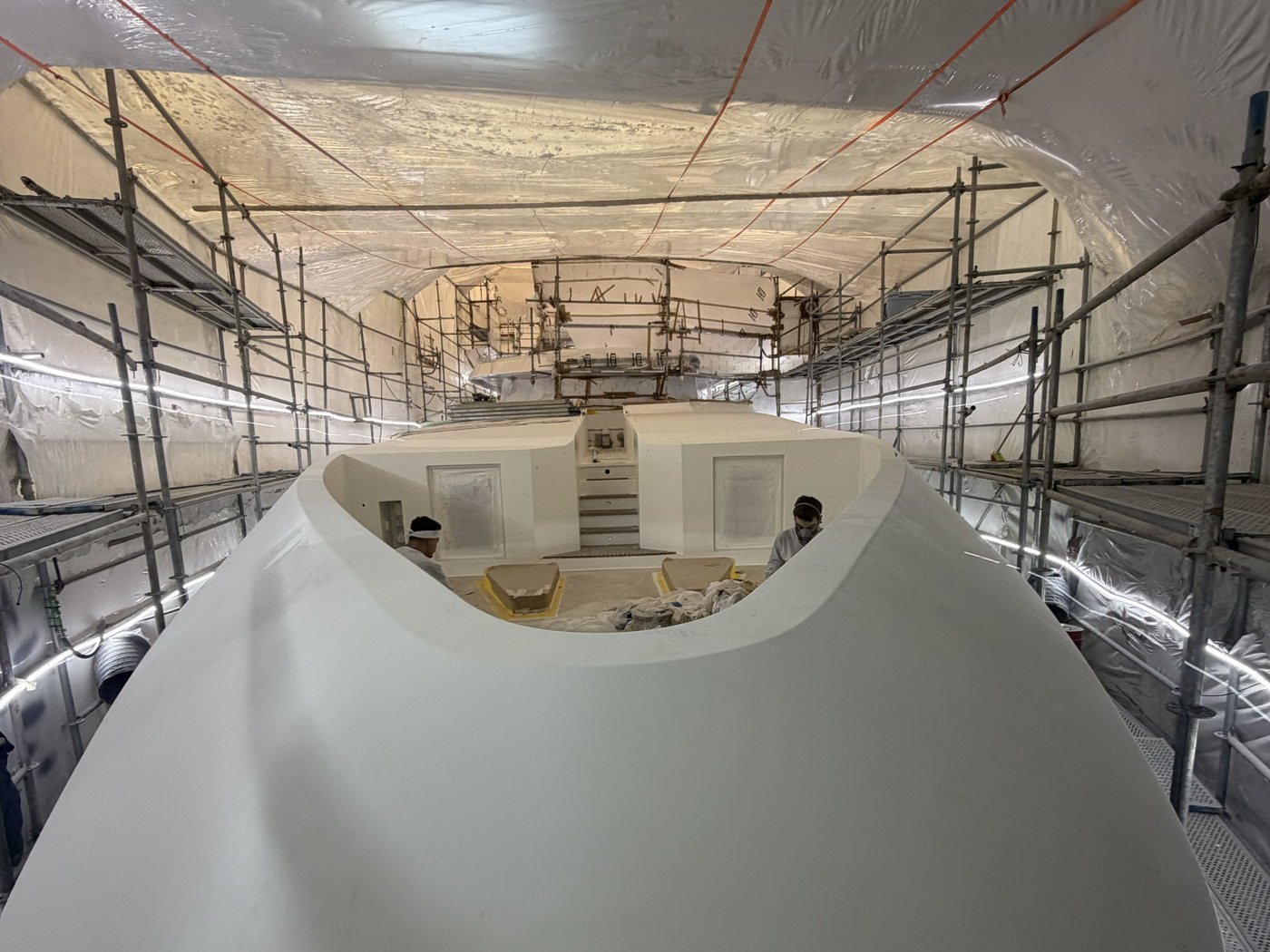
A large part of what a refit costs is not the work but the access to it — the haul-out, the strip-out, the staging, the tenting, the protection and the demobilisation. Split the job across two yard periods and that access is bought twice while the work is bought once. Add the season lost to the second period, and joinery that will not match the first.
Deferral is defensible when the survey says she is safe and the money is not there. It is a poor way to save.
Written at the yard in Tuzla. Figures quoted are the ones we record on the job and hand over with the vessel.
What to ask for before a price
If a yacht is being weighed up, the useful first step is not a quotation. It is the survey: a condition report where every reading is located and dated, and a work list that can be cut in daylight. Send her length, material, year, and what she is wanted for next. We will say what we would measure first, and whether we think the answer is no.
ASK FOR A SURVEY