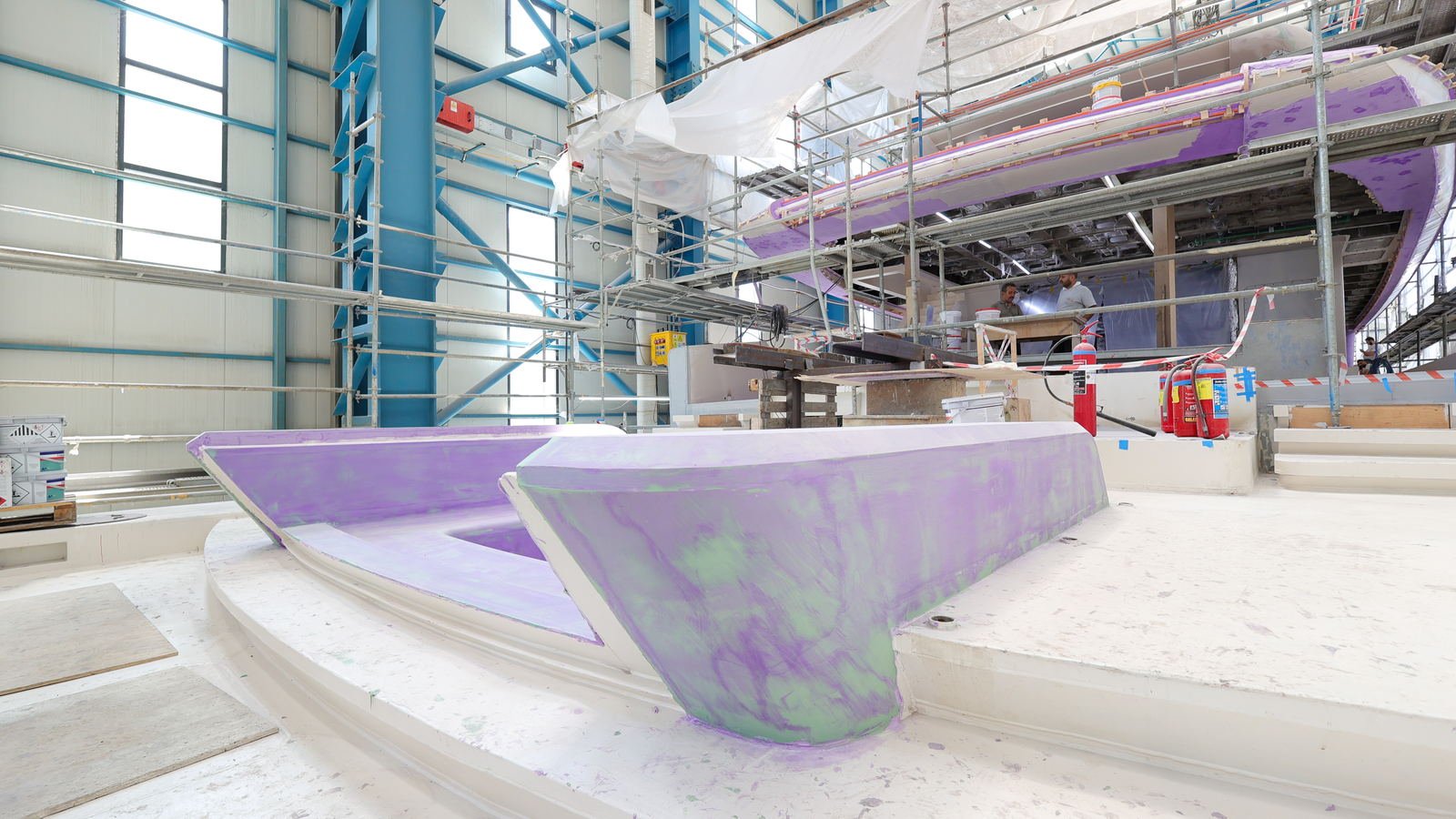
Days of paint, months of preparation
Blasting a forty-metre topside takes days. Fairing it takes weeks, and the number of weeks is most of the quotation. The topcoat is the last few days of a coatings programme counted in months. An owner reading a yacht topside repaint price is reading a labour price, and the money sits in what comes off the hull rather than in what goes back on.
All of it stops at the boot top. Below that line the chemistry and the failure modes are different ones, taken apart already in anti-fouling, and where the runoff goes.
A superyacht paint job also cannot open until the last hot work permit on the shell is closed. Compound over plate that still has a renewal in it is money spent twice.
How far back to go
The first decision is not colour. Two readings settle it: the adhesion of the existing scheme, pulled off and recorded, and the accumulated film build measured through it. A sound scheme at three or four hundred microns can be abraded and overcoated. One letting go in sheets, or built past a millimetre, comes off. Why we take off a coating that still looks sound from the dock is set out on one hull already, in forty-three metres, back to bare metal.
What it comes off with is decided by the substrate. Steel goes to the cleanliness grade the datasheet calls for and to a medium grit profile, commonly fifty to seventy-five microns, deep enough for the primer to key and no deeper. Both grades are the manufacturer's to set and ours to hit. Aluminium is stripped with non-ferrous media, because ferrous grit embedded in a soft substrate is a cell waiting under the primer.
Fairing, and what fails a batten
Fairing is the longest line in a repaint and the one that moves. It is bought against a batten walked across the panel, and there are three ways a panel fails one. It rocks, which is a high spot. It shows daylight under the middle, which is a hollow. Or it crosses the frames and fails along them.
The abrasive steps down rather than jumps: a coarse cut to bring the compound back to shape, a finer one to take out the scratch the coarse cut left, and the last by hand where a machine cannot hold the line. Skip a step and that pattern comes back through the topcoat. Painting is one of the eleven workshops on this yard's payroll, which matters less for the spraying than for the sanding.
There is a build past which compound stops smoothing a shape and starts being the shape. Thick epoxy shrinks unevenly across a section deep in one place and thin a metre away, so a panel flat under the batten in March has moved by June. It is weight as well, carried high. Past that the plate is corrected in metal.
A coating system is one manufacturer's, not six purchases
Primer, fairing compound, high-build, undercoat and topcoat are one engineered stack, with a clearcoat where the topcoat is metallic. A build we have specified runs an epoxy primer at fifty to eighty microns, the fairing over it, a high-build epoxy of two hundred and fifty to four hundred microns for the longboards to cut, an undercoat near eighty, and two polyurethane topcoats. The figures are the datasheet's rather than ours.
Substituting a cheaper equivalent at one layer is where the guarantees stop. Solvent in an upper coat can lift a lower coat it was never formulated over, and a manufacturer will not warrant a stack with somebody else's layer inside it.
What enforces a system is a person rather than a document. We write the manufacturer's technical representative into the coatings package, to attend, sign the substrate off before each stage and countersign the batch records. Where that scope has not been bought the yard is signing off its own work, and an owner should know which was priced.
The tent, the window and the readings taken inside it
A containment tent is built around the hull off the staging, sealed to the ground and closed at the ends. Make-up air comes in filtered and the extraction is filtered before it leaves, at a cross-draught the datasheet and the yard's permit both have a say in.
The substrate has to sit above the minimum temperature the datasheet sets, below which a polyurethane will not cure to the film it was formulated for, and a stated margin above dew point through application and cure. Why that is logged hourly is its own subject, in why we log dew point every hour. A hall holds the window open. It does not shorten the cure, and a week lost to a cold spell is not recovered on overtime.
Wet film is read at the gun with a comb, coat by coat, because the next coat buries the one beneath it. Dry film thickness is gauged after cure, panel by panel against a numbered elevation and not as an average. Adhesion is pull-off tested to ASTM D4541, on the old scheme before she is stripped and, for the new stack, on witness panels sprayed alongside the hull, because nobody pull-tests a finished topcoat.

How a yacht topside repaint fails
Failures are almost never a bad tin of paint. They are decisions taken weeks earlier, and four are worth naming. Contamination is the first: silicone off a polish or off nearby work, and chloride, which a decade in service leaves in her pitting and weld lines and which blasting drives in unless she is washed first.
The second is a recoat window missed, so a bond that would have been chemical has to be bought back by abrading, and it is not always bought back. The third is moisture left in the substrate or the fairing when it was overcoated, which returns as blistering.
The fourth is movement in compound laid over plate nobody corrected, and that one does not blister. It telegraphs as a shadow, invisible square on and unmistakable from forward. None of them shows at handover. They show after a season, which is why a coating guarantee is read for what it excludes.
Reading the hull, and what twelve months covers
Gloss is read at twenty degrees on a topside, because sixty and eighty-five stop separating one good finish from another once the units are high. Distinctness of image is the separate property, deciding whether the reflection has an edge to it or only brightness. Then she is read by eye, sighted from forward at a shallow angle with a light held low, which finds a fairing wave a gloss figure passes.
The twelve months runs from redelivery as it does on any scope here, on the terms set out in yacht refit services in Turkey. On a coating it stops at a boundary worth naming: it covers the stack we applied, from the substrate we prepared upwards, and not the adhesion of a scheme somebody else laid down. An owner who overcoats rather than paying for the strip can have that, but the twelve months then stops at our own film.
Written at the yard in Tuzla. Figures quoted are the ones we record on the job and hand over with the vessel.
What to send before we price a repaint
A repaint is priced from what the plate is doing under the old scheme, and none of that is visible from the dock. Send her length, material and year, the age of the current scheme and who applied it, and any adhesion or film build figures that have been taken. Photographs help most taken down the topside from forward at a shallow angle, because square on is the one angle at which a fairing wave does not show. What comes back says what we would blast first, what we would measure on it, and a fairing line carried as a rate against an agreed batten tolerance rather than a lump nobody could stand behind. Send it to info@revivarefit.com.
SEND THE PAINT HISTORY