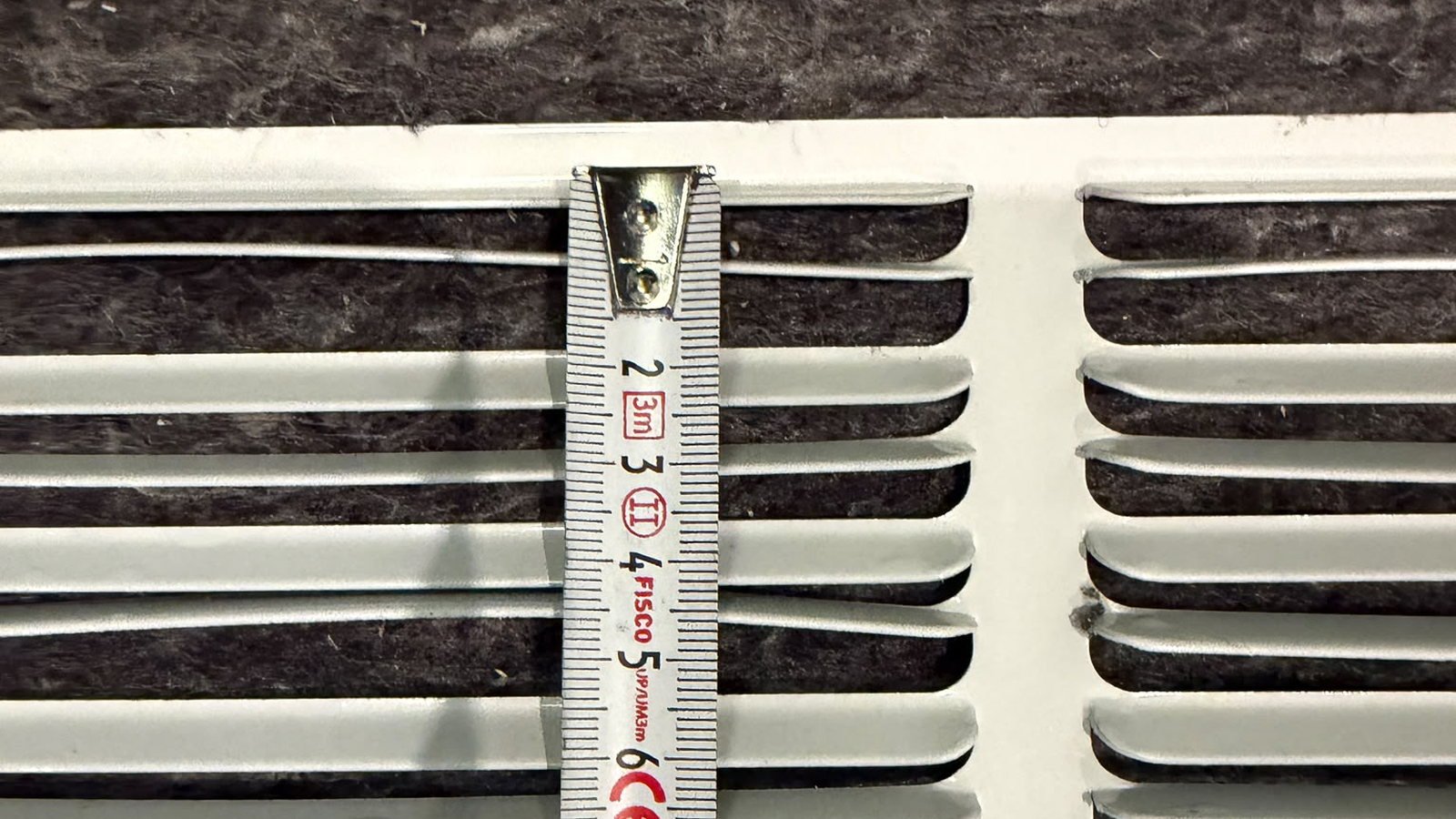
A louvred panel comes off in the strip-out. It will be remade, so a tape goes down it before it is racked: hooked over its top edge, the blade run across the slats, the figure written into a phone. The figure is twelve millimetres over the one on the drawing for that panel.
Neither figure is wrong. The panel is what was actually built, and two later yards have worked the opening it sits in. The tape measures the object. The drawing records a decision taken before the object existed, and she has been diverging from it since she was launched.
The figure was right on the day it was taken, and nobody wrote down which day that was, or what state the opening was in. What the figure lacks is provenance. Measuring a yacht for a refit is something every serious yard does; what separates them is whether anyone can say what a given number was taken off, and when.
What an as-built set fixes, and when
That her drawings were out of date before this refit began is already settled in what leaves with her, down to the draughtsman who has to walk a run before a set can be called as-built. We concede all of it.
But an as-built set fixes the record on the last morning, and nothing fixes it on the first. Between those two points every trade aboard works from a dimension it took privately, off its own part, on its own day, and wrote down somewhere no other trade can read.
Four trades, four tapes, four dates
Aboard one vessel, measuring a yacht for a refit happens four times over, in four shops.
- The interior is assembled in the shed on a jig that answers to the compartment as it was found aboard, and not to the sheet: six cabins, one dry fit, set out at the joinery bench.
- A run is cut into spools against what will actually go down the hatch, and the figure that decided the cut is written on no drawing: the joint count.
- A pane is not ordered until the aperture has been trued, because the aperture is only readable for distortion once the linings are out: aperture, then template, then order.
- Shafting and seatings are set against a datum instead of restored to a line already tired when she came in: a builder's habit carried into a refit.
Four correct measurements, four trades each doing the right thing, and the joiner's number and the fitter's describe the same compartment without agreeing where its faces are, because they share no reference, no date and no stated condition. Each is honest, and no two were ever reconciled.
A dimension has a date, and a condition
A measurement ages, because the object moves. Plating cut and welded either side of an opening pulls towards the weld as it cools. Hangers take up. A compartment settles once its weight is back in it. And a hull on blocks does not sit as she sits in the water, which this yard has conceded twice already: in the rule that alignment is only meaningful with two sets of readings in two conditions, and in the thruster's motor alignment, set on blocks and unloaded, so whatever the hull takes up between blocks and water is taken up at the coupling.
That concession cuts against this yard as hard as any other: nobody can promise that a dimension taken today still describes the object once the compartment around it has been worked. What a yard can do is say when it was taken, and in what state she was. The discipline exists here already, in steel: a gauging reading carries its position, the coating condition, the instrument and the date, so the next survey compares rather than starts again. We take it from the steel shop unchanged, and ask an ordinary dimension to carry as much.
- what was measured, named by the object, not by the part it will become
- what it was taken off: the vessel, a drawing, or an existing part
- the date
- the condition: on blocks or afloat, before or after hot work in that compartment
A figure carrying all four is a record: it can be checked, argued with and superseded. One carrying none can only be believed or ignored.
Against what, then
Naval architecture and interior design are in-house here and the drawing board is not outsourced, so the joiner's figure and the fitter's can be put on one desk and argued out by people who can walk to the compartment both measured.
No instrument is named here and no scan is promised. Agreeing a reference does not stop the vessel moving; it only makes the movement measurable instead of surprising. Stage One ends with a written condition report, an approved scope and a price that does not move, and the first of those figures belongs in that report, taken before anything is cut.
Does the measured record leave with her?
An as-built drawing tells the next engineer where a run is. It does not tell him what the compartment measured, on what date, in what condition, or what has been cut near it since. So the next yard takes the figure again from nothing, and the same dimension is established twice off the same object.
This journal is already honest about the limit of our own paperwork: a record is not a survey, it measures nothing. That describes the hole rather than filling it. The measured record of the vessel as she stands is a separate document, nobody asks for it at redelivery, and it belongs in the file beside the drawings, dated and conditioned. It is worth more to the owner than to the yard that took the figures.
The test, on a figure you already hold
Pick one figure you are relying on now. A panel width somebody is about to remake. An aperture somebody is about to order glass against.
Then ask two things. What object was it taken off: the vessel herself, a drawing, or an earlier part made to one of those two? And when, with her in what condition?
If the answer to the first is a drawing, the figure describes an intention, and the part will be cut to it anyway. If nobody can answer the second, the figure may describe an opening that has been welded either side since. Neither is settled by asking again. Both are settled by going back to the opening with a tape before the order goes in.
Written at the yard in Tuzla. No measuring instrument or method is named here, and whether any particular reference or record satisfies a vessel's class is for her flag and the attending surveyor to decide rather than ours to state.
Which of her dimensions would we have to take again
Send the drawing set she is actually working to, with a note of its date and its revision. Then tell us one thing about her last yard period: whether anyone handed you a measured record of what was found aboard, or only drawings. Say when she was last out of the water, and whether any compartment has been worked hot since. What comes back is which of her dimensions we would expect to take off the yacht again before anything can be priced, and which of the paper you already hold can still be trusted. Write to info@revivarefit.com.
START A REFIT