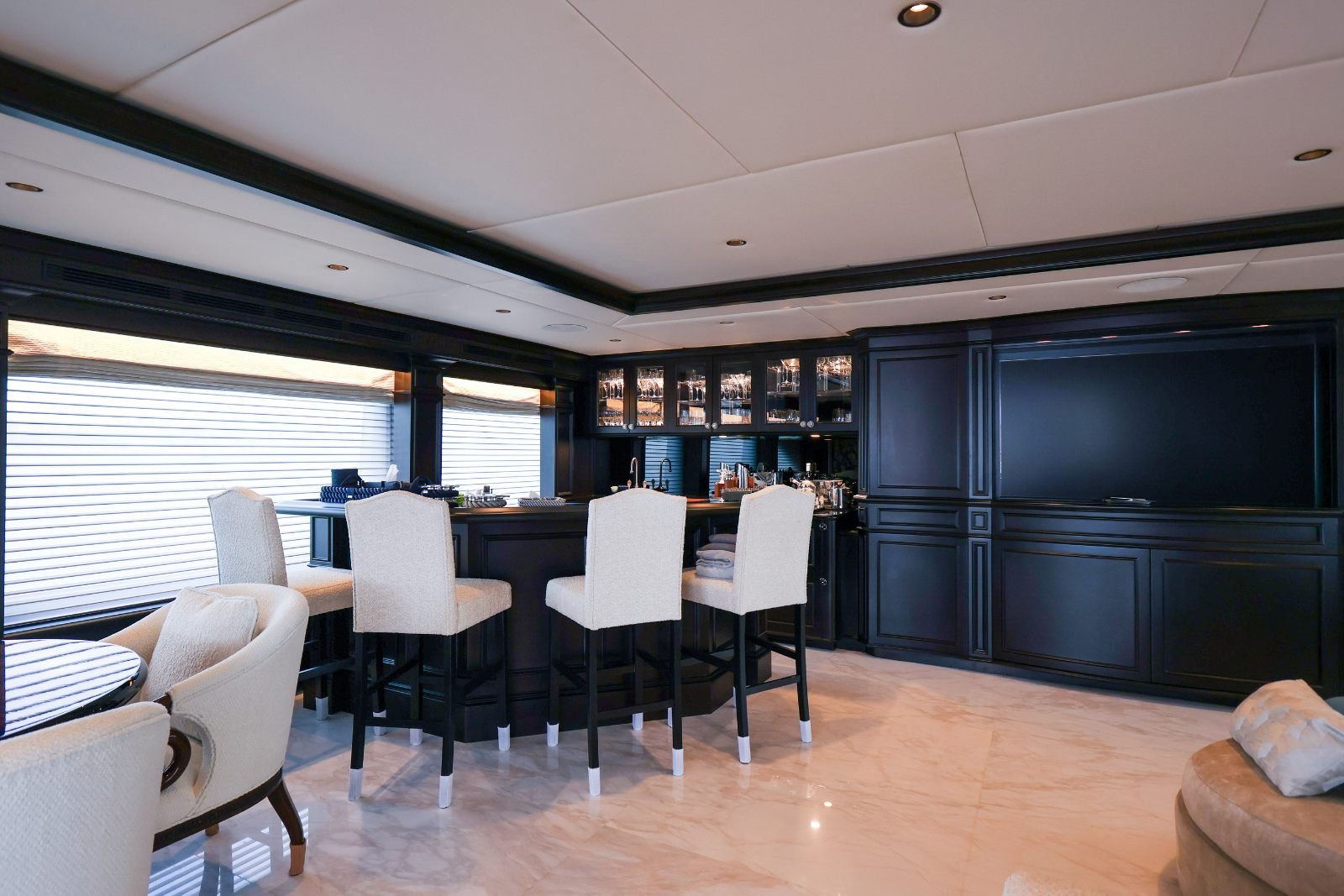
The whole interior goes together in the shed before a single panel goes aboard. It costs a week and saves a month.
A yacht interior is built twice. Once in the joinery shop, where everything is square, lit, accessible and at bench height. And once aboard, where nothing is square, the light is bad, half the space is occupied by somebody else's trade, and every adjustment costs three times what it would have cost in the shop.
The dry fit is the decision to do as much of the second build as possible during the first.
What a dry fit is
Before anything goes down the passerelle, the complete set of joinery for a space — bulkheads, linings, furniture, doors, drawer fronts, stone, the lot — is assembled in the shed on a jig that reproduces the vessel's actual geometry. Not the drawing's geometry. The vessel's, taken off her by measurement after she arrived.
Then it is looked at. Every joint is closed, every door is hung and swung, every drawer is run, every reveal is checked along its length, and the whole assembly is viewed under lighting that matches what will be installed. Anything that is wrong is wrong in a place where it can be fixed with a machine and an hour.
Every problem found in the shed costs an hour. The same problem found aboard costs a day and somebody else's schedule.
Why it is worth a week
- Cumulative error. Six cabins built to drawing and installed sequentially will accumulate tolerance. Six cabins assembled together reveal the accumulation before any of it is fixed in place.
- Access. Trimming a bulkhead in the shop is a bench operation. Trimming it aboard means protecting finished surfaces, extracting dust from an enclosed space, and stopping whoever else is working there.
- Sequence. A dry fit exposes install order — which panel has to go in before which service run, and which fitting cannot be reached once the lining is up. Getting that wrong aboard means taking something apart that was finished.
- Finish integrity. Components that are adjusted after finishing rarely look adjusted-and-refinished. They look adjusted. The dry fit puts every adjustment before the finish, not after it.
What it does to the schedule
The honest accounting is that a dry fit adds time in the shop and removes considerably more time aboard — and, more importantly, removes it from the part of the programme where time is most expensive. Aboard, the interior is competing for space and access with systems, electrical and finishing trades. A week lost there does not cost a week; it costs a week multiplied by however many trades are waiting.
There is a second effect that does not appear on a bar chart. Because the interior has already been seen assembled, the conversation with the owner about finish, reveal and hardware happens in the shed rather than aboard at week thirty. Decisions made then are cheap. The same decisions made later are variations.
What the owner sees
Joinery is judged from a metre away, in daylight, by somebody who has had a long time to think about what they wanted. That is a harder test than any specification, and it is not passed by working faster. It is passed by having already found, in a well-lit shed, the things that would otherwise have been discovered aboard with a deadline attached.
Written at the yard in Tuzla. Figures quoted are the ones we record on the job and hand over with the vessel.