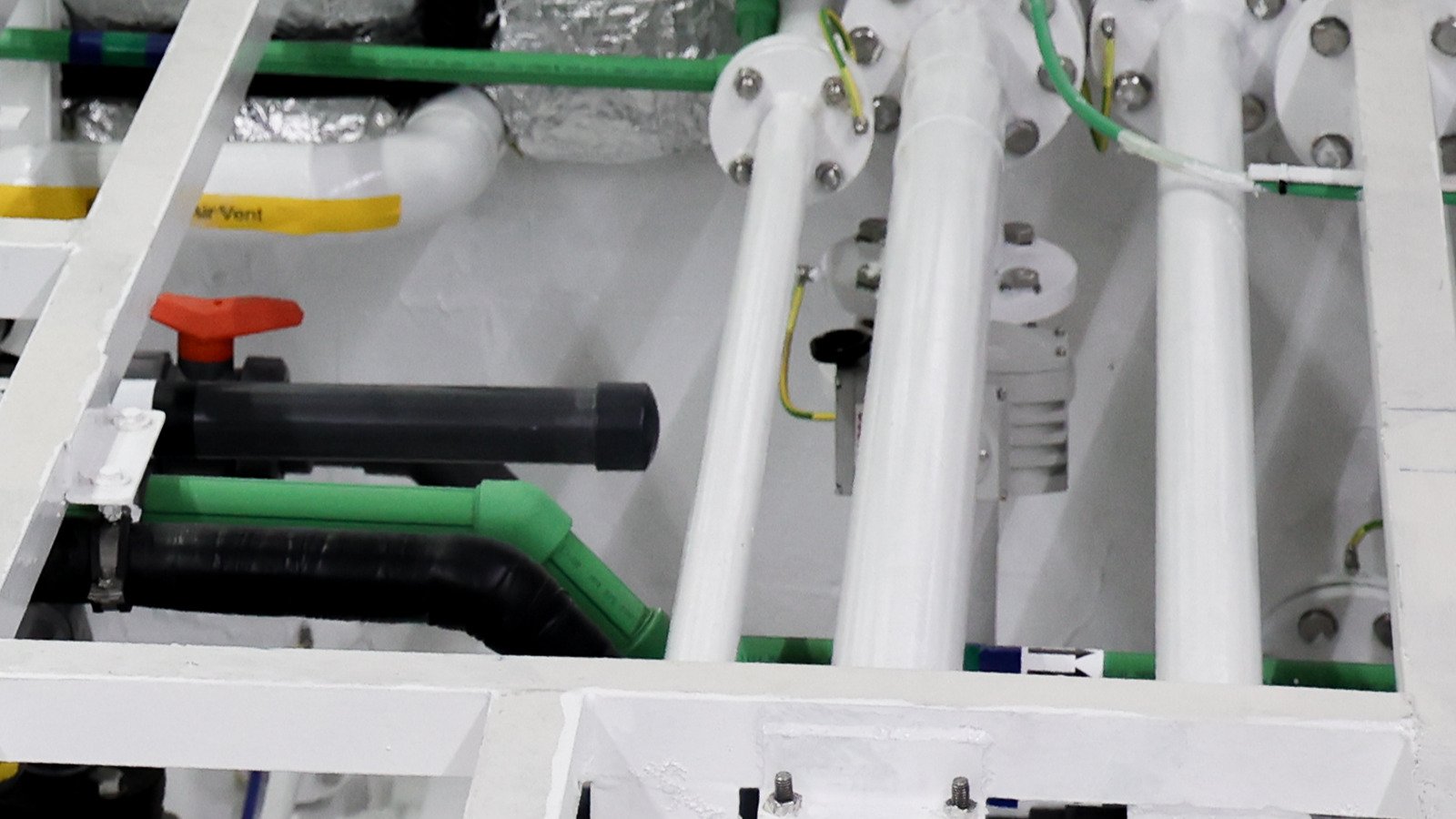
A metre and a half of 316 tube comes down through the hatch on two men's shoulders. A flange is bolted at one end, a swept elbow sits a third of the way along, a plastic blank is taped over the open end, and a number is written on masking tape below the flange: 14 of 23. It was cut, bent, welded, dressed back, pickled and pressure tested at a bench in Tuzla. Nothing further will be done to it aboard but bolt it up.
The drawing calls that a line. The pipe shop calls it item 14 of 23. Twenty-three items make twenty-two boundaries. The items were proved at a bench. The boundaries have not been made yet.
A line is drawn; an item is manufactured
A piping diagram gives a line a fluid, a bore, a material, two end points and a class: it is a topology, not a cutting list. Yacht pipe spool fabrication begins where the line stops. The run is broken into a numbered set of spools, and each spool acquires what a line never has — a cut length, the heat number of the tube, a weld map, the welder's stamp on each weld, a test pressure and a date.
The pipe shop is one of eleven in-house workshops on one payroll at Tuzla, so the fitter who templates, the welder who runs the root and the foreman who cuts the run up answer to one programme. Our welders hold RINA certification, and a certificate covers positions a fitter in a wing space cannot get into anyway.
What arrives aboard is not a pipe run but a pallet of finished objects and a countable number of joints still to make. Those joints carry the run's whole risk, because they are the only ones made in a place nobody would have chosen.
Where the run is cut is settled with a tape
Nothing on the diagram says a run is twenty-three items rather than nine. That is settled in an afternoon by a foreman with a tape, against the clear opening of the hatch, the swing at the bottom of the ladder, whether a three-metre spool will turn a corner, and how much of it two men can hold level while a third starts a bolt.
Longer spools mean fewer joints made aboard and a harder carry below. Shorter spools travel easily and leave more work in the worst place aboard. That trade is the substance of the job and appears nowhere in the specification. Templates come off the compartment as corrected rather than as drawn — the same discipline a curved pane needs before it can be ordered — and a spool found wrong-handed goes back to the bench on the short road it left by.
A bend has no joint; an elbow has two
A bend is tube persuaded round a former: no filler, no weld, nothing to prove but the wall. What it costs is a machine, a radius the tube will take without thinning the outside of the curve, and a straight tangent at each end for the dies to grip — which a compartment crossed by frames often cannot offer.
So an elbow is not laziness. It is what the space leaves room for, and each one is two more welds. Where both fall inside one spool they are bench welds. Where one falls at a spool boundary it becomes a joint made aboard, a different order of cost from the line beside it on the quote.
The bore goes the same way. The inside of a welded stainless spool is protected by a chemical film, not a coating, and what that film is for is settled at the stainless bench. The pickle happens on the trestle, because the film has to be grown on a surface a brush can still reach. A joint made aboard gets no such bath.
On fusion-welded polypropylene there is no demountable joint in the method at all. A socket fusion joint is as permanent as a weld, so the count on those runs is not of welds but of the flanges, unions and valves somebody drew in, and where nobody drew them in there are none.
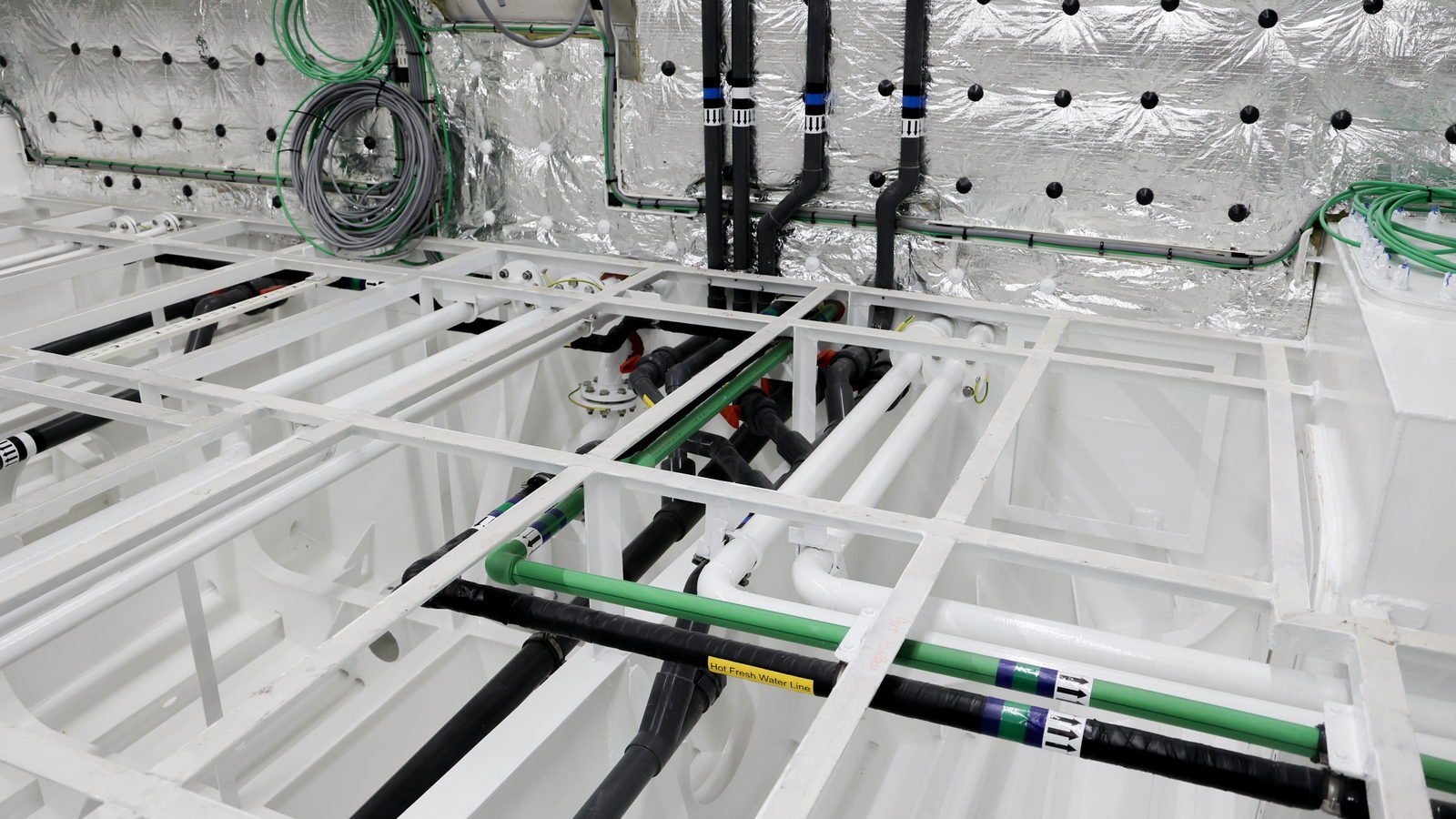
A shop weld is proved twice; an aboard weld once
A spool is proved on a trestle, against a gauge at eye level, with the joint turning in the fitter's hands; if it weeps it goes back to the bench. A joint made aboard is proved where it lies, in a compartment belonging to three other trades, or it is not proved at all.
That a test must be dated before insulation and joinery go back is argued elsewhere. What the count reports is how often each weld was proved. A shop weld is proved twice: once on the trestle, and again under the system pressure. A weld made overhead against a mirror is proved once, at the end, with insulation and joinery already waiting on the result. Twenty-three at two proofs and three at one is the shape of the run. The held pressure is common to all twenty-six; the labour and the access behind each are not, and a quote written off the line charges for both at one rate.
The closing spool is left long on purpose
The last piece into a compartment cannot be pre-made. By the time the rest is in, the geometry has moved: hangers have taken up, the compartment has settled, and the two faces the spool must meet are where they are rather than where the template said. Allowance for thermal growth is set at that moment, against the spring the supports will accept. So the closing spool goes down deliberately long, is marked in place, cut square and made up where it sits.
The count can be pushed down. It does not reach zero, and a yard that says it does has not been down the hatch with a tape.
What to ask a yard about a piping quote
Ask for the spool count and the aboard-joint count for each run, ask whereabouts each of those joints falls — on an open sole, or over a head in a wing space — ask which of them are flanged, breakable and remakeable and which are welded or fused shut, and where a run sits inside a maker's package or passes through classed structure, ask whose marks the break carries: the designer places it, the surveyor accepts it. That is a question about manufacture. Whether a run can be opened again in five years is a separate argument. A yard that can answer has broken the run down before quoting it. A yard that cannot has priced a line. Those answers belong in a specification three yards can price.
The class-stamped piping diagrams and a marked general arrangement decide the spool count before anything can be costed. Stage One ends with a written record of what we found, an approved scope and a price that does not move, and on piping that price rests on a count somebody made with a tape in the compartment.
Written at the yard in Tuzla. The spool and aboard-joint counts we quote on a run are the ones our pipe shop records on the job and hands over with the vessel.
Send the piping diagrams
Class-stamped piping diagrams and a general arrangement marked with hatch and route dimensions are enough for us to begin a spool count on your runs. Stage One ends with a written record of what we found, an approved scope and a price that does not move. Email info@revivarefit.com.
START A REFIT