A third of a turn
A fitter kneels in a machinery space, one hand on a grab rail, the other on a handwheel. The wheel goes a third of the way round and stops. Nothing is seized; it comes back freely and halts in the same place. What arrests it is the back of his own forearm against lagging on a pipe that was not there when the valve was fitted.
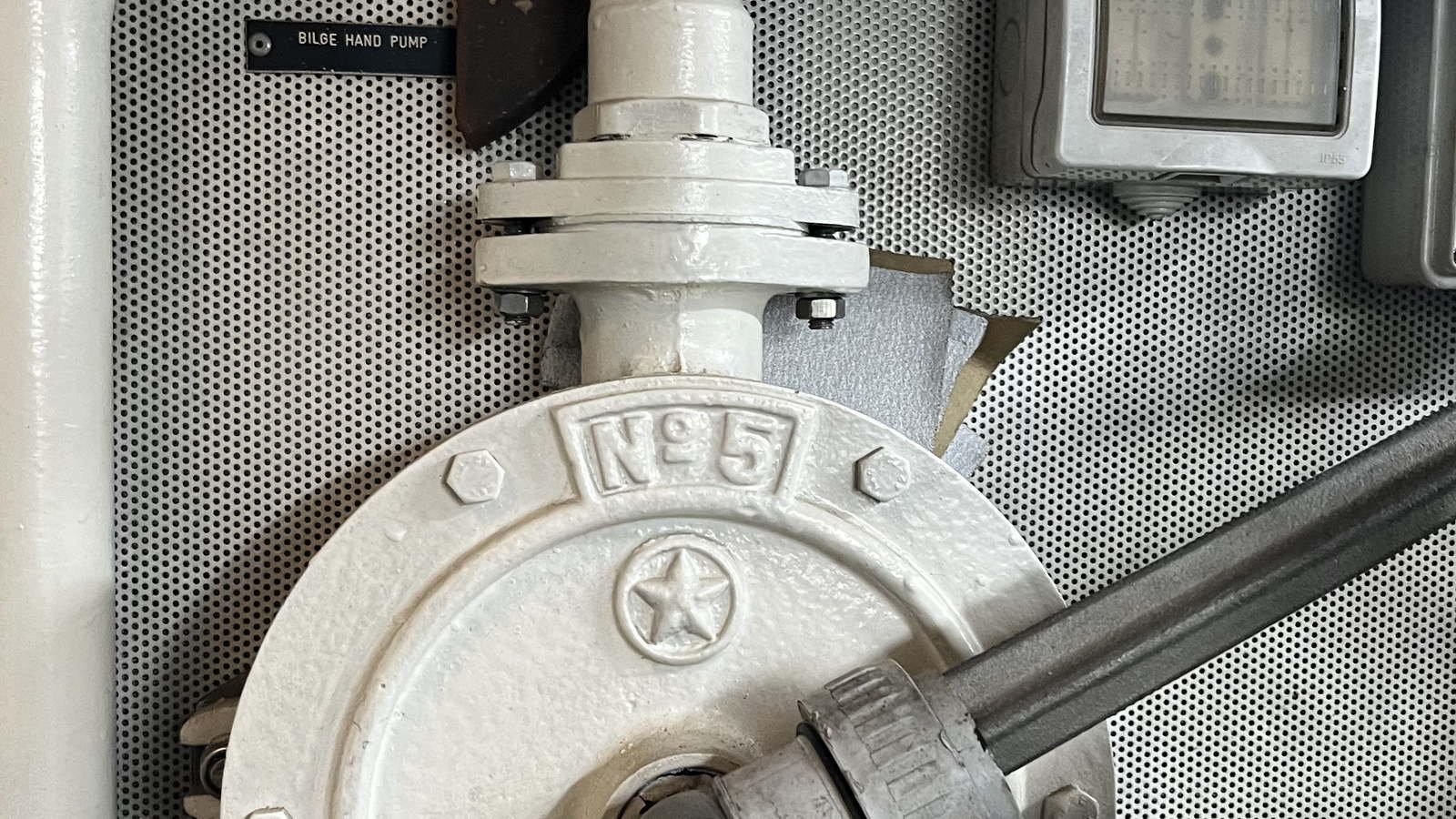
The post on a tender garage and davit refit said that the manual fallback belongs in the same drawing and is rarely on it, and that a hand pump which cannot be reached with the tender swung out is not a fallback. Conceded whole. The hand pump at the head of this page, cast body and steel lever, is that instance. Suctions and floats are bilge and fire systems. What is traced below is one valve, and the fault is not reach: the man got to it.
That such a fitting cannot be surveyed by looking at it is settled in handles, latches and hinges, which works each lever through its travel and back. That reads the mechanism; this reads the compartment it sits in.
A powered fitting is finished by its body and a hand-worked one is not
The general arrangement and the equipment schedule hold bodies: an outline, a bolt pattern, a connection. For a powered unit that is nearly the whole truth: it does whatever it does inside its own casing, which is why powered gear almost never fails this way.
A hand-worked fitting is specified by its body and used through a travel, and the travel is on nothing. That is what sets hand-operated gear in a yacht refit apart: the lever swinging out from a cast body, the bar shipped on a spindle. Each occupies a volume while it is worked that no sheet in the set carries.
What the check was asked
Interior movement joints already argued that a failure can live in a quantity on no drawing while every part passes. A gap between two solids can be drawn, because both solids are in the set. A motion cannot be drawn at all: it is not a thing the set contains.
A clash check is not wrong. It answers a narrower question than it appears to, and comes back clean on a complete and current set while the fitting it cleared is unusable. The check passed because it was asked about the valve, and the valve was never the thing that moved.
Converting a private yacht to charter prints the harder test: whether a closure can be operated from outside the space it protects, without a key, a ladder or a stored item in the way. There the arrangement is read against a code, so the test exists and a surveyor applies it, and asks whether the space can be left rather than whether the wheel turns. These fittings answer to no code and meet no surveyor. The inspection and test plan names that class: points with no institutional sponsor, which do not exist unless the owner authors them. No requirement for a hand-worked means is stated here: whether one must exist at all is in her file, read by a surveyor.
The volume includes the person turning it
The travel has two parts, both absent: the volume the handwheel passes through, and the volume the person swinging it occupies.
Deciding what to renew argues for routing a line for the hand that comes after it, and for clearance behind a unit for a hand and a tool. That is the static version: access to a fitting. Operation is different, because torque is only available in a posture. A handwheel at knee height behind a new run can be touched with two fingers and never turned. The body producing the effort wants a stance, a shoulder square to the rim, somewhere for the other hand, room for a second pull, heeled and in the dark. No figure for that is given here and none should be taken from it: what can be measured is this handle's travel in this compartment, in a stated condition.
What arrives in that volume
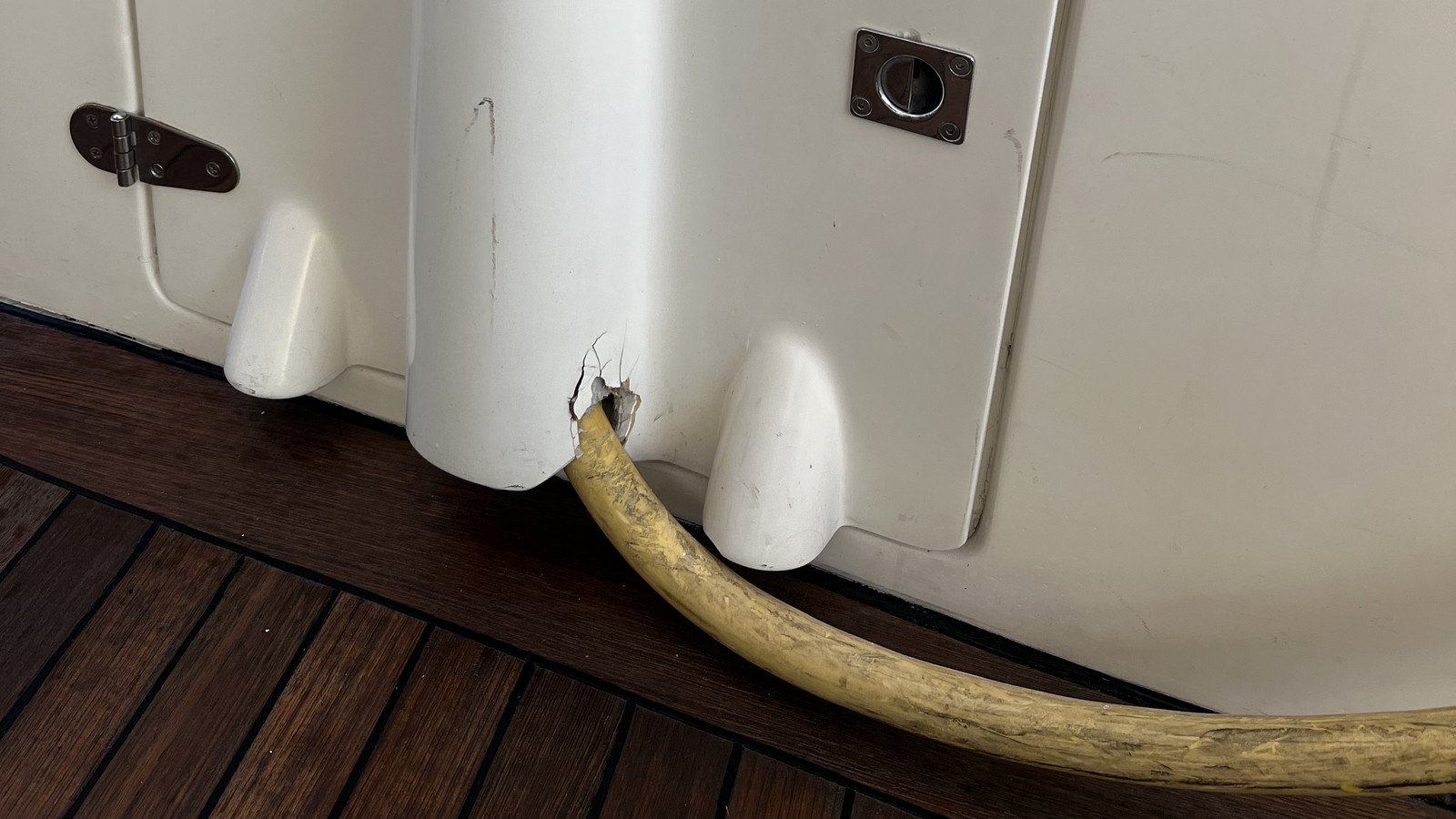
Nothing was done to the valve. The compartment closed around it, one correct arrival at a time, and the working volume was the first thing spent, because no sheet carried it.
- The lagging arrived on the pipe beside it, at its specified thickness.
- The lining came out and went back deeper, to a detail drawn with the valve's outline on it.
- A new chilled-water run took the short way, clear of the valve.
- A stowage was built against the frame where a man used to stand: the stored item the charter test asks about, arriving where no test asks.
Every one cleared the fitting's outline, the one figure on their sheets. A galley refit owns moving a unit through the boat; this is working one in place, losing the room without the fitting moving.
Every trade cleared it and the handle still stops
Every sheet in that compartment was correct and complete. The lagger holds a schedule of pipes and a thickness; the pipe fitter a route and a clearance to the body; the joiner a panel and a fixing. None was issued a solid to keep clear of, and a trade cannot clear what is not on its sheet. Nor is this a failure of anyone's drawing office: the volume is missing because a drawing set has never held it, and an outline is not a travel.
The yard's own instrument catches part of this: six cabins and one dry fit assembles the whole interior in the shed, and does expose which fitting cannot be reached once the lining is up. But a dry fit is walked and looked at, and the jig has no pipe run and no lagging on it, so it catches the panel landing on the service run and misses the arc. The same gap sits in our own sheets: the board that draws them is a short walk from the compartment, and that puts no travel on a sheet which never carried one.
Drawing the travel as a solid, before the joinery is cut
Sweep the handle through its full travel and put that swept volume on the general arrangement as a solid with a name. Then the second solid, the one the operator stands in, described in words with no figure attached.
A solid can be cleared. An outline with a motion implied around it cannot, and the sheet is the cheap place to find that out. Installation is what our twelve-month workmanship warranty covers, and a handle that cannot be swung is no defect in an installation, which is why the warranty passes over it.
Naval architecture and interior design sit in-house at Reviva, so the person drawing that solid can put a hand on the wheel first. Put it no higher than one more hold point in the inspection and test plan: the swept solid named on the general arrangement, and the operator's solid beside it, before the lining goes back.
Written at the yard in Tuzla. Nothing above states a requirement for manual or emergency gear: whether a hand-worked means has to be fitted at all, where, and what it must achieve belongs to her flag's requirements and to her class file, read by the attending surveyor and not by this journal. No clearance, travel, stroke or effort figure here is a standard; ratings and operating figures for any fitting belong to its maker's data sheet and to the supplier who furnished it. The lagging, lining and pipe runs described are a trace of how a volume closes, not a finding about any vessel. No scanning method, model or clash-detection tool is named here, and none is promised.
Photograph one handle at the end of its travel
Pick one hand-worked fitting aboard and photograph it from where a person actually stands to work it, with the lagging, linings and runs that are in there now in the same frame. Tell us who aboard has to work it. We will say whether that travel can be drawn as a solid on her general arrangement, and who has to be standing in the second solid when she is heeled. Write to info@revivarefit.com, or telephone the yard on +90 (850) 226 28 72.
START A REFIT