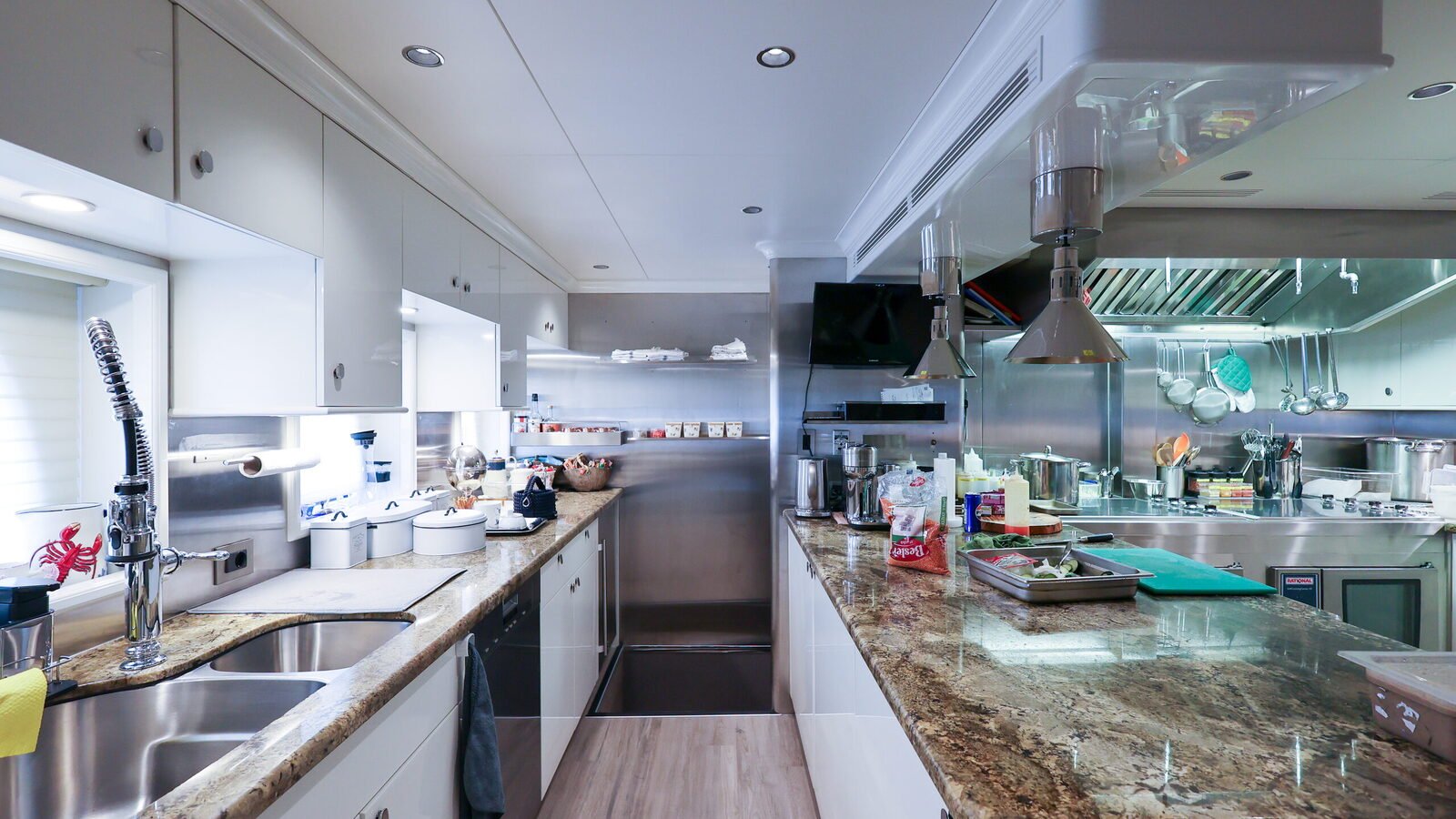
A range arrives at the yard in one piece. Nobody has measured the companionway it has to go in through — the old one left in pieces, cut up in place, because the original build dropped it in from above and the deck closed over it.
Or the cheaper failure. The compartment is finished, and the first time somebody washes the deck down the water gathers in one corner and stays there. The fall was never set. It belongs to nobody on the drawing: below the joinery, above the structure, between two trades.
Outside the bridge and the machinery space, a galley and a crew laundry are the only compartments where somebody works a shift. The rest of the accommodation is slept in, sat in or passed through. Five trades meet in each of these two, in a floor area that gives none of them room to work around another. Which gets settled first, the compartment or the equipment list, is what the joinery costs.
A galley is judged by whoever works a shift in it
Guest spaces are inspected by an owner and photographed. A galley is judged by whoever cooks in it, at speed, in a seaway; a crew laundry by whoever turns round the linen on a changeover day. Neither will write you a snag list about the veneer. They will tell you the door swings into the only clear run of worktop.
A refit is the only chance to move the compartment itself. Appliances can be swapped in any yard period. The bulkhead they stand against moves only while she is stripped.
The appliance schedule gets fixed before the compartment does
The equipment list is written early for a sound reason: appliances are bought items with lead times, and purchasing wants them on order. So the schedule gets settled — model, quantity, who supplies — while five questions that depend on it are still open.
Where the extract leaves from, and what gives the compartment its air back. Which way the deck falls, and to what. What the drain line will carry, and who can reach it. What the electrical load wants, and where it is fed from. And the route the old unit leaves by, which is how the new one comes in.
None of those is an appliance question, and all of them move the joinery. Settle them first and the equipment list drops into a compartment drawn to take it. Settle them second and the carcase gets built around an answer that arrives after it. Opening her up and measuring first is what makes the scope you approve the scope that gets built.
Extraction takes air out of the accommodation, and something has to put it back
A canopy over a range is the visible half. The invisible half is the duct — where it runs, what it passes through, and whether anybody can get inside it later to clean it. A galley extract does not carry air. It carries air with fat in it, and the fat settles along every change of direction. A run that cannot be opened cannot be cleaned.
Then the half that gets forgotten. Air pulled out has to be replaced, and if nothing is designed to replace it the compartment takes it from wherever it can: under the door, out of the air conditioning supply, out of the cabins beyond. The symptoms turn up a long way from the galley. A door heavy to open, a cabin that will not hold temperature, a canopy that stops catching what rises into it — a pressure problem rather than a filtration one, and not one a yacht air conditioning refit is likely to settle while the galley runs at a deficit.
What the duct is made of, how it is insulated and what has to close on it are not settled here. Those belong to the attending surveyor and to her flag, and want answering while there are still drawings.
Water has to be able to leave on its own
Both compartments get washed down. That is the design condition, not a hose test. The deck has to fall somewhere, and the fall has to exist under the appliances as well as in the clear floor, because the puddle that matters is the one nobody can reach.
Knowing where the appliances stand before the sole is built up is the same sequencing point again. It also means a coved junction between deck and bulkhead, carried behind and under the equipment rather than stopping at the stainless plinth. A square internal corner in a compartment that is washed down is a reservoir with a bead of sealant holding it back.
The drain is its own line. A galley waste carries fat, which cools and sets; a laundry waste carries lint, which mats. Both narrow a line sized on volume alone. Ask where the trap sits, whether somebody can reach it with a tool in service, and what the gradient of the run is inside the structure.
Five trades, and the junctions between them belong to nobody
Count what has to be in the compartment at once.
- Joinery, for the carcases, the linings and the panel that comes off again.
- Metal, for the stainless worktops, splashbacks, the plinth and the canopy.
- Piping, for supply, waste and the vent.
- Electrical, for the appliance circuits, the extract fan and the lighting.
- AC, for the supply and return the extract has just unbalanced.
Those five are among the trades on this yard, each in its own shop. A galley is not one of them; there is no galley trade. What exists is a compartment where five trades meet, and they fail at the junctions: a penetration through a lining closed up before the pipe arrived, a canopy fixed to a carcase never designed to carry it, a worktop landing on a carcase built to a different datum. Where stainless meets timber there is a movement question as well, and that one is settled in the detail rather than in the sequence.
A worktop that gets wiped down several times a day wants to be welded, the weld dressed back and the heat tint taken off, and then passivated, or it will mark and pit exactly where it is wiped most. That is decided at the bench.
The route the old one leaves by is a line in the specification
Nothing leaves a working compartment by itself, and the route runs through finished accommodation.
That route is a scope line: it decides which panels are demountable, which door frames come out, and whether a unit gets cut up in place. Cutting up a dead unit is cheap. Cutting a joinery run to let a live one past is not.
And it runs both ways. The access designed to get the old one out is the access that gets the next one in, with her in commission and no yard around her.
Where Reviva comes into it, and what to send with the specification
Reviva refits, rebuilds and restores in Tuzla, with the workshops and stores a few metres from the berth. That matters in a compartment this size: the joiner, the metal fabricator, the pipefitter, the electrician and the AC fitter can stand in it together over one general arrangement. A second cut is almost always the price of an answer that arrived late.
The appliance schedule is worth sending with the specification, so the compartment can be drawn around the equipment. Beyond that it is the same discipline as a yacht interior refit: what the panels weigh, how they are fixed, what has to come off again.
Written at the yard in Tuzla. No requirement, interval, clearance or dimension is given here as settled: duct construction, insulation and closures belong to the attending surveyor and to her flag, and every rating, capacity and service figure belongs to the maker's data sheet for the unit actually specified.
Send the appliance schedule with the specification
Send the specification, the general arrangement and the appliance schedule together, and the galley and the crew laundry can be looked at as compartments rather than as equipment lists: where the extract leaves and what feeds the air back, which way the deck falls, what the drain run has to carry, and the route each unit travels in and out. Write to info@revivarefit.com.
START A REFIT