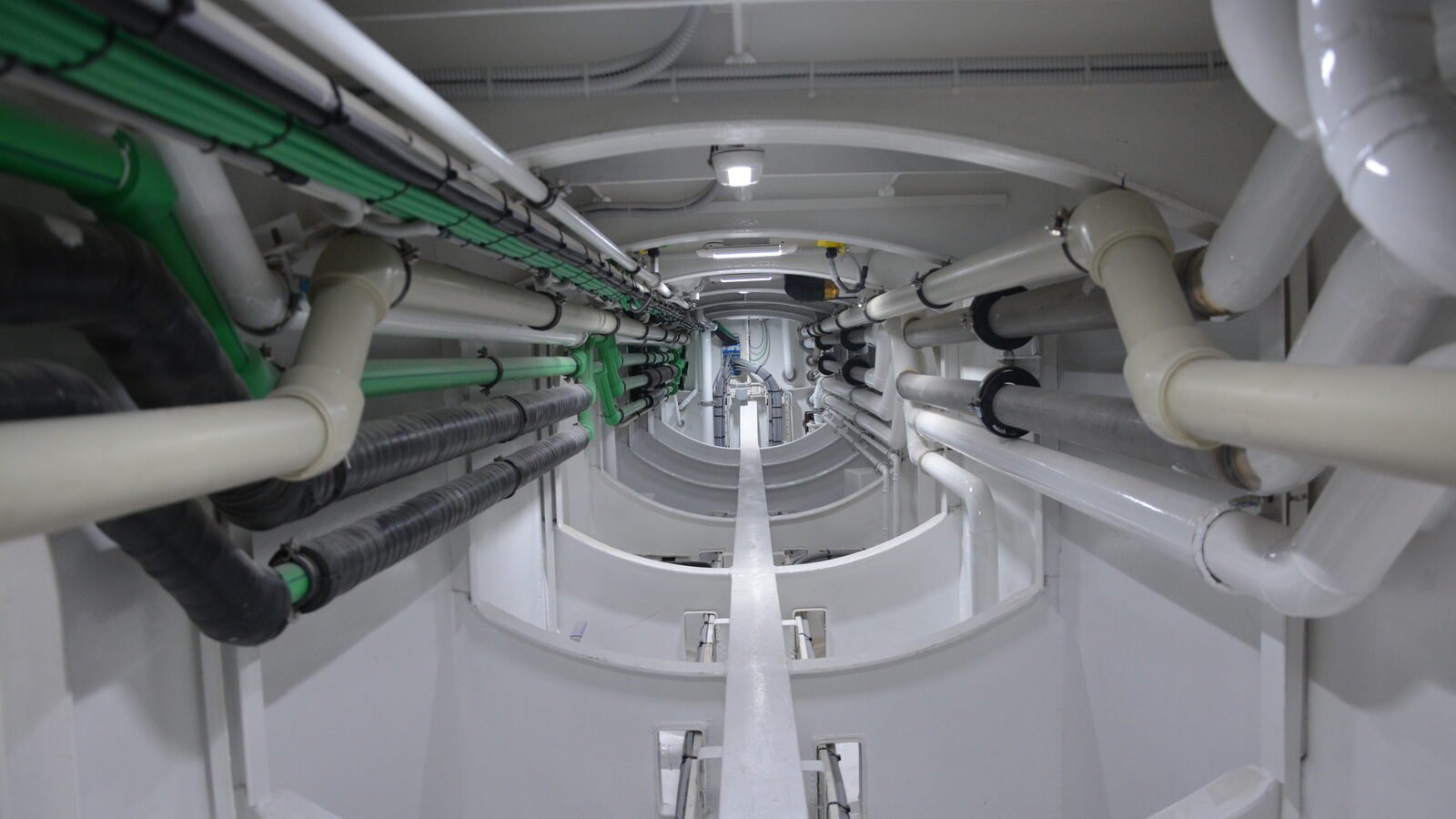
The thermostat in the owner's cabin is at its lowest setting and the display reads what it was asked for. The pillowcase is still damp, and there is a bloom on the ensuite mirror. Nothing has failed, and the complaint is real.
Air conditioning is rarely written into the specification until the interior is already apart, and by then it reads as a plant replacement with a capacity figure. The faults owners complain about are not in that figure but in the trays, the ducts and the return paths — reachable for weeks and not afterwards.
Two faults wearing the same complaint
One sentence covers two failures. A cooling fault is a shortage of total capacity: the cabin never reaches setpoint, the plant never stops, and the symptom arrives with the heat.
A dehumidification fault is a shortage of latent capacity: the cabin reaches setpoint and the air in it is still wet. It arrives with the humidity rather than the heat — a muggy overcast morning, not the hottest day.
The two take opposite remedies: more plant improves the first and worsens the second. A yacht lying cold and unpowered is a third case with its own machine, in what four months laid up do to her.
Why a yacht air conditioning refit can leave a cabin damper
A cabin that has never been cold is usually a changed heat load rather than a failed plant, argued in sizing the plant for the yacht she has become. The error comes afterwards: buying the number. A load is computed near the worst condition she will see, and she sits well below it most of the season.
A unit sized for that day satisfies the thermostat and stops. A coil removes moisture only when its surface sits below the dew point of the air crossing it, and for long enough that condensate forms and runs off. A short run cools the air and leaves the coil barely wet.
- Airflow across the coil. More air raises coil surface temperature and moves the machine towards sensible-only. Less air runs it colder and wetter, but capacity falls and the coil moves towards freezing. The band is narrow, and set at commissioning.
- Fan run-on. A fan turning after the compressor stops draws cabin air over a wet coil and re-evaporates much of what it just took out, many times a day on a short-cycling plant.
A plant matched to the range she occupies holds a wet coil and dries the yacht. A single larger stage does not.
Chilled water or direct expansion, costed as a refit
The choice between them is argued elsewhere; what each costs inside a refit is not.
- Who may open the circuit. Refrigerant handling is certificated work, and direct expansion has as many circuits as units. Chilled water keeps refrigerant in the plant room and sends water through the accommodation.
- Where a leak shows. Refrigerant leaks behind joinery as a unit quietly losing capacity, invisible until somebody weighs the charge. Water leaks as a stain — damage, and evidence.
- Length, lift and growth. Refrigerant runs carry oil-return limits on rise and total length, so on a tall yacht the route can be ruled out. Chilled water answers to pump head, and a cabin added later takes a fan coil off the nearest lines rather than another condensing unit, seawater branch and charge.
Where the condensate actually goes
Every fan coil makes water whenever its coil is running wet, which on a hot humid day is most of the time, and the drain is drawn before the joinery is built and routed after it.
A tray needs continuous fall to its discharge — or a condensate pump where the discharge sits above it, with access to the pump and its float — and fall that still runs at heel and at a loaded trim, not only alongside. A raised sole or a moved bulkhead takes any of that out without anybody revisiting the drain. A trap allowed to dry out becomes a vent, and trays sharing an untrapped manifold let one unit draw air through its neighbour's tray.
Chilled water pipework brings its own water. A missed flange or a bare section at a hanger sweats, and the drip runs along the pipe before it falls, arriving away from its source. A thermal camera goes aboard at survey for exactly this.
The ductwork and the plenum nobody has opened
Flexible duct crushed in a batten run has lost area no plant will give back, and a lined trunk with a porous facing has been a filter nobody changed. Soiling on the coil face and the lining adds resistance, and that airflow comes off the band above.
The honest measurement is at the grille, not the air handler: a machine on its curve above a starved cabin is an ordinary finding. Which argues for specifying access to trays and handlers while the compartment is open, as in what deserves the open compartment.
The return path carries more than air
A supply branch serving two cabins and a return through a shared ceiling void make them one room above the deckhead: speech crosses a trunk nobody drew as an acoustic element. This is the airborne path only; what arrives through seatings, clamps and battens is separate work, argued in noise aboard as work on the path, not the source. The duct-borne half is answered in the duct: a lined bend, an attenuator, a longer path between grilles.
What the new interior did to the air, not the load
A cabin can take its design airflow and still be uncomfortable: the supply short-circuits across the deckhead to a return half a metre away, and the bunk sits in still air. Replace a louvred door with a solid one and the return loses the transfer path it was sized around, so the cabin runs positive, spills its supply past the door seal instead of returning it, and then takes less air as the branch fights its own back pressure. None of that changes a figure on the schedule, which is the case for writing the air path into the specification rather than a capacity, as in a document three yards can price.
What the yard answers for, and what it does not
Air conditioning here is one of eleven workshops on one payroll, listed as AC Repairs under climate and ventilation. Piping hangs the chilled water lines and condensate drains so the next engineer can reach them, electrical returns the fan coil circuits labelled at both ends, and joinery closes over them. Systems work sits ahead of insulation and joinery in the published order, because joinery is the trade that closes the access the trays and handlers need.
The week here is photographed and written down, and owners and captains get the same file the yard does — which is the file a tray, its fall, its trap and the duct run behind a panel belong in, before the panel goes back. Air temperature, relative humidity and airflow are worth reading and logging at commissioning, but dry-bulb and airflow alone will pass a coil that never runs wet; the wet-bulb across the coil and the condensate leaving the tray have to be read with them. Commissioning is the input to the trial rather than part of it, and the trial proves the yacht rather than the list.
Written at the yard in Tuzla. Coil selection, refrigerant charge and rated capacity belong to the maker, and any contractual temperature, humidity or airflow figure to the specialist who wrote it and the surveyor witnessing it.
Send the air side, not only the plant
Before the air conditioning can be priced we need the HVAC schematic and the air distribution drawing as issued, the plant make, model and nominal capacity, and a note of which cabins the crew have stopped trusting and in what weather — warm and dry, or warm and wet. Add the general arrangement marked with anything the interior has changed since she was built, and say whether distribution is chilled water or direct expansion. Write to info@revivarefit.com.
SEND THE HVAC DRAWINGS