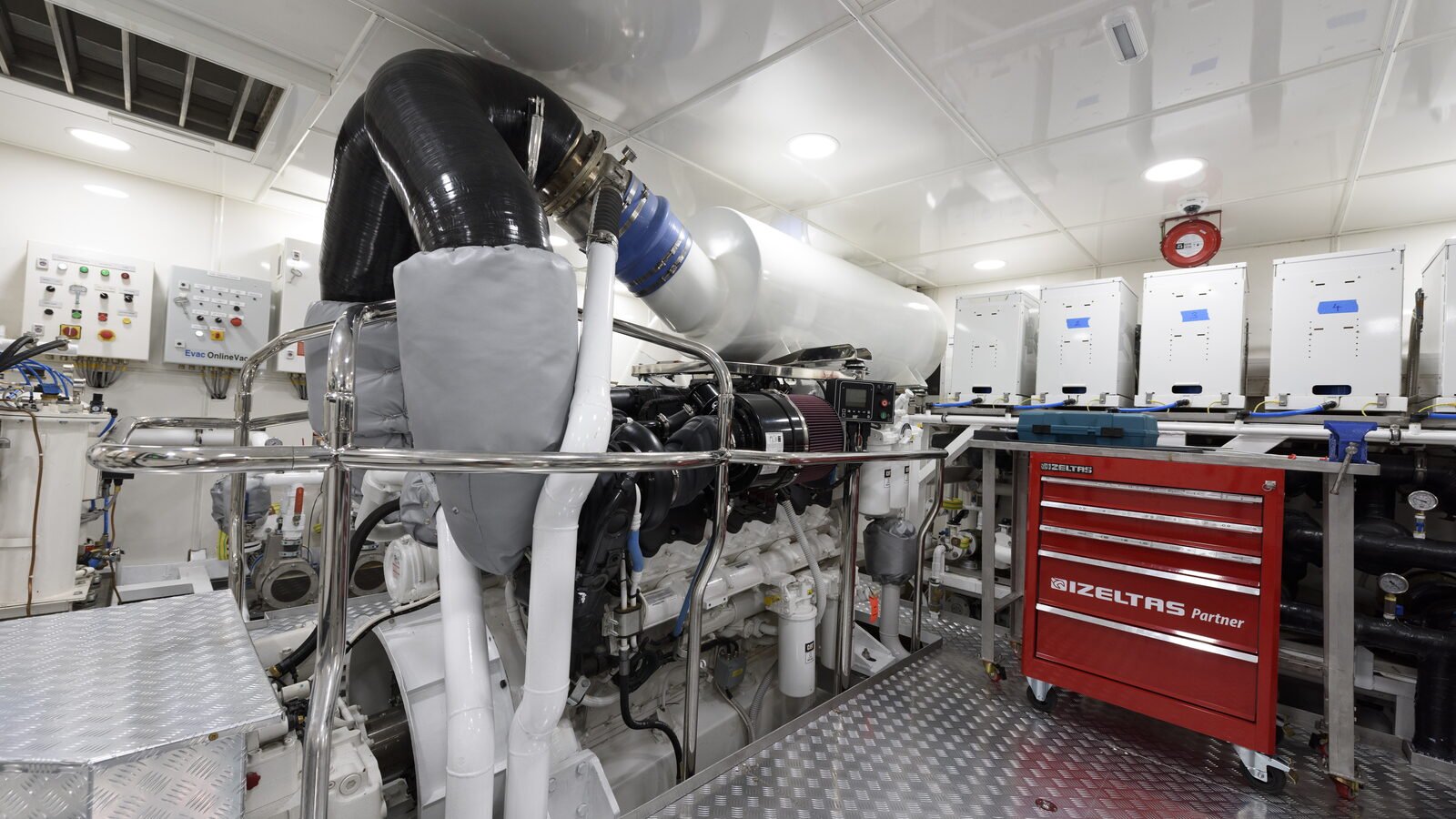
The stand is bolted down beside the gearbox and the tooling laid out. The coupling faces are still together, because the conditions that keep this machine's warranty alive say who may open it, and that person is not on the payroll.
The machine the yard can lift and reinstate but cannot sign for
Eleven trades sit on one payroll here, under one roof and one programme, and the work of getting a machine out and back is spread across several of them: the mechanical shop lifts it, piping makes up its lines, metal works the brackets, electrical returns its circuits. Every one of those is inside the fence. Opening the machine itself past the level the maker's conditions permit is not. A seal is broken once, and a signature afterwards does not put it back.
Two things hang on the attendance. One is a manufacturer's warranty, whose conditions frequently require a stated operation to be witnessed by somebody the maker has authorised. The other is the acceptance of the installation. Type approval belongs to the equipment and stays with the maker whatever happens aboard; what a surveyor accepts is the installed unit, and acceptance can turn on the machine having been set to work in a stated way, by a stated person.
The cover was never a statement about the work, but about who did it.
Who actually holds the authorisation for that brand in Turkey
Owners already understand one outside attendance, because they book it: the class surveyor. That one is rule-based, argued through a certificate the society can endorse or withhold, as what class asks of the yard in a refit sets out. It has a lever behind it; the diary is still the society's, and no yard can reach into it.
The maker's engineer inverts it. A certificate can require the firm but it cannot produce the person. Class and flag do oblige certain work to be done by an approved service supplier, and for proprietary machinery that supplier is often the maker's own agent, with the endorsement withheld until its report arrives. What no rule reaches is the diary.
Underneath the rule sits a commercial permission held inside a private agent network. Turkey has good engineers; what it may not have is the firm holding that brand's authorisation, with a person cleared for this model and this generation of control software. An agent for sales and spares is not thereby authorised for the intervention the warranty turns on, and a scope turning on one proprietary specialist is decided by that specialist's location rather than by the country's — the argument in planning the passage and the yard period.
What the manufacturer's service engineer carries that nobody on the payroll has
They arrive with tooling, the ordinary half. The larger half is software: a service-level laptop, a licence that expires, a firmware image, and a right to write parameters the vessel's own crew cannot. The difference between a competent fitter and an authorised engineer is often no more than write access.
A calibration is only a calibration against something traceable, which is why a yard controls the instruments it checks work with. What no yard's store holds is the maker's model-specific master or test jig, and that travels in their case. So does the current revision of a setting-up procedure, frequently not the revision in the manual aboard.
Which is why the attendance cannot simply be halved. Where a maker does allow a half, it is supervision by video link with its own report still issued — worth asking for in writing. What no authorisation covers is figures sent by email and the yard setting the machine up on them.
Which jobs in a yacht refit genuinely need the attendance
Three questions separate them, and the maker answers all three in writing.
- Does the warranty, or the condition on which the installation is accepted, name attendance in words for this operation?
- Is there a parameter, a calibration or a software step the yard cannot technically or lawfully perform?
- Does the output have to be a document issued by the maker rather than by the yard?
Where all three answers are no, the work belongs with the trades. Where one is yes, the attendance is a scope line with a date, an owner and a cost against it.
Who books the attendance, and who owns the date when it slips
The Tuzla shipyard supply chain asks who holds the order, because whoever places it owns the date, and notes that warranty-bound control systems arrive sealed with a commissioning engineer attached. A late part sits in a store. A late diary is somebody else's week.
Settle before she is hauled which of three bookings this is: the yard, inside the scope; the owner's management company, with the yard working around a date it cannot move; or the maker's regional office, against a service contract predating the refit. The last is most often forgotten, because nobody in the refit team is party to it.
Then put it on the programme twice: as the attendance, and as a dated readiness milestone in front of it. Releasing the travel is what that milestone is for, and it is the one that slips. Check both against the non-working days, which the Turkish shipyard holiday calendar that moves takes apart.
Check the address too, because a machine can be opened at one and witnessed at another: the head yard on Tersaneler Caddesi in Tuzla, the dry dock at Pendik, hull and steel at Yalova.
An attendance left unbooked becomes a snag. The attendance itself is not one, and should not be forced in front of the trial: a gearbox at full load, a stabiliser, a radar in open water and an autopilot in a seaway are proved afloat and nowhere else, in the sequence set out in proving the snag list is closed.
What the attendance record has to say afterwards
The attendance is spent the moment they leave the gate, and what survives is paper. Manufacturer warranties on equipment are administered at this yard and not underwritten by it, and administering a claim means producing evidence that the maker's own conditions were met.
Impose the standard already applied to survey work: every reading carries a location, a date and the name of whoever took it. Ask the maker's service report to meet it: machine and serial number, operation performed, parameters as found and as left, readings with units, and the name and authorisation reference of the attending engineer. File it in the work record, indexed by compartment and date.
That record also fixes which date a manufacturer's clock runs from, and those clocks do not reliably start at redelivery, as servicing a warranty claim abroad sets out. They fly home as well, and whatever they did not pass on goes with them, which is why living aboard during a refit in Tuzla puts the crew at setting-to-work.
The eleven trades here can have a machine lifted, re-piped and reinstated without a part leaving the fence. What none of them can do is issue another company's authorisation. That line is bought from somebody else, early or not at all.
Written at the yard in Tuzla. The authorisation, the attendance date and any travel or work permission belong to the equipment maker, its agent and the owner's own advisers, and no particular engineer, firm or date is ours to promise.
Send the attendance list before a dock window is booked
Before a dock window is booked, send the list of machinery whose warranty, or whose acceptance as an installation, depends on an authorised attendance, and against each line: the firm holding that brand's authorisation in Turkey, the words that make attendance a condition, and who is placing the booking. Say which attendances already sit under an existing service contract, because those are the ones nobody in the refit team is party to. Write to info@revivarefit.com.
SEND THE ATTENDANCE LIST