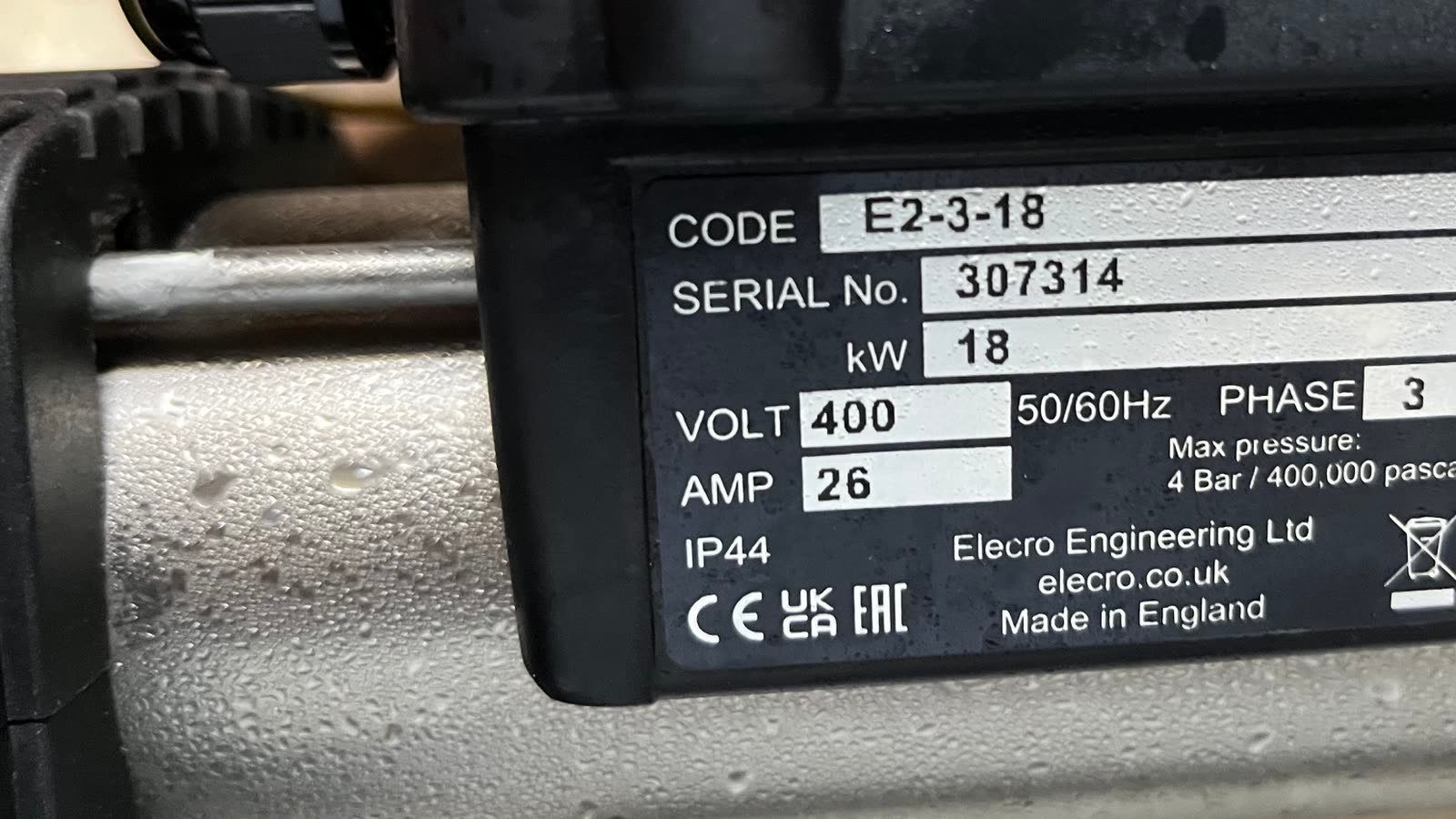
A panel is off in a technical space below deck and a torch is on a rating plate the size of a playing card. It is the entire documentation of the unit behind it: no schematic in her file, nobody who remembers fitting it. The code and serial number go onto a sheet, and become a line in the equipment schedule.
The plate records what the unit was supplied to withstand, not what the system was asking of it, and the second is the figure the replacement has to meet. Nothing further gets asked, because the plate is all there is to copy.
What yacht refitting inherits: a plate is a limit, not a duty
Yacht refitting inherits plant with its own paperwork, and here it is one plate: a code, a serial number, electrical and pressure limits. The discipline of copying those fields rather than reconstructing them is settled already, along with the case of a ram asked for more than it was rated to give. Every field is a boundary. None is a duty.
That ram had a relief setting in its own circuit, so its plate had a counterpart to be read against. An electric in-line heater has nothing of the kind. Its breaker is a protection limit rather than a statement of demand, and nothing aboard records what the system asked of it. The duty has to be measured.
Leisure plant is where this bites hardest: a spa pool heater, a towel rail circuit, a deck shower pump are the fittings most often put in without a schematic.
Yacht refit scope: the circuit around the box, priced as one line
The air side of a plant replacement can at least be argued from an HVAC schematic as issued. Here there is none, and no drawing of what a previous yard may have altered, so the yacht refit scope has to be walked with a torch.
The objects are the pressure tube and a clamp at each end, the cable, the breaker and its rating, the bonding, the thermal cut-out and the isolator. Each is nameable, which is why it can be quoted, and why an equivalent unit stops being a swap and starts moving things around it.
The line priced as one item is then in front of the pipe fitter, the electrician and whoever closes over them, and none of them was asked.
Three standards hiding inside one yacht equipment replacement line
Like-for-like carries three standards at three prices: the same maker's same model number, cheapest to write and often hardest to obtain; another maker's unit with the same stated limits; or a unit that delivers the duty the old one did, which is what anybody was asking for.
The general case is settled in the document three yards have to price. What it does not reach is what happens when the first standard stops existing: a model number can be discontinued or the maker gone, leaving the plate the only instrument for proving equivalence. It shows the limits matched, never that the duty did.
As-found duty is the only one of the three that survives the model number ceasing to exist, which is why it has to be recorded while the unit is still there to measure.
As-found condition: the settings rarely asked for
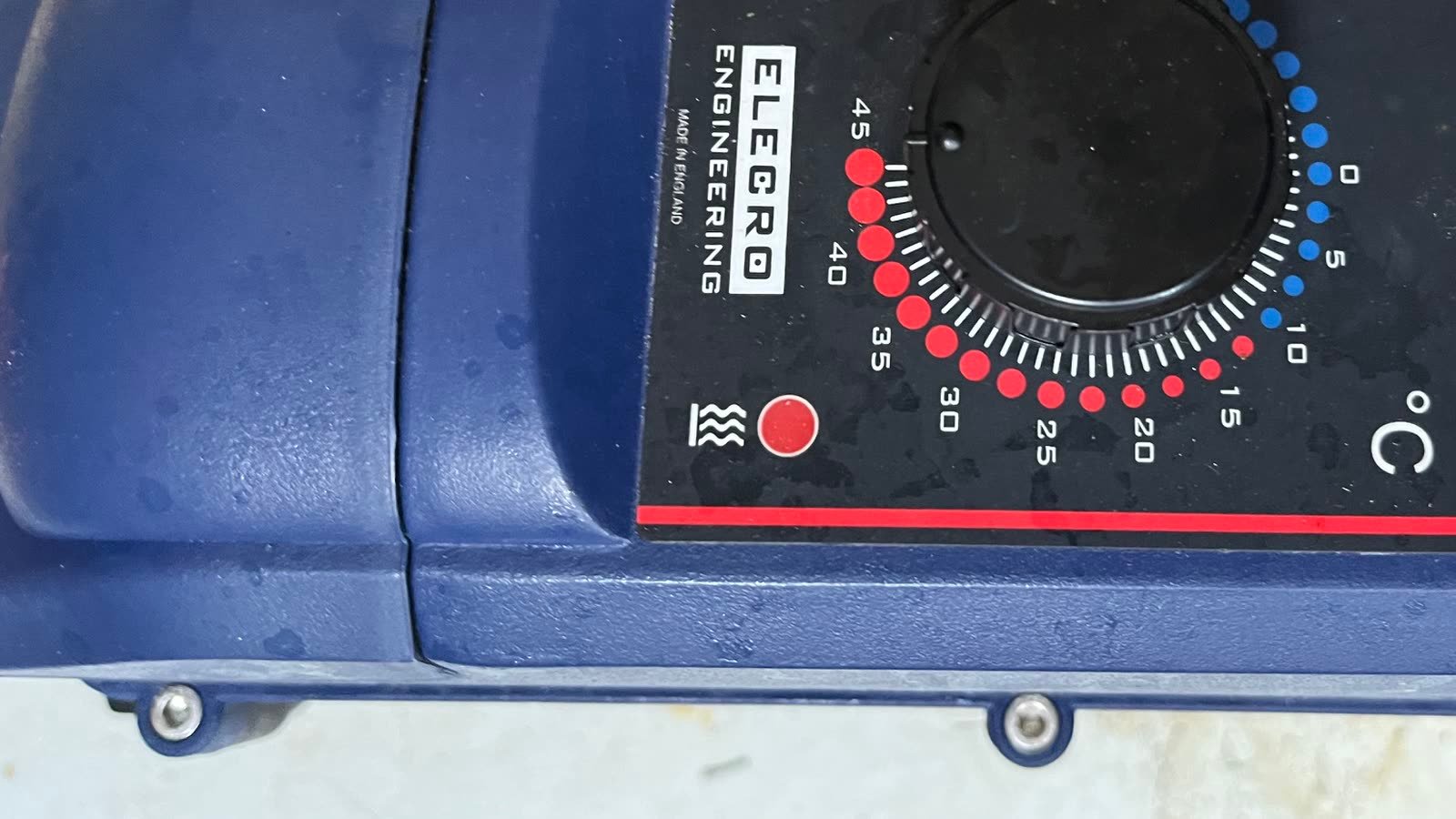
The control face is a knob on a graduated scale in degrees Celsius: OFF, a blue end, a red end. Nothing on the face offers a log, a stored setpoint or a fault history. The knob is the archive, and where a hand left it is a reading.
A condition report is not normally asked to carry that. It photographs what is broken, corroded or missing, dates it, and establishes what she arrived with. It is rarely asked for the position of a dial or which cut-out had been tripping. Those are as-found condition too.
Hidden steel at least earns a provision against what the survey could not reach. This unit is not hidden: it sits in an open compartment, free to read, and usually goes unrecorded, because nobody has been asked for it.
The readings a refit survey can only take while the yacht systems still run
A yacht systems refit is only readable while the systems are running, and a refit survey taken while she is still energised collects readings no later work recovers. That sits against the preparation a condition survey needs: tanks drained, soles up, breakers off, a permit before a man enters a space. Isolation puts them out of reach.
So the duty visit is not part of the survey and cannot be added to it. It happens before the isolation programme starts, and is the one task that gets cheaper by being done early.
- The current it draws at switch-on against the current it settles to, because the two answer different questions and the designer who sizes the protection needs both.
- Inlet and outlet temperature across it while working, taken together with the flow below, because the rise on its own is not the duty and neither figure alone is.
- Flow through the tube, measured or bracketed, since the rise is only half the figure, with how long it ran per cycle and how often.
- Which interlock stopped it, and whether the crew ever got what they asked of it, in their own words and in what weather they stopped asking.
That is a visit and a sheet of paper, the cheapest line in a yacht equipment replacement and the only one that expires.
The yacht systems refit failures that wait for the first full season
Commissioning happens on a cold vessel with the system barely loaded. The unit energises, the lamps light, the interlocks prove. Everything passes, because the sheet asks whether the unit works, not whether it is enough.
The trial does not catch it either, and not because it is weak. It loads propulsion, steering, stabilisers, noise and the main systems, because each has an acceptance criterion written against it. A deck spa pool heater has no line on any trial programme, and goes through dock trial and sea trial without being asked for its duty.
The pool then reaches temperature overnight alongside and never reaches it on a passage. The omission was made in week one. It arrives as a fault a season later.
Where the duty record belongs in the superyacht refit process
In the superyacht refit process the duty record belongs before isolation and strip-down, which means the days when she is still reachable. After that the unit is in a crate and the only evidence left is the plate.
Two photographs go in the weekly file ahead of anything written: the plate in place rather than transcribed, because a photograph cannot be mistyped, and the dial before anybody touches it. Whether the unit earns the open compartment is a separate sort, made by a clock rather than by wear, and not made on a unit nobody has measured.
What the yard answers for, and what belongs to the maker's plate
Electrical reads the current at switch-on and at settle; piping brackets the flow and the temperature each side of the unit while it works. Both go on one weekly sheet, and the scope line prices the tube, the clamps, the cable and the cut-out, not the box. It is quotable because both men are on one payroll, under one foreman, across eleven in-house workshops.
The sizing figure is not ours to give. A duty calculation belongs to the specialist who writes and signs it, and any contractual figure to that specialist and the witnessing surveyor. A twelve-month workmanship warranty answers for how a unit was installed, not for what it was asked to do.
Written at the yard in Tuzla, with the panel still off. Whether a plate's markings still stand after a unit is replaced or re-marked is not ours to say; that belongs to the attending surveyor and to her flag, and it is cheaper to ask before the order goes in than after the unit is clamped up.
The readings we need before the order goes in
Before a yacht equipment replacement can be priced properly we need the rating plate photographed in place rather than transcribed, a note of which spaces or systems the unit serves, and the crew's own account of where they habitually set it and whether they ever got what they asked for. Add the breaker that feeds it and the rating written on it, and say whether she is still energised, because that last answer decides how much of this can still be read. Write to info@revivarefit.com.
SEND THE PLATE