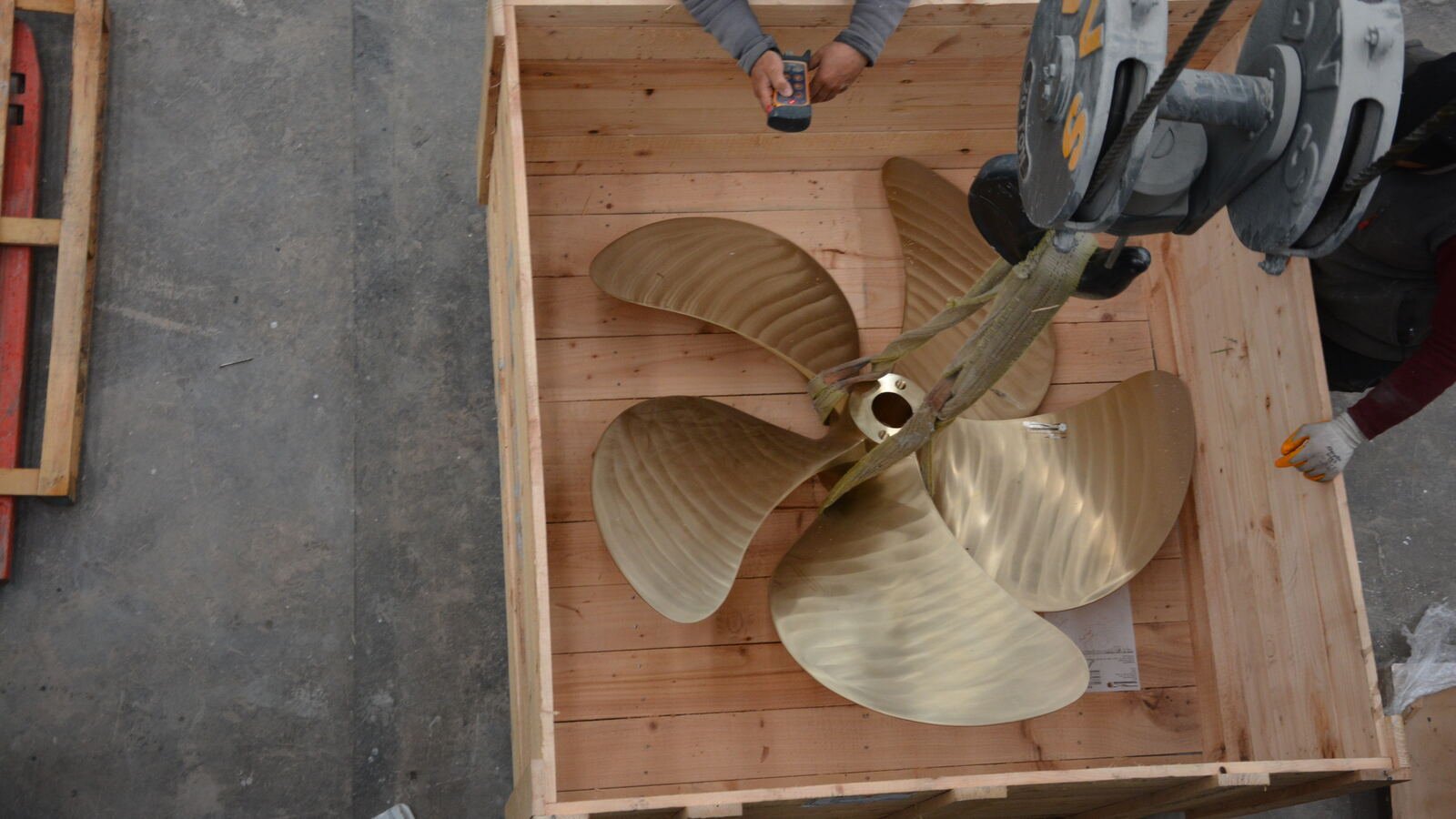
She comes off the blocks on a Friday morning. The final account was signed on the Thursday, the fenders are back over the rail, and somebody is coiling the shore lead. In the ship's file there is a certificate of insurance that has not been touched since the previous spring.
It names a figure, and a date. That figure was agreed against a yacht that no longer exists in that form — a different suit of spars, a bridge rebuilt, a tender she did not carry. Nobody aboard on Friday is thinking about it, and nothing in the yard's paperwork reaches an underwriter by itself.
The variation register is a yard document; it goes to the owner and stops there unless it is sent on. A refit moves what it would cost to put her back. What it does to the number on the policy depends on whether anybody asks, and on which lines of the account are evidence when they do.
A yacht refit insurance revaluation moves one figure of three
Three figures can be meant by what she is worth, and the certificate in her file names only one of them. What she would fetch with a broker's board is the first. What her policy conceded at inception, and goes on conceding until renewal, is the second. What it would cost to put her back as she now stands, at today's prices for plant and hours both, is the third — the only one a refit touches by itself.
The first two follow only if somebody asks. Nothing updates itself at redelivery. Agreed value yacht insurance is stable by design. That is the point of it, and the trap.
So a yacht refit insurance revaluation is not an argument about whether the work was good. It is an exercise in sorting an invoice — which is not the same as sending one.
The final account is the wrong document to send
A large part of any refit account is labour that restored a condition. Blasting, fairing, the hours spent getting a substrate clean enough to coat: real money, necessary money, none of it putting anything aboard that was not on the original general arrangement. The account does not separate it from the money that added plant; it is organised by trade and by cost code.
The sort has to be done on the owner's side, out of the variation register and the signed specification, before anything goes to a broker. An account sent unsorted invites whoever receives it to do the sort, and nobody does that generously.
Resets, additions, and the one that is not a number
The first class resets a wasting item against its own clock. Anti-fouling. A coating renewal. A tailshaft withdrawn, bearings and seals renewed. A flexible hose renewal falling due on its own schedule. They sit inside a reinstatement build-up and count there in full. What they do not do is move a market figure, and an owner arguing a coating renewal to a broker thinking about resale will be told so.
The second class puts something aboard that was not there before. A new set of spars. The lift that launches the tender, bolted to her deck. A bridge rebuilt around a network that did not exist as drawn. An interior heavier than the one taken out. This is what a revaluation is made of: each line has a replacement cost, built up from a quotation and an installation record. The tender itself usually sits on a schedule of its own, not on the hull figure.
So: does a refit add value to a yacht? Some of it does, and the account cannot tell you which part without the register beside it.
Then the third class, which is not about a number at all. A strip-out that removed equipment and left her lighter. Or a change from private use to charter. Neither is a valuation question first; both ask which cover regime applies and what attaches to it.

What a valuer is likely to ask to see
A surveyor or valuer putting a figure on her after a refit will usually want four things, worth having ready in this order.
- The specification as signed, which fixes what the work was meant to be.
- The variation register, where what the work became is written down line by line.
- The equipment schedule, carrying maker, model, serial number and commissioning date against each unit.
- The certificate file, with the test and class paperwork proving the work closed.
The schedule matters more to this reader than any photograph. A line carrying maker, model and serial number gives that unit's replacement cost on today's quotation, which makes the equipment schedule arithmetic rather than opinion. It is also among the documents nobody can rebuild afterwards. Nobody is taking a ceiling down to read a plate.
The commissioning date is a date; what happened around it is in the work record, indexed by compartment, part of everything that leaves the yard with her.
What a low figure costs later
She is covered on one basis while she lies open on the hard and another in commission, and the move between them happens when somebody notifies it, not on a date that arrives by itself. A post-refit yacht valuation belongs on the commissioned side, because a figure struck while her linings are out describes a different vessel. The yard-period half is its own subject: the cover that applies while she is open has its own permits and custody questions.
On an agreed figure the cost of leaving it is simple: the number holds until renewal, and a stale one holds as well as a good one. Not every hull is written that way. Where the sum insured is what a claim gets measured against rather than a figure the policy has conceded, a sum insured after yacht refit struck below the cost of reinstatement is a problem of its own, and an unvalued basis is not the only wording that does that. Whether hers does is a question for her broker, cheaper asked at renewal than after a locker floods.
That is a separate thing from betterment, which is an argument inside an open claim with an adjuster on the hull. Here there is no claim and no adjuster, only a figure on a renewal notice and a window to put a better-supported one beside it.
The schedules, and who is in the chain
The items that move most are often the ones that schedule separately: tenders and toys, a new suit of sails, loose equipment, the spares now stowed aboard. Cover that fits the hull well and the schedules badly is common.
Three people can send it: the owner, the management company acting for the owner, or the broker on their instruction. The yard is not one of them.
Reviva refits, rebuilds and restores at the yard in Tuzla. What a yard can do is produce the record — hours booked, work packages closed, variations raised, and the photographs to go with them. Owners and captains get the same file we do. The before condition sits in the written condition report that ends Stage One.
Two documents make the whole exercise cheap, and both exist only if built while she was open: the variation register sorted into the three classes, and the equipment schedule with its serial numbers. The yard can say what was done and when. What she is worth is somebody else's signature.
Written at the yard in Tuzla. Nothing here describes a policy, a cover basis, a sum insured or any settlement as settled; no interval, requirement or renewal period is given here as fixed, and how a particular loss is dealt with is fixed by her own wording rather than by anything described here. Every figure belongs to her own policy and to the valuation actually carried out, and anything with a legal edge belongs to her owner's advisers.
Ask for the register in a form a valuer can read
Ask for the variation register and the equipment schedule to be issued in a form somebody outside the yard can use: each account line marked as a reset item or a new one, and every unit carrying maker, model, serial number and commissioning date. Both are cheap while she is open and neither is worth much rebuilt from memory afterwards. Write to info@revivarefit.com.
START A REFIT