A length of exhaust pipe stands on two trestles outside the metal works door, waiting for lagging nobody has made yet. It tapers from a hand's span to a bolted flange, and partway along a small blanked boss is welded into the wall where the water went in. Below the boss the black film inside stops in a hard line: above it the soot is dry and powdery, below it washed.
That line is the whole system in one object. Above it the pipe carried hot gas. Below it, hot gas and sea water together — and those are not the same engineering problem, however firmly the drawing gives them one item number.
An exhaust run is a structure that happens to be hollow. It carries gas at temperature, injected water, pressure pulses and the weight of its own insulation, from a turbocharger outlet to a hole in her side, through compartments where people sleep. The limit it has to come in under belongs to her engine maker, and what a repower does with that limit is argued elsewhere. Almost everything else about the run is water.
A run nobody can order off a shelf
The machinery in an engine room arrives with a part number: somebody else dimensioned and tested it, and the yard's work is to put it where it belongs. The runs between those items do not, and the exhaust is the least shelf-bought of them. It is dimensioned by this hull and this engine room — the height of the turbo flange above the sole, the frames it clears, the reach to the shell, the waterline it stays above. Two hulls from the same mould can need different runs because a generator moved in an earlier refit.
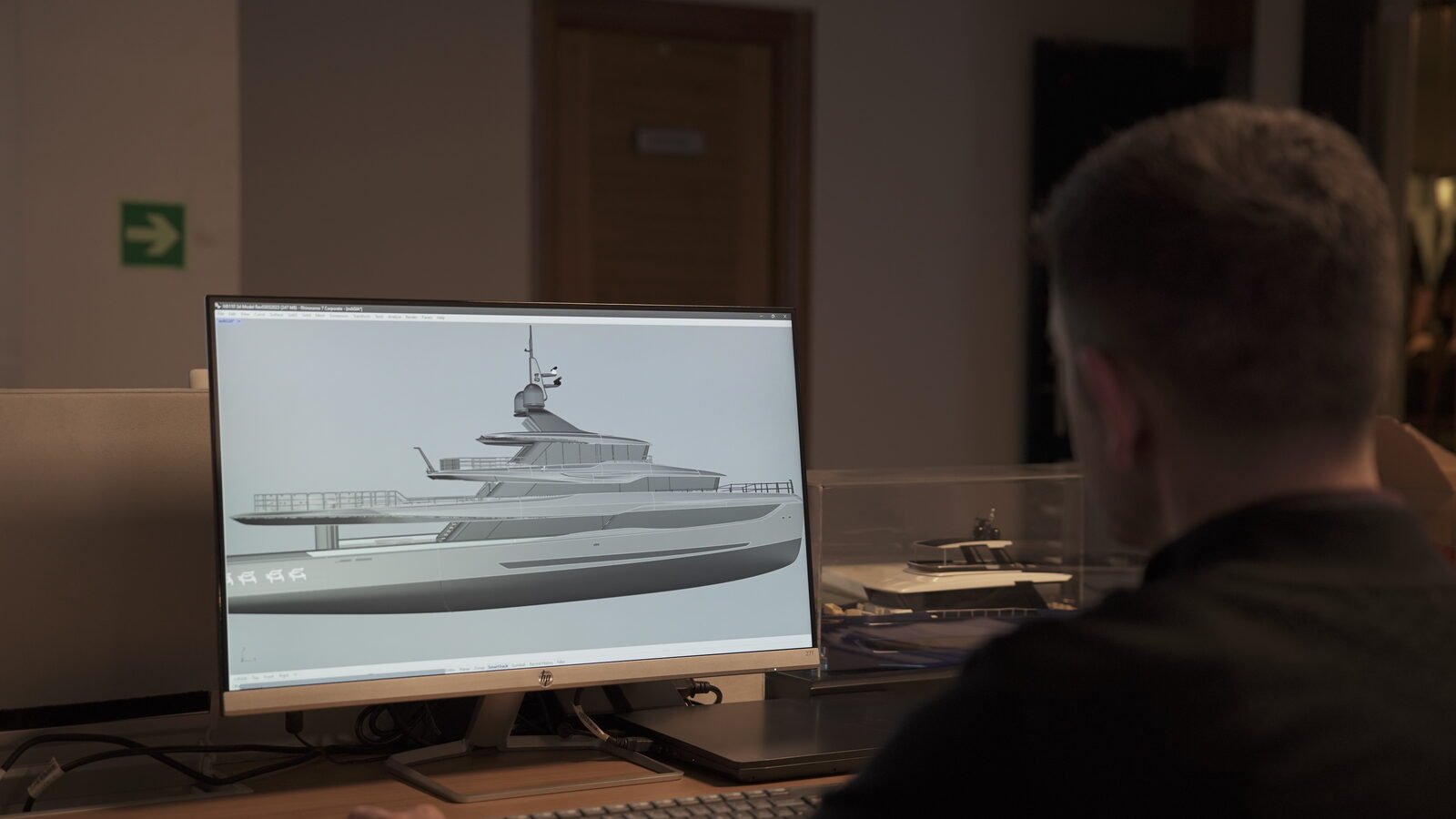
So it is made rather than bought. It is drawn and fabricated in the metal works bay, on the same trestles as a davit or a gate, by welders whose qualifications the yard keeps current with the societies it answers to. How much of a run is welded on the bench and how much of it overhead in the compartment is the same question as how many of a run's joints were made aboard, and a section that fouls a frame goes back to the bay it came from, not into a reorder.
The dry length and the wet length are two different objects
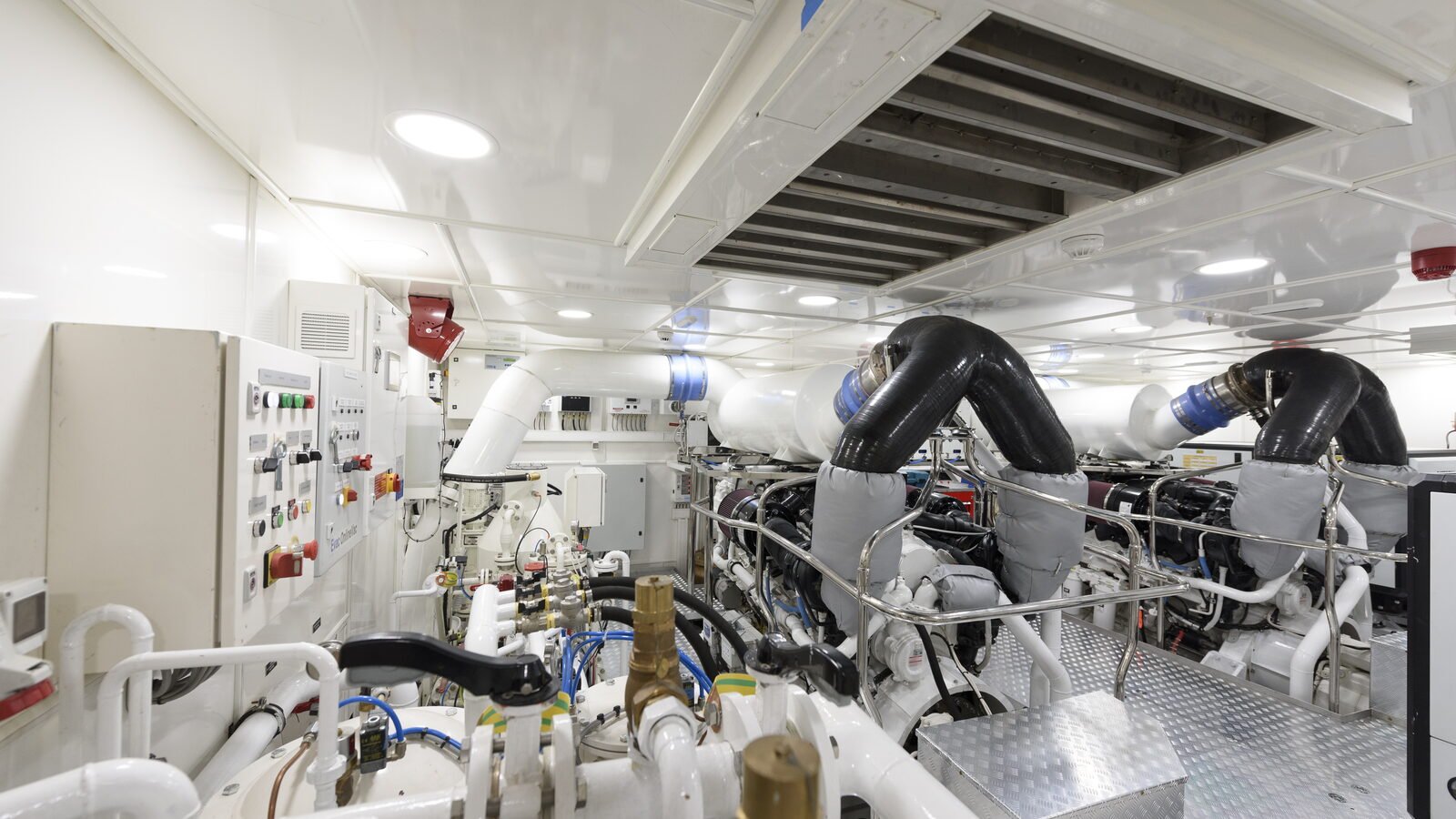
Water is injected at a mixing point, usually an elbow close to the engine, and that single fitting divides the run into two objects. Upstream of it the pipe is dry: it runs at the temperature of the gas, grows and shrinks with every start and stop, needs supports that allow that movement, and makes a fire question of anything within reach. A flexible section absorbs the engine's movement on its mounts and the pipe's expansion, and it is the one part of the run with a service life of its own.
Downstream the gas is cooled and carried in water, which is what lets the rest of it be hose on lighter supports. The price is a wet, salt-laden, oxygenated pipe, and a new failure mode: geometry. If the injection does not wet the full bore, or the elbow sits so that water lies in it between runs, the signature appears within a hand's width of the fitting: scorched hose, a hard scale line, a weep at a clamp. The hose is only where the error shows.
The generator runs are the ones renewed last
Her main engines run for passages. Her generators run for evenings at anchor, at part load, while everything forward of the engine room is quiet. The runs carrying that gas are smaller and almost always longer: a generator sits where there was room for it, not where the shell was convenient, so its exhaust crosses more compartments to reach the water, with more bends, more supports and more lagging to go wrong.
Part load is the condition that punishes a wet run — less gas, less heat, the same water, and a pipe that never dries out between evenings. Scale builds, the hose softens behind its clamps, and nothing in the engine room points at it: the generator starts, carries its load and stops. So the generator runs are renewed last, and they are routinely the ones that were worst.
Lagging is a fire boundary before it is comfort
Lagging is treated as comfort insulation and it is not. It holds the pipe's surface temperature down to something that will not ignite what touches it, it keeps heat out of a space somebody works in, and where the run crosses a rated division it is part of a boundary with a performance to meet. None of that is a trim item.
Lagging which has been wet is no longer lagging: it holds salt water against the pipe and corrodes it from outside while reading as intact, so a soft, sagging blanket over a wet section is a reason to open the run rather than reclad it. Lagging is also the last thing fitted and the first thing a later job cuts away. A run left uncovered while hot work goes on nearby has a fire exposure it was never designed for, which is why what happens an hour after the last spark is a yard discipline rather than a formality.
The geometry that stops the sea coming back up
A wet outlet is a hole near the waterline with a pipe behind it, and the sea may use it in both directions. When the engine stops, the water standing in the run has to go somewhere, and at a stern-down trim or in a following sea the column outside stands higher than the pipe inside. The route back is through the mixing point and into a cylinder, and an engine filled that way is not a repair that waits for the winter.
No alarm reports that, and no switch undoes it. Geometry is what prevents it — a high point above the static waterline, a siphon break or vented loop where the arrangement needs one, a water lift silencer whose volume holds whatever drains back before it reaches the manifold, and an outlet her wake will not stand against. Each was set for the trim she had when it was drawn, and a refit that adds tankage, a tender and a davit aft moves the figures.
Where the gas leaves her, and what her transom shows
The last stretch is the one the owner sees, which makes it a decision about her appearance as much as her machinery. A transom outlet puts soot and salt onto the flattest panel she has, and the stain runs down it for the life of the paint. A topside outlet moves that mark to a surface the sea washes, and buys it with a penetration lower in her side, closer to an opening window or a bathing platform, and a change in the path noise takes through her. A dry stack takes the argument out of the water altogether — into a structure to be carried, shielded and made to look deliberate.
The penetration itself is structure: a hole cut in the shell, a surround to be made good, a closure arrangement where her rules call for one, and a seam somebody will want to see before anything covers it. Both belong in the same drawing, and both are better made before the pipe is cut than after the paint is on.
Written at the yard in Tuzla. Nothing above settles a figure for her own run: the limits are her engine maker's, the arrangement is her attending surveyor's, and the decision to open the lagging is her engineer's.
Send the engine room drawings
A general arrangement of the engine room marked with the route as it stands, photographs of the run either side of the mixing point, and the lagging as it is now are enough for us to begin drawing a replacement. Stage One ends with a written condition report, a scope you have approved and a price that does not move. Write to info@revivarefit.com.
START A REFIT