Most lines in a maintenance budget answer to something. An anode has a wastage rate, a seal a service interval, a generator its running hours. Compound and polish answers to nothing. It is priced every year, approved every year, and the years are never added together.
What the line buys is removal: a cutting compound does not clean a moulded surface, it takes one off. The pad lifts the weathered top off and leaves a fresher one behind, so the gloss that returns is the gloss of what was underneath. Done well it is the cheapest upkeep on the boat, a finish drawn out of material bought long ago, with no cure window and no approval to wait for.
Conceded once and left alone: the moulded skin is finite, and every round draws on it. That is a premise here, not the engine. The engine is the decision this journal has never put: whether to stop.
What the moulded layer is not
A concession first, because the case below leans on it. Whether she is worth refitting at all says composite is read with moisture and adhesion rather than with a thickness gauge, and that its bad news arrives as laminate and core. That is right, and nothing here revises it.
Then a claim withdrawn before anyone reads it in. The moulded skin is not a second thickness map. There is no grid by station and frame, no renewal limit agreed with class, no rate of loss from two surveys. That discipline exists on steel plate because the same hull is gauged again and again; almost nobody has gauged a moulding twice. Any figure for what was originally laid is the builder's moulding specification, not a reading this yard holds.
The decision is settled instead by three questions, asked in order, and only the last of them can end it.
Maintained by taking it off, or by putting it on
The direction in which her outside is maintained changes with the first coat, and it does not reverse. A coating comes off again if somebody pays for it; the upkeep underneath does not come back with it. Painting a gelcoat hull is a one-way door.
Before paint she is maintained subtractively. What keeps her presentable is already on her, and a round that goes badly is corrected by another.
After paint she is maintained additively. Material is bought, laid on in sequence and cured inside conditions a datasheet sets, and a round that goes badly is a defect in a stack. That change of direction is the real content of painting a gelcoat hull.
How that work is done is written down here already, in fairing, film build and the readings taken inside the tent, a post about metal substrates that never asks whether a moulding should enter one.
Through the moulded layer, or into it
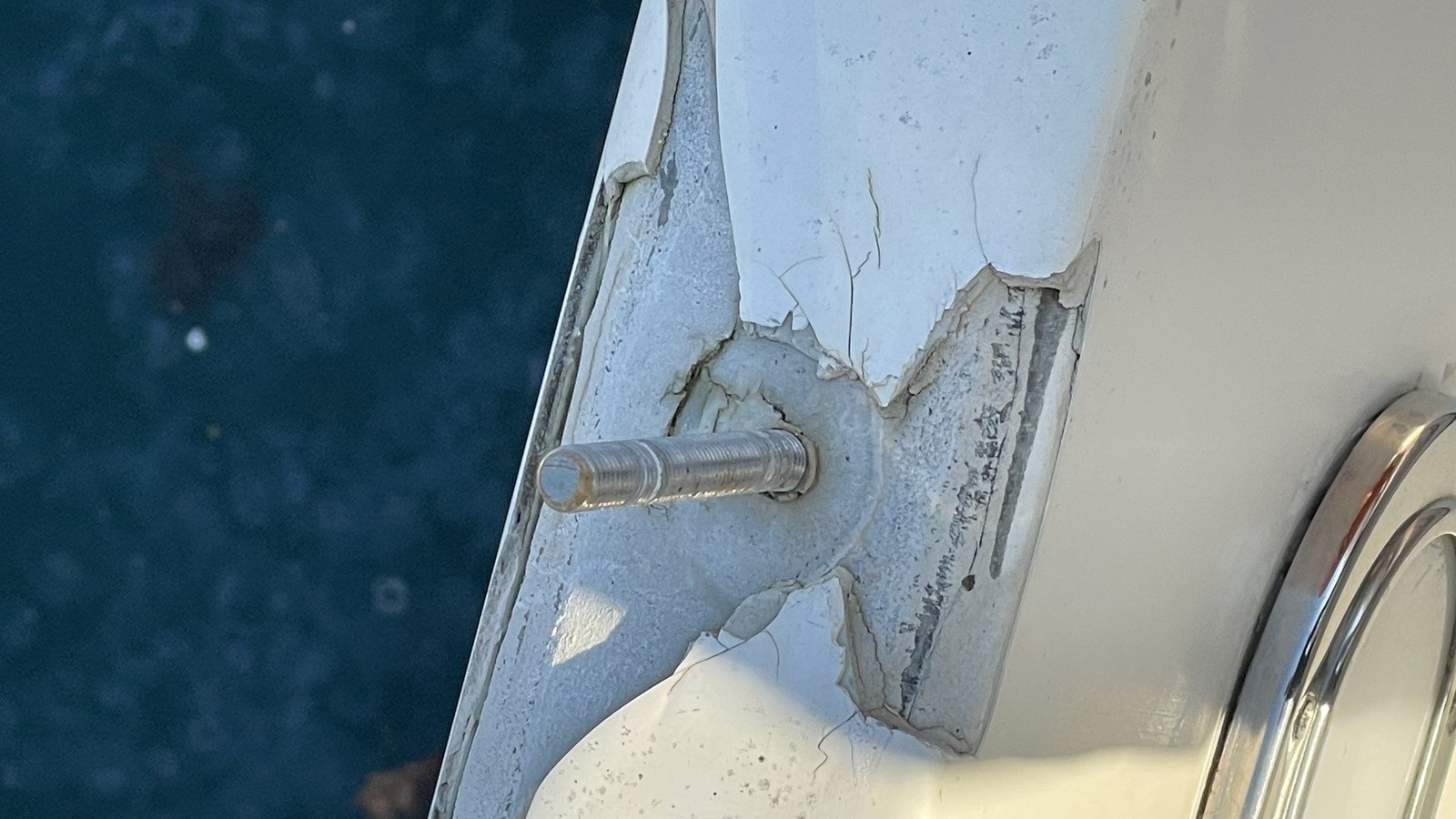
Into it is what abrasion exists for: scuffing, chalking, swirl, light crazing that fades at its own edges. Through it looks like the photograph below: a fitting unbolted, and what sat under it coming away with it.
- Crazing that radiates from a point load and keeps going rather than fading.
- A fracture with lifted edges, the surface standing clear of what it was keyed to.
- A boss of bedding compound cracked around a stud, the layer beneath open.
Through is not a finish question but a laminate repair, and in a moulded skin also a colour match against a surface weathering since she was built. One breach is made good and the repair holds its colour. A dozen, in a hull whose colour has moved, answers the first question towards paint, not because the repairs cannot be made but because they will be legible in raking light whatever goes over them.
The moulding, or the repairs in it
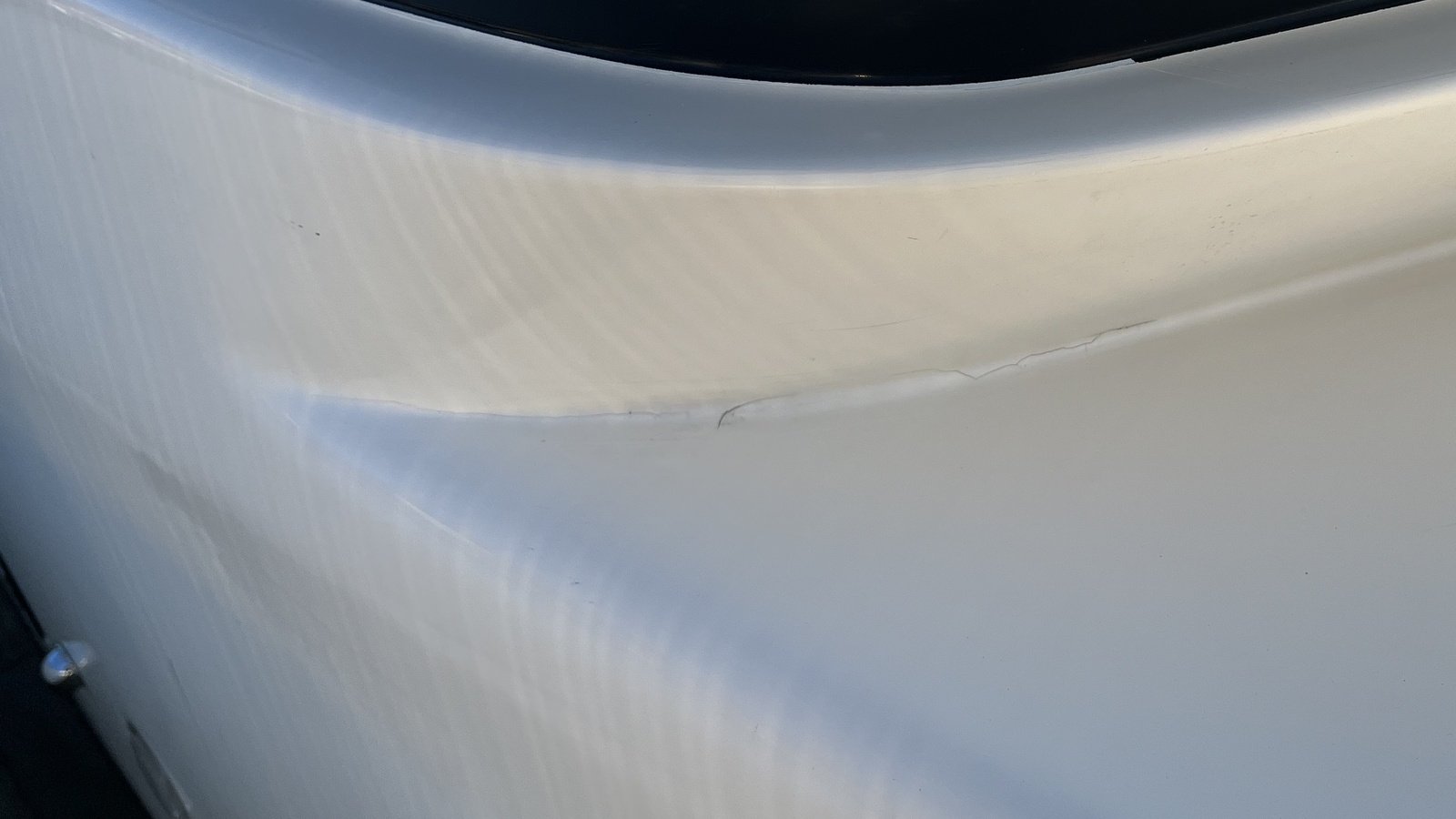
Low raking sun is a harder instrument than it sounds. Sight along her from forward with the light low and the surface reports its own history: polish swirl, a hairline split tracking a moulded knuckle. What has to be decided is whether what offends is the moulding's or the repairs'.
- The moulding's own unfairness. A hollow out of the tool, a flat where the laminate cured against a stiffener, a rail that always read heavy. No abrasion reaches it, and correcting it is fairing, the long line in any coatings price.
- Accumulated repair. Filled work that has shrunk and telegraphed, hard edges, colour that has moved at a different rate from the surface around it.
Abrasion flatters the first and sharpens the second: each round cuts the sound surface beside a repair and not the repair itself, so the difference grows more legible. This is the question owners resist, because its remedy is not more polishing.
The clock, and a correction to one of our own rules
We publish a rule for sorting a refit: sort every line by whether its life runs on her clock or a maker's. That post files coating under hers.
Before paint it is right: the surface is hers, corrected on her dates.
After paint it is wrong, and the rule is better corrected than left standing. The stack is one manufacturer's and may not be mixed. The recoat window is set by a datasheet rather than by the programme. The twelve-month period we give has a published boundary: it answers for the stack we applied, from the substrate we prepared upwards, not for the adhesion of a scheme somebody else laid down. The manufacturer's representative who signs the substrate off attends when his employer can send him. Upkeep the owner used to schedule is scheduled elsewhere afterwards.
None of that argues against paint, only for knowing what is bought. It does not retire a recurring line; it exchanges one the owner controlled for one he does not.
Taking an aluminium hull back to substrate reached the opposite conclusion on the same reasoning: the coating history starts on a known date and the patch cycle ends. That substrate was metal, which never had a subtractive upkeep to lose. A moulding has one, and paint spends it at once.
One more interval by abrasion
This is the only one whose yes ends the conversation. Can she be kept presentable by abrasion for one more interval, to the standard she is used to? Three things decide it.
- Whether the surface still responds. Ask whoever last polished her whether a fine compound still raises gloss, or whether the cut has had to step coarser each round for the same result.
- Whether the defects are local or general. Scrapes, a split along a knuckle and a stained lip are a repair list. Chalking and crazing across whole quarters are not.
- Whether the standard being asked for is hers or a new one. Sometimes the moulding has not changed and the specification has.
If the answer is yes, the honest recommendation is not to paint her. Make good the breaches, polish her, and spend on whatever is actually failing. Put her in front of the same three questions next time she comes out. The door will still be there, and it still opens one way.
Written at the yard in Tuzla, after a hull went through all three questions and did not go into the tent. Nothing here is a reading taken on anybody's moulding; what a particular surface can still stand is settled in front of her and not at a table.
Send the photographs before the quotation
Before anyone prices a repaint, send photographs of her topsides taken in raking light, sighted along her from forward rather than square on, together with whatever repair history exists: who filled what, roughly where, and roughly when. Sometimes we will tell you she is not ready for a tent, and that is the whole of the advice. Write to info@revivarefit.com or call +90 (850) 226 28 72.
START A REFIT