
The settee bases in the saloon are stripped back to bare carcase, and brown paper is laid over them, cut and weighted down with joinery offcuts, each sheet marked in pencil with the compartment and the date. Nobody has ordered cloth.
The pencil date is the part worth looking at. It is the shortest-lived figure in the file. Every reading in a survey carries a date because it was true on that date; this one expires when the carcase under it moves.
There is a detail drawing for this compartment, as there is for every trade on the job. What it cannot give the upholsterer is a figure to cut to.
That sets the shape of a yacht upholstery refit. Soft goods are templated the moment there is joinery to template off and fitted almost last, with the dusty end of the programme in between — and that gap is where the trade is got right or quietly made twice.
A yacht upholstery refit is measured off the boat
A joiner templates aboard too, then machines to a figure that holds: the part is cut, and it is the same part tomorrow. The upholsterer's pattern reduces to no figure at all. A cushion is patterned off the opening as built, not as specified, and port and starboard bases drawn identical will not template identically.
Reviva's interior joinery shop has a phrase for it: a hull is never square twice. What the paper records is not only a shape. It records a seam line, a compression — how far the filling is squeezed to enter the opening and hold there — and a direction of pull.
A template is therefore the record of one assembly on one date, and it is scrap the moment the carcase, the fiddle rail or the sole beneath it moves. The cloth is right, the workmanship is right, and the set does not fit.
The cushion foam, not the cover
A seat that has gone hard, or dished where everybody sits, is almost never a fabric problem. It is a core problem wearing a cover. The cushion foam has taken a compression set, either because the grade was softer than the load that seat carries, or because the base has never dried.
Strip a sound-looking cover off that cushion, put new cloth on the same core, and the identical seat goes back aboard. That is the commonest wasted line in a yacht upholstery refit. While the lid is off, the base is the thing worth reading.
- Whether the plinth or locker under the seat drains, and to where.
- Whether there is an air path through the base, or a sealed box with a cushion on it.
- Whether the old cushion foam is heavier at one end than the other, which is water.
A soft-goods scope that lists fabric and nothing about filling or ventilation is half a scope — and it is the half that decides whether the saloon seating is still comfortable once she has been used.
Choosing cloth, and the light she is actually seen in
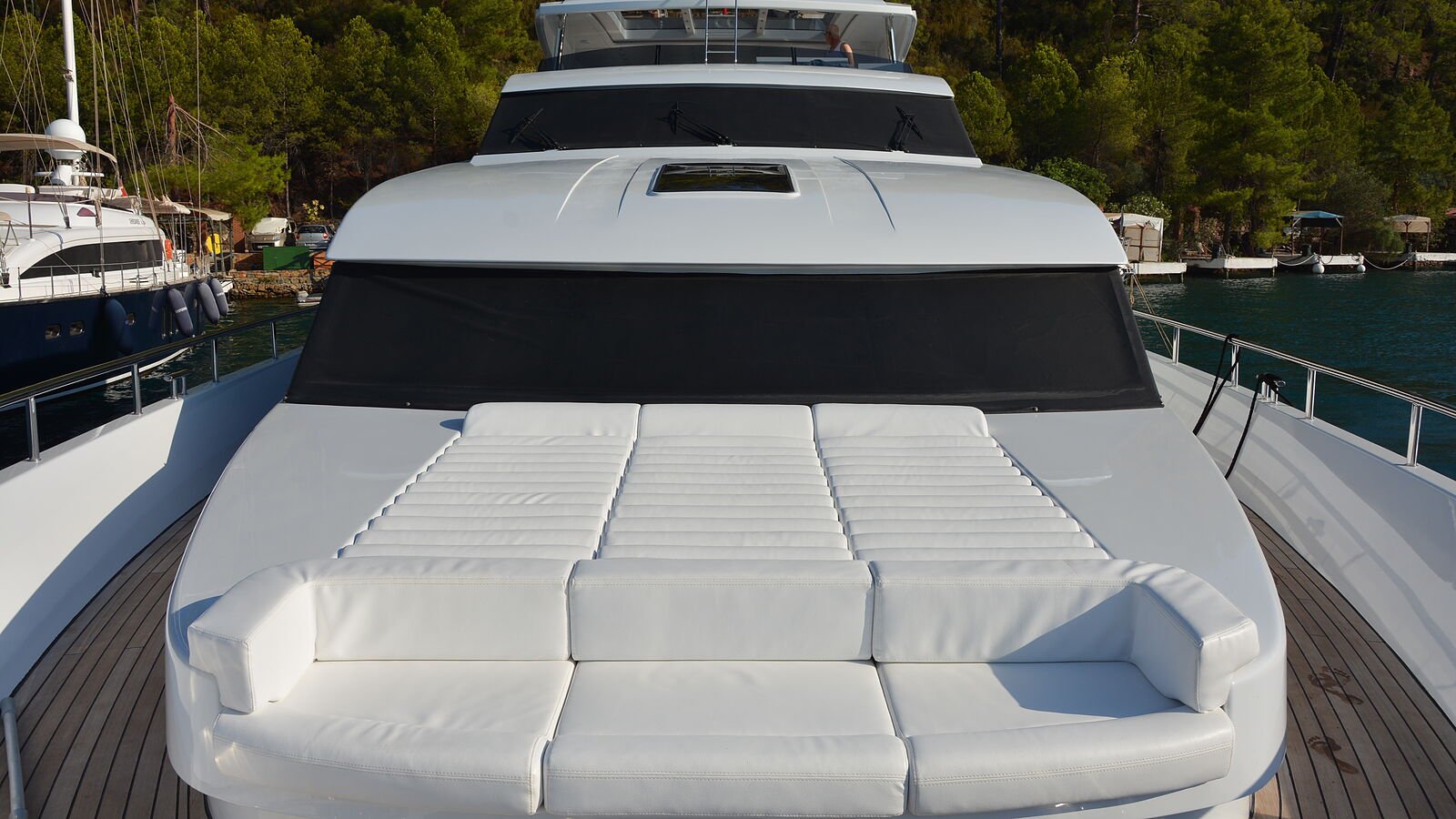
Marine upholstery divides into two material problems that look like one. Interior cloth and exposed cloth are selected against different properties: abrasion resistance, light-fastness, the cleaning method each tolerates, and whether the backing is specified for sun, salt and standing water.
A saloon fabric carried out to a sunpad is a specification error rather than a wear problem. It did not fail early. It was never asked the question it was built to answer.
Then there is light. A sample read in a showroom is read at the wrong colour temperature, beside none of the materials it has to live with. Reviva names the rule at design stage for the teak, the lacquer and the topcoat: chosen aboard, not from a catalogue. A yacht interior fabric has at least as strong a claim on it: the same weave reads warm against dark veneer under tinted glass and cold against pale lacquer two decks up. That is separate from how a sample is approved and retained, which is procedure.
The certificate follows the assembly, not the roll
Fire performance is the part of a yacht upholstery refit most often bought wrongly, because it is bought as a swatch. In general marine practice the test is run on the composite — cover, interliner and filling built up over a frame — not on the cover alone. So the question for a supplier is whether the certificate covers the build-up or only the cloth.
The document a surveyor asks for is the test report for the assembly, not a swatch book page marked flame retardant. Certification sits with the supplier and the test house; the yard specifies the build-up.
Registration is the other thing to settle first. A commercially registered or chartering yacht is generally the harder case, so her registered use belongs in the scope before cloth is ordered. What that requirement is belongs to her flag.
Templated early, made in parallel, fitted last
Two facts set the sequence and pull against each other. Patterns can only be taken once there is joinery to take them off, and here the interior is dry-fitted in the shed before a panel goes aboard. Against that, nothing finished comes aboard while blasting, fairing or spraying is running near it.
The first pattern comes off the dry fit, the second off the compartment once the joinery is aboard, and the gap between them is what the pencil date measures. The work is made in parallel with the dusty trades and arrives at the end of the programme. Three things follow.
- The pattern is re-checked against the compartment before anything is cut, because something moved.
- The old set is inventoried, bagged and stored off her, or it becomes what the painters kneel on.
- Because the soft goods cannot start earlier, any slip upstream lands on them, which is why the fitting window is protected rather than spent as contingency.
That is why soft furnishings reach an owner's attention late and suddenly. Nothing had gone wrong with them; they were behind everything that had to dry.
What to keep, and what nobody put on the list
A hardwood frame with slipped webbing and sound joints is re-covered, not rebuilt. The decision is made by opening one corner and reading the joints and the webbing anchorage, rather than the cover above them. The joinery shop's rule for original timber applies here too: repaired rather than replaced wherever there is life left in it.
The items that go wrong at handover are the loose pieces no specification ever named. Bunk runners. Scatter cushions. Dining chair seats. Sunpad and helm covers. They fall between the interior joinery scope and the deck scope, and unless the specification says which owns them they arrive unbudgeted and in whatever cloth is to hand. Settle that line on paper, not at handover.
Then the whole trade is read from a metre away, in daylight, by the person paying for it. A puckered seam shows at that distance, and so does a filling that reads as a shadow through the cover. None of it appears on a test report, and all of it is seen first.
Reviva refits, rebuilds and restores at the yard in Tuzla, where joinery, metalwork, upholstery, coatings, electrics and systems all sit within a few minutes' walk of the berth. For a trade whose pattern carries a date on it, that distance is most of the argument.
Written at the yard in Tuzla. Nothing here gives a foam grade, a cloth rating or a fire requirement as settled: what a particular yacht has to satisfy belongs to her flag and to the certificate for the assembly actually fitted, and every material property belongs to the supplier's own data for the roll supplied.
Photograph the seat bases, lids off
Send photographs of the seat bases with the lids off, one old cushion turned over, and a note of how she is registered. The cushion foam, the base ventilation and the certificated build-up can then be looked at before any cloth is discussed. Write to info@revivarefit.com.
START A REFIT