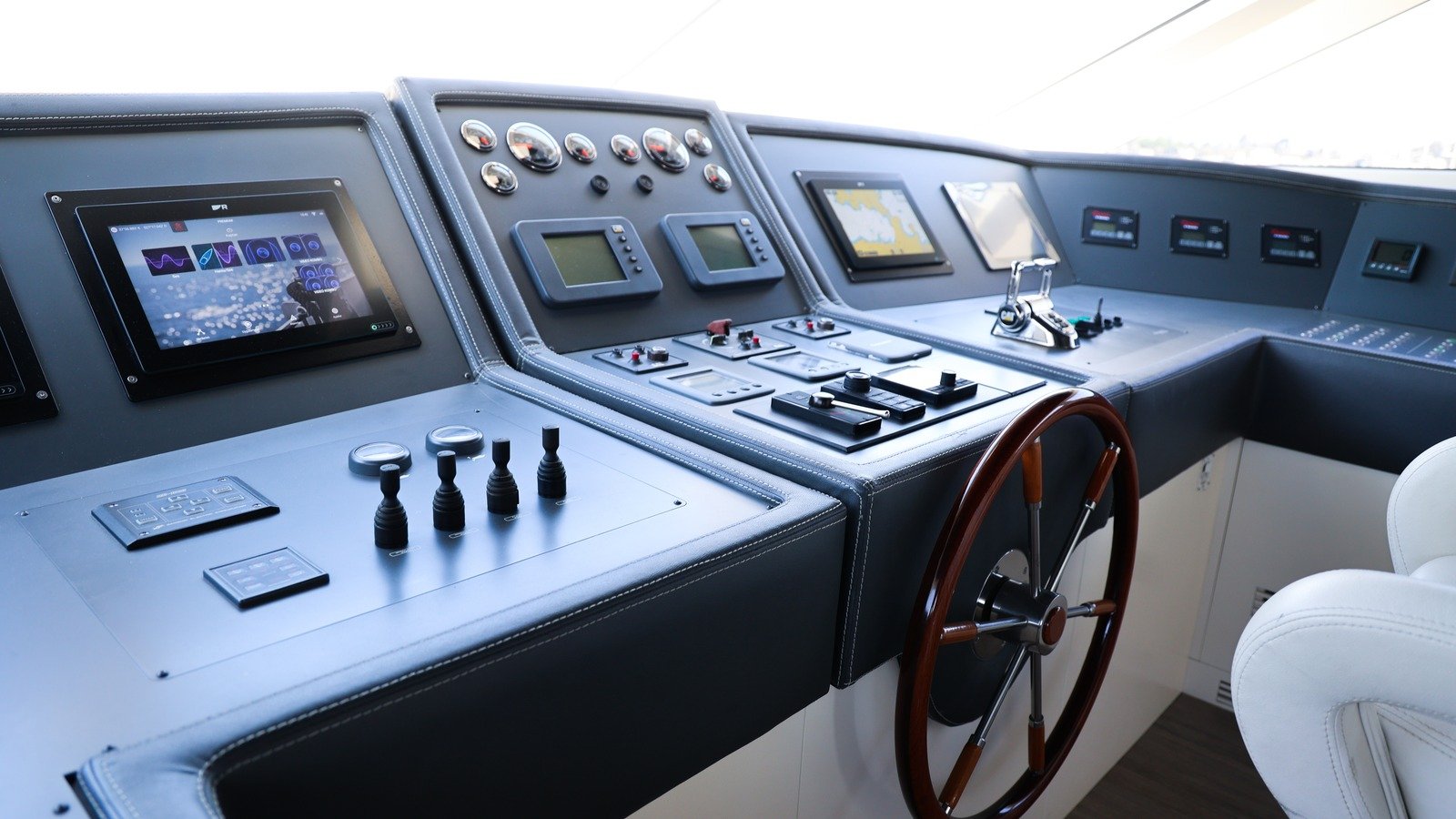
A bridge refit is asked for as a list of screens. It gets priced as a list of interfaces, and those are two different documents. It is a network rather than a set of boxes, and it reaches into compartments other trades are about to close, which is why it is scoped on its own. Below are the questions that decide it, including where the honest answer is a limit.
Is this a swap or a rebuild?
The age and architecture of what is already aboard answer this, not what is wanted. Where the installation is one generation old and still supported, displays and processors can often change onto sensors, antennas and cabling that stay. Two generations back, the sensors are the problem: heading arriving as a synchro or stepper output, log and depth on a proprietary serial line, an autopilot expecting a signal nothing now made produces. Each can be converted, and each converter is a box in a locker somebody has to power, label, draw and fault-find in five years' time.
A display that still lights is not evidence of anything. What decides it is whether a failed unit can be replaced inside a season, what bus each sensor speaks, and whether anything new will talk to it. Somebody opens the console and writes down what is actually connected to what, and until that is done a bridge quotation is an estimate wearing a number.
What is forcing the job?
Obsolescence is the quiet driver: nothing has failed, the manufacturer has stopped making the part, and the vessel is one component away from a bridge she cannot use. A chart engine that no longer receives updates is a different problem from a dim screen.
Carriage is the hard one, set by size, flag and whether she is registered commercially. SOLAS Chapter V Regulation 19 scales the carriage of navigational equipment by gross tonnage, with a gyro compass and its repeaters entering at 500 gross tonnage; a commercially registered yacht carries what her flag's yacht code applies to her, and a private yacht of identical dimensions may sit outside it. A change of trading area moves it too. Put that question to the flag or the class society before putting it to a supplier.
Equipment list or interface list?
The interface list. The equipment list is the easy half, and the half every yard prices much the same. What differs is what the boxes have to say to each other: heading, position, speed, depth, wind, rudder angle, rate of turn, AIS traffic, alarms. Each has a source, a destination and a format.
This is where a scope quietly triples. Replace the gyro and the autopilot takes its heading from it, so either the format matches or the autopilot goes as well; the autopilot also wants rudder feedback, which is a sensor on the steering gear rather than anything on the bridge. Route a new alarm into bridge alert handling and the alarm and monitoring system is in scope too. One sensor, three systems.
So what a yard should price against is a signal-by-signal schedule: what produces each value, what consumes it, in what format, and where a converter is being relied on. Against that three quotations can be compared; against model numbers they cannot, which is the argument in writing a specification three yards can price.
Where do the new cables go?
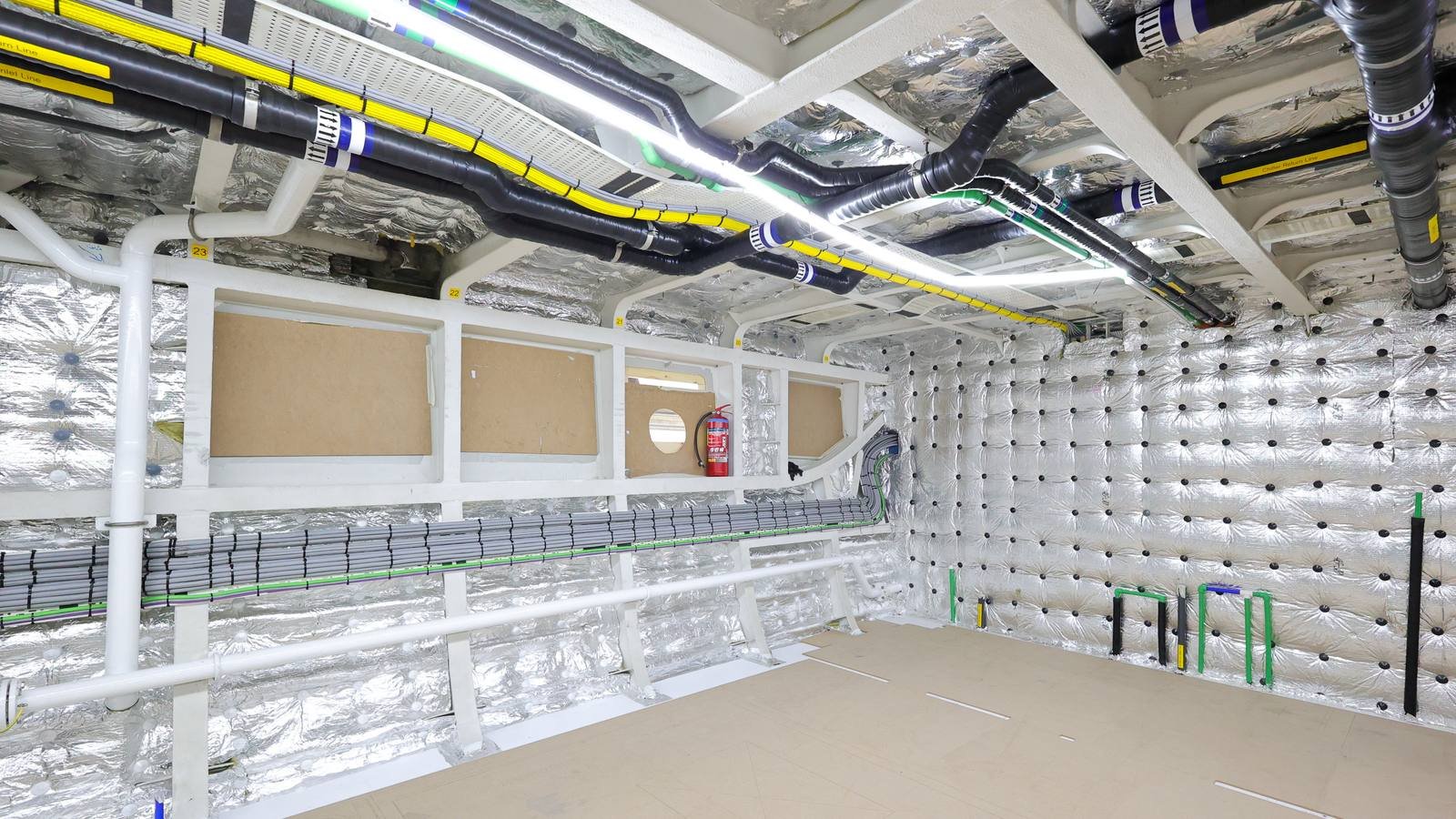
A bridge package is not local to the bridge. Coax goes up to the radar and satcom antennas, data runs down to sensors in the machinery space, and a backbone has to reach every drop. Those runs pass behind bulkheads and deckheads which, on a finished yacht, are joinery.
So the electronics scope and the interior scope compete for the same access. Panels that come off for cabinetwork are the panels a cable run needs, and pulling cable while they are off costs a fraction of pulling it afterwards. The sequencing is in what a yacht interior refit has to prove and what the joinery closes in. Coax has a bend radius a tight corner will exceed, and a run crossing a watertight or fire boundary crosses through an approved penetration with a record attached, not a hole.
If the interior is not coming off, a route may not exist. The honest answers are then a longer run with more loss in it, an antenna position that is second best, or waiting for the yard period when the panels are out.
Is the console furniture or structure?
It is underestimated because it looks like a fascia. New displays are rarely the shape of the old ones, so apertures have to be cut, and a widescreen unit in a console laid out for square ones usually means the panel is remade rather than patched. Where instruments sit in a console that carries load, the opening is an engineering question before it is a joinery one.
Heat is the failure that arrives a season later: displays and processors behind a closed fascia need a stated airflow, and an installation that ignores it fails on the first hot afternoon at anchor rather than on the day. Screen angle against the windscreen decides how much of the display is reflection at midday. And the screen used underway has to be readable from where the person conning actually sits, not from where the drawing puts the seat.
Who has to accept it?
Type approval belongs to the equipment: a unit carries a mark against the relevant performance standard, and the flag decides which marks it accepts, which is not always the answer a supplier gives.
Acceptance belongs to the installation, and that is what gets surveyed. The survey is specific: as-fitted diagrams matching what is aboard, the interface schedule, antenna siting and separation, compass safe distances. Every unit has a stated safe distance from a magnetic compass, and equipment fitted inside it invalidates the deviation card whether or not anyone notices. The radio side runs on its own paperwork: a change of transceiver, or of any device carrying the ship's identity, reaches the radio licence and the radio survey, booked against a date rather than discovered in the last week.
What can only be proved at sea?
Enough that the programme should assume it. A radar tuned alongside in a working ship repair district is looking at cranes and steel, and says nothing about how it will discriminate a small target in clutter. The magnetic compass has to be swung and a fresh deviation card issued, because the steel and the electrical loads around it have changed. An autopilot is tuned in a seaway and over more than one run, because its behaviour at ten knots in a following sea is not its behaviour tied up.
Nothing is signed off until it has been proved afloat, and the trials programme should carry a repeat day for the electronics, in the sequence set out in proving the snag list is closed.
The electronics package is the scope most often written last, and the one most likely to reopen the joinery when it is written late. That is the argument for putting it into the specification at the same time as the steel.
Written at the yard in Tuzla. The carriage requirements cited here are the published regulation; what applies to a particular vessel is settled by her flag and her class society, not by the yard.
What to send us about her bridge
Send the make and age of what is fitted, her tonnage, flag and registry, and whether she is coming to us with the interior open or closed. Photographs of the back of the console are worth more than photographs of the front. What comes back is a signal-by-signal schedule of what each sensor produces and what would have to consume it, marked where a converter is being relied on and where a route may not exist, so three yards can be asked to price the same job. Write to info@revivarefit.com.
START A REFIT