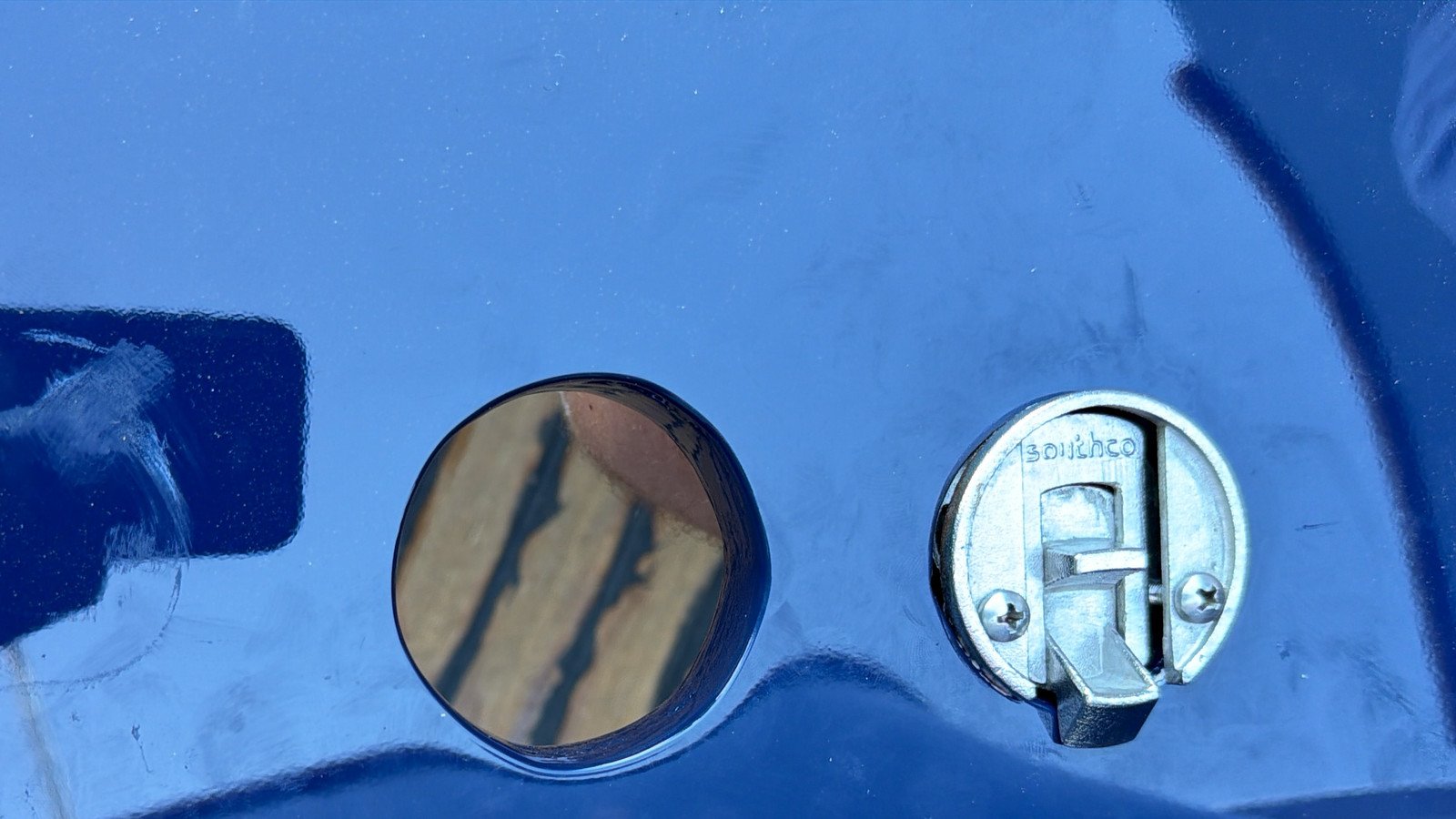
A cockpit locker lid spends its life clamped. The cam of its flush catch draws it down onto a gasket, holds it at a set deflection, and lets go for the few minutes a season somebody has the lid open. Nothing about that arrangement is a catch; it is a spring held compressed for a decade, and the spring is not the metal part.
Cockpit locker lids, sole hatches, vent panels and their grilles, gas and bathing-platform lockers, tender-garage catches, engine-space access covers — a few dozen openings a season between them, and not one of them offered to a hose test, because a locker lid is drained rather than sealed. Wear is looked after elsewhere. Handles, latches and hinges reads the accommodation's only moving parts by duty cycle: the finish going first in a crescent on the underside of a lever, the follower opening up under a decade of small torques, and counting it by cabin as the right commercial answer. A locker opened a dozen times a season returns nothing to a cycle count. Both readings are sound, and neither was written with a locker lid in front of it. The drawing usually says which of these panels is a barrier and which is merely a cover. What it rarely says is what holds the panel down, and against what.
A compression latch is a preload, not a catch
A cabin door latch is loaded for the instant the bolt is against its keeper and unloaded the rest of the day. A compression catch is loaded through the season, the yard period and the winter, at one point, in one direction, with nothing relieving it. That is a different loading history from the one a wear count measures, and it runs on the items nobody touches.
What relaxes is the moulding
The cam bears on a keep, the keep on a plinth, the plinth on the moulding it is screwed to, the moulding on the framing under it, and the gasket takes the remainder. Every one of them gives way under a load that never comes off.
- A thin, locally unsupported laminate lid creeps — not much, and not evenly: most of it where the cam is pulling.
- A closed-cell gasket takes a compression set. A seal that stood four millimetres proud stands three and a half.
- Two countersunk screws in a moulded plinth are a small bearing area under a large permanent load, so the plinth beds down and the keep it carries sits a fraction lower.
- A fastener hole in gelcoat elongates, and the keep walks with it.
- A plated keep is a bought-in casting, not fabricated stainless. It does not have to corrode to sit low; it only has to bed.
Every one of them presents identically: the lid closes soft. The adjustment that answers all of them is the same half-turn, and by the time a lid reaches a yard the cam has been taken up by more than one pair of hands. Each half-turn is free, and the travel it spends is not put back. Where a keep has corroded as well as bedded, the arrival report is usually the first place anybody wrote it down.
What is worth writing down
None of this shows up in either check, so a lid wants numbers of its own, and they are numbers nobody currently holds.
- Turns of adjustment left before the cam bottoms, written as a figure rather than as an impression, entered in the job record and dated on the cam body with a paint pen.
- The gasket's free thickness, measured off the lid with a vernier against the section it was cut from, which is the only way to see how much of it has gone permanently.
- Whether the panel comes back. Press the middle of the lid with the flat of a hand and let go. Creep does not return. A gasket does.
Taken together they say how much of the assembly's deflection budget has already been spent, and on what. Less than a turn in hand, or a measurable loss off the gasket section when it is held against the offcut, and the landing is rebuilt, not the cam reset.
Drainage belongs in that list as well. A locker sole with a blocked drain holds water against the lid from underneath instead of shedding it, and a fitting and its penetration are one job has the plugged gutter in it already. But a drain proved clear takes five minutes at close-out and is booked by nobody, because the panel above it belongs to one trade and the gutter below it to another.
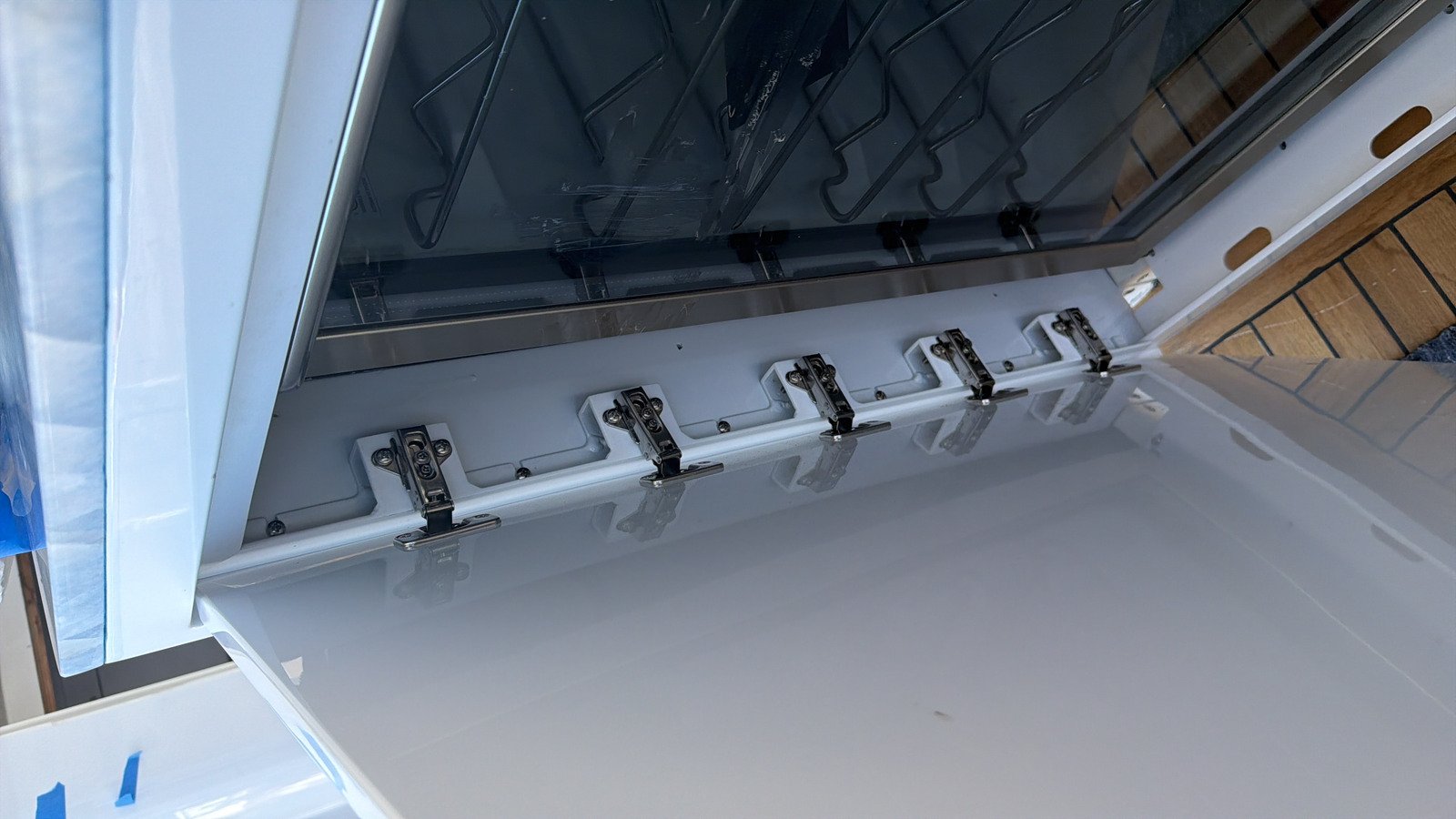
A bought-in fitting and the hole it lives in
A proprietary compression catch is sold against two numbers: a panel thickness range and a cut-out diameter. On a refit it is rarely the panel it was drawn for — sheathed since, re-moulded, thickened at a repair, or replaced in joinery where a moulding used to be. The result is a catch that never reaches full throw and a cam at the end of its travel on the day it is fitted.
Three answers are honest. A local doubler bonded behind the cut-out, to bring the landing into the fitting's grip range. A re-moulded landing, where the laminate will not carry a point load at all. Or an oversize trim ring that admits the hole is wrong and covers it properly. The fourth, washers shimmed behind the keep, is the one that gets used, and it puts a soft joint straight into the load path above.
A panel built to come off buys its access with stiffness, and the trade is made once, at the drawing. On a cabin door that is the price of access, and it is paid once. On a lid the compliance is the failure mode: the stiffness given up to make the panel liftable is the stiffness the latch spends its life pulling against, every hour of every winter it sits closed.
Whose figures these are
Cam torque and gasket deflection are the latch maker's figures, published against a grade and a section, and we work to them, not to feel. Whether a particular closure is rated at all — a gas locker, a means of escape, a boundary — belongs to her flag and her attending surveyor, on their own inspection, and is asked before the panel is cut, not after.
A lid that shuts because it is drawn onto a gasket and a lid that shuts because somebody has taken the last turn out of the cam feel identical from the cockpit, and only one of them will still shut next season.
Written at the yard in Tuzla, from the catches, keeps and lids that come off panels during strip-down and get measured on the bench before anything is ordered, and not from any one vessel's file. Cam torque and gasket deflection figures remain the latch maker's, and whether a given closure is rated at all belongs to her flag and the attending surveyor.
Count the turns before you order anything
Before anything is ordered, go round her lids and covers with a screwdriver and write down, for each one, how many turns the cam still has before it bottoms. That number takes an afternoon to collect and nobody holds it. Send the list with the vessel's age and what each panel is made of. We can then tell you which of them are still adjustable and which have already spent the adjustment the assembly was built with. Write to info@revivarefit.com.
START A REFIT