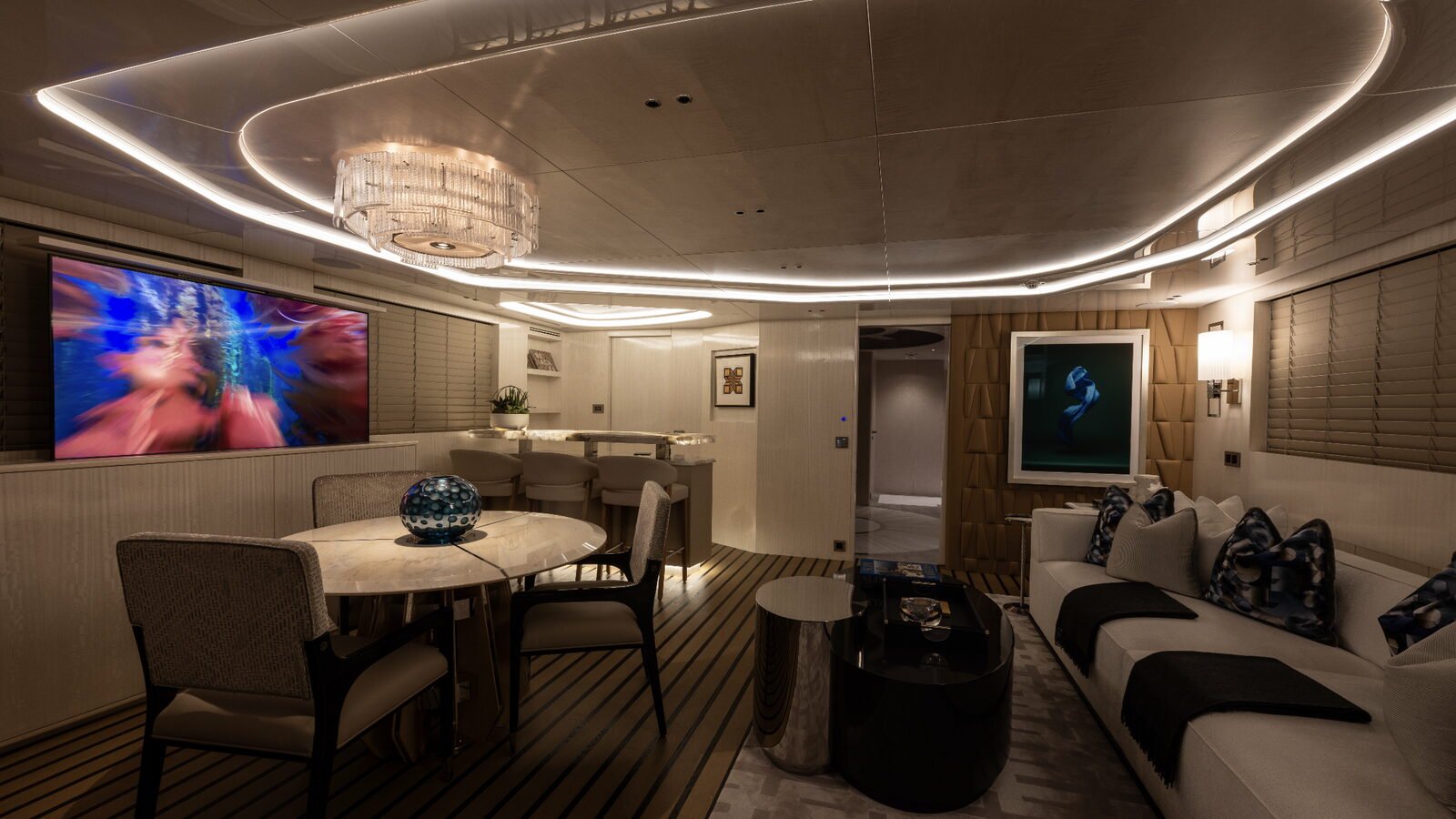
A flat screen lies face down on a blanket in the outfitting workshop, beside the cabinetwork it came out of. The panel is the older object, and the one with life left in it. The screen was current when she was last alongside; the frame was drawn with the saloon, to last as long as the interior.
No other system aboard has that arithmetic. Her generators are overhauled and go back. Her joinery is refinished and goes back. A yacht audio visual installation is not overhauled. It is replaced outright, more than once, before the cabinetwork around it is touched.
So what a refit owes an onboard entertainment system is not the equipment. That is the owner's choice, and certain to be superseded. What the yard owes is everything that has to outlive it — a pathway a new cable can be pulled through, an aperture that will take a different outline, a cupboard that can lose the heat the next boxes make, a supply chosen for a scope that grows, and a handover where somebody is shown how it works.
A saloon screen is let into a panel
An entertainment refit reads as a hardware decision and lands on the joiner's bench. A saloon screen is let into a panel, carried on a frame and closed with a bead worked to the outline of the unit specified that year. That the next unit will have a different outline is not a discovery. What matters is how the surround is detailed before it closes.
One detail works the bead into the panel, so the panel becomes the unit of change. The other stands a demountable surround proud of the opening, screwed from the face as its own length of moulding. A cabinet detailed so one length of moulding is the whole of the next change has settled the question for every screen she will carry.
The cupboard nobody chose
Amplifiers, a matrix, a server and the switches end up in one cupboard, seldom a chosen one: a void under a stair, a locker off a crew passage. Everything in it turns most of what it draws into heat, with the door shut.
Heat collects at the top, where the failures appear, and a fan breathing against a closed door becomes a noise instead of a cooling device. The cupboard wants air admitted low and taken out high, and clear volume above for whatever is taller next time. How much heat a given equipment rack makes is the makers' figure; the yard's part is a cupboard that can be given more air later.
The route is drawn before the cable is chosen
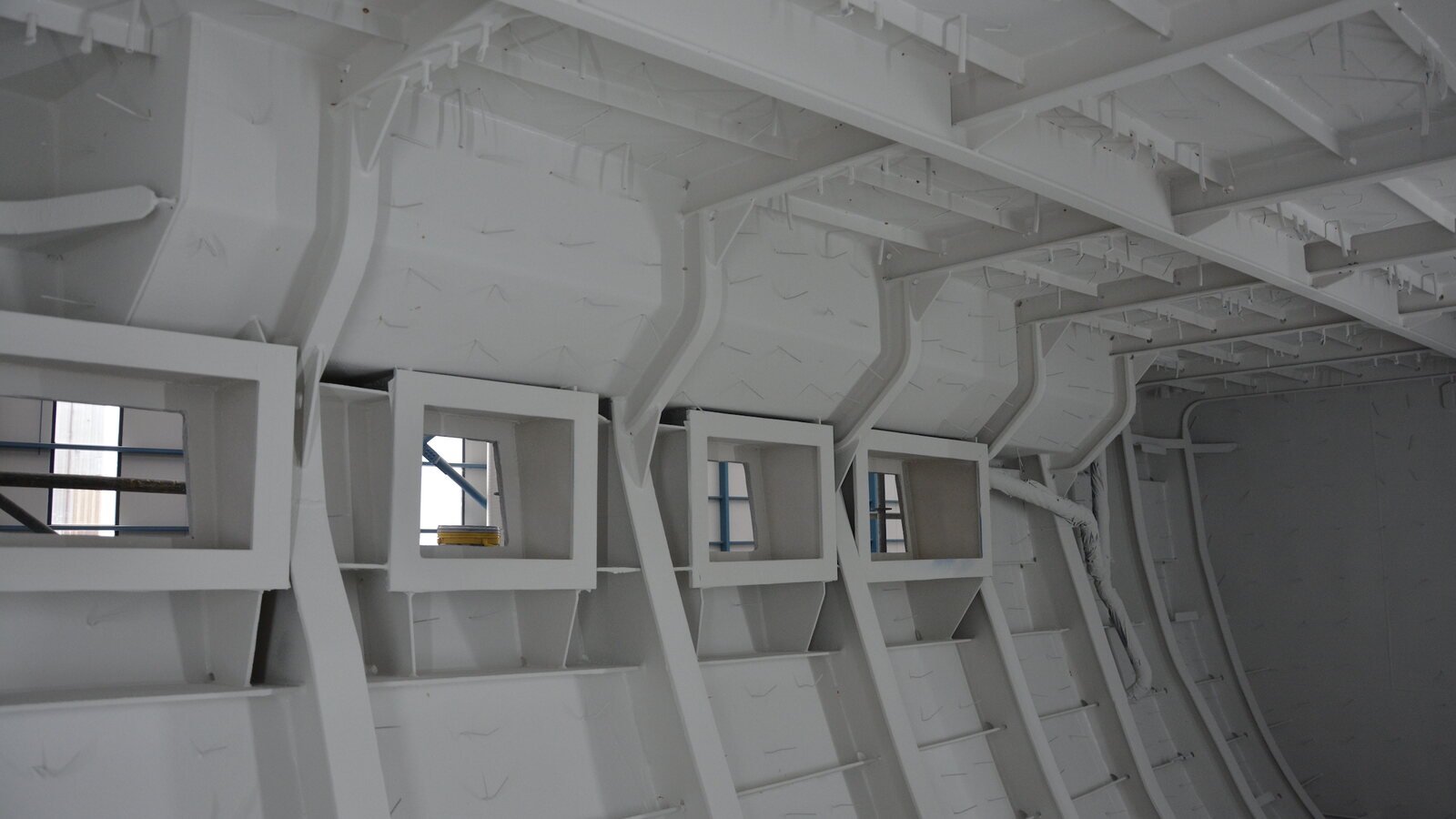
A cable is pulled once and then lives behind everything built after it, unreachable without taking something apart. So the route is drawn first, because the route is what the next cable has to fit.
A route is trunking with room left in it, and bends a stiffer cable will accept. A cord stays in the duct for the next pull rather than a bundle filling it, because a duct full of cable is already spent. The pull point sits in a locker or behind a demountable grille — somewhere a fitter can stand and take the weight of a drum. Both ends are marked as the cable is cut, which nobody then repeats by tracing.
Everything in this scope repays room left in it, and yacht network cabling repays it soonest: the cord weighs nothing and is the part a later fitter is glad of.
What carries a drive unit joins in
The part of a loudspeaker anybody looks at is a grille, the part nobody has to design. What decides whether it is any good is the volume behind it and the stiffness of what carries it. Landed on a thin lining, a drive unit works against a panel larger than its own cone, and the panel joins in.
The remedy is mostly carpentry — a stiffened backing, and an enclosure carried on the carcase so that it does not couple straight into a frame. Where that enclosure lands decides what the structure around it does with the sound. The opening dates as fast as the screen aperture: cut tight around the basket of the day, it is unlikely to take the next unit; drawn with a little room, it may take what follows.
Supply, earth and the way on the switchboard
An entertainment scope is written late, so it is fed from whichever way on the switchboard was still spare, and spare ways are spare for a reason. The load is small per unit, continuous, and standing all night.
Switchboards here are made up and proved in the electrical workshop, and the breaker is chosen against the load actually measured — the way itself picked for a scope that will grow rather than for this winter's cupboard. On an older hull the original loom diagram has often gone, and the workshop's answer is a rewire ending in a drawing of what is actually there. Where an entertainment scope lands on old distribution, what feeds it is worth renewing with it and labelled at both ends.
Earth is the part nobody specifies, and worth asking about before the hardware is blamed: a hum can be an earthing arrangement with two paths in it rather than a fault in a box. It is the one noise here no carpentry cures.
The half of the handover that gets dropped
Audio, screens and networks are commissioned here and then demonstrated. AV commissioning is the first half; the second is the half that gets dropped. A system handed over working and not demonstrated is not yet delivered: it runs, and nobody aboard can drive it.
Crews turn over. A demonstration given once, to whoever was aboard that day, goes when those people go, and what replaces it is a remote with tape on it. What survives is a demonstration given to more than one person, repeated, with somebody writing down what was shown.
Inside the outfitting door
Audio visual and entertainment sits inside the outfitting workshop, one of eleven doors here, and is scoped as fitting out rather than as a purchase: appliances and entertainment fitted to the way she is used, the equipment arriving working rather than in its cartons.
What the discipline owns is the hole, the enclosure, the feed and the handover. The unit in the middle of them is somebody else's: the taste is the owner's and the ratings are the makers'. That is the only line in the scope where the yard's answer stops. Our side of it is leaving all four so that the next change is a trade decision rather than a strip-out.
What to send about her systems
A general arrangement with every screen, every loudspeaker and the rack cupboard marked on it lets the apertures and routes be drawn before anything is chosen. The useful documents say where things are.
A photograph taken from above the rack, lid away, shows how much clear volume is left over it — the question nobody asks before the cupboard is closed in. What the crew have quietly stopped switching on tells us more than the specification, and nobody writes it down. So does what she is for, because a superyacht entertainment scope for long seasons with guests aboard is not the scope for weeks alongside with crew only.
Written at the yard in Tuzla. What a unit draws, and how long it stays current, is published by whoever made it, and no yard improves on that. Which unit it is was never the yard's question — it is the owner's, and the owner is the one who lives with it.
Mark the rack cupboard on the drawing
Mark her general arrangement with every screen and every loudspeaker on it, and say which cupboard the rack lives in. What comes back names the apertures we would detail as demountable and the routes we would leave a cord in, before anything at all is specified. Write to info@revivarefit.com.
START A REFIT