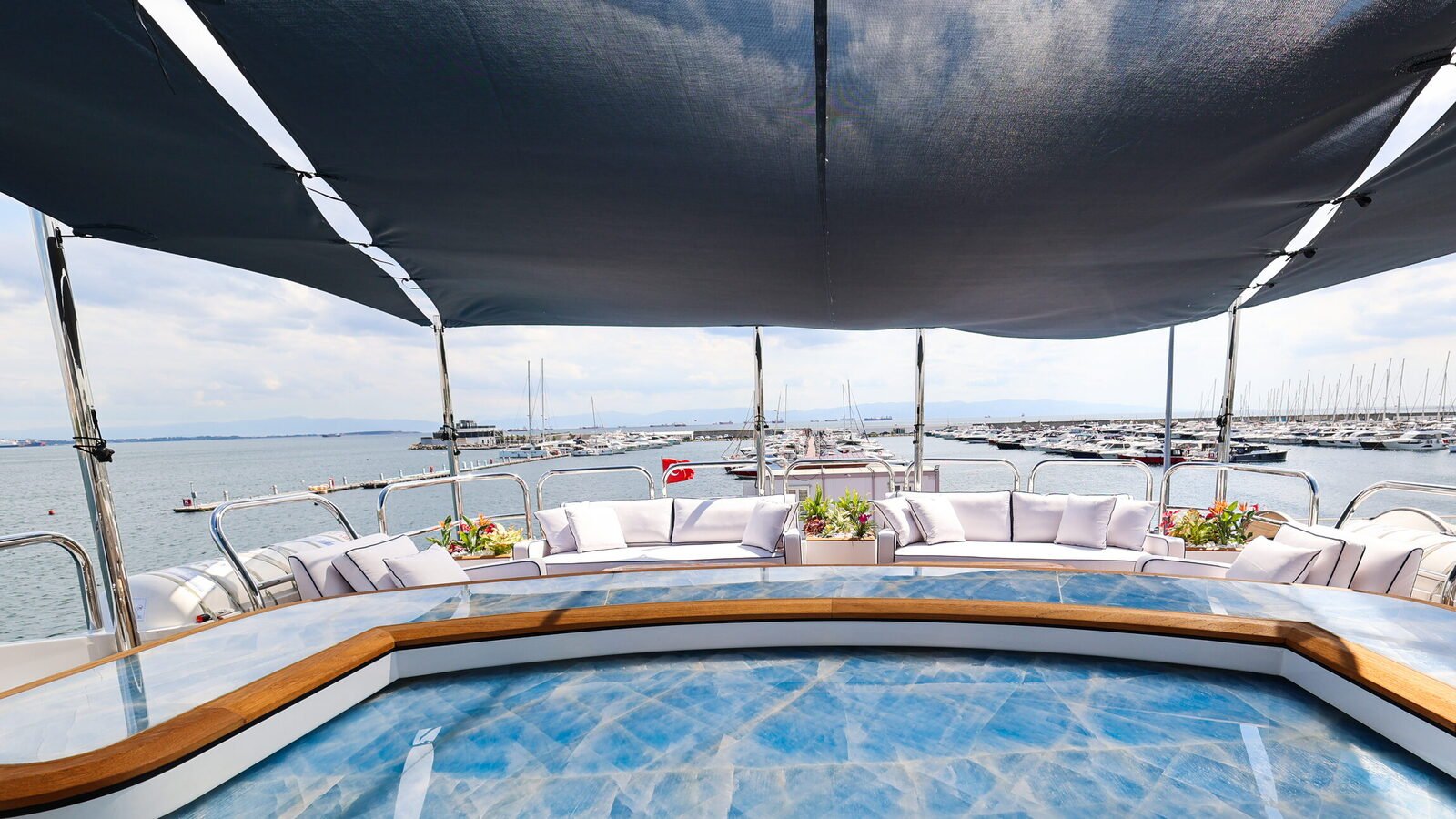
A frame comes off a sundeck in a Tuzla shipyard and is laid out beside its own shadow: stainless posts, spreaders, a roll of navy cloth already bagged. Where the feet stood there are sockets set into the teak, one with a dark ring round its flange. The cloth is what the owner asked about. The socket is what the fitter is kneeling over.
A deck awning is read as soft goods and bought like soft goods, and that is most of why it fails. It is the only thing aboard that is a textile with a short life and a structural load path at once. A sail is trimmed and taken in by somebody whose job that is. An awning is set up and left standing — a sail nobody trims, bolted to a deck drawn before it existed.
So the honest scope of a yacht awning refit is written from the deck upward, not from the cloth down. The fabric is the cheapest part to buy twice. The socket, the frame foot and the structure behind them are nowhere in the price, and they decide whether the cover is worth cutting at all.
What the enquiry asks about
An awning or bimini enquiry arrives as a cloth question: a colour held against the topsides, a weave, a price per cover. All of it is answerable, and none of it is the hard part.
Of everything in the assembly the fabric has the shortest life, and it is the one part that can be renewed without cutting into the yacht. A cover is cut, fitted and one day taken away, and the hull does not notice. That is an argument for reading it last rather than first.
This yard builds or sources awnings and shading to the interior's own palette. It does not weave cloth, coat it or laminate it: what arrives here arrives on a roll with somebody else's name on it.
From the deck upward
A frame foot lands on a deck with a finish on it. Load arrives at a socket, through teak laid as a wear surface, through whatever the teak is laid on, and into something that has to be there. Where that something was never drawn the load still arrives, and finds the weakest thing in its way.
Bedding a lifted fitting back belongs to a yacht deck refit, not to this one. A tensioner strap at a toe rail, an eye through a bulwark, a cleat borrowed because it was near enough — each takes a steady pull, at an angle no drawing shows, for as long as the shade is up.
So a socket is read from underneath: a headlining down, a locker emptied, a bolt backed off and its washer looked at. A socket examined only from above has been examined from the wrong side.
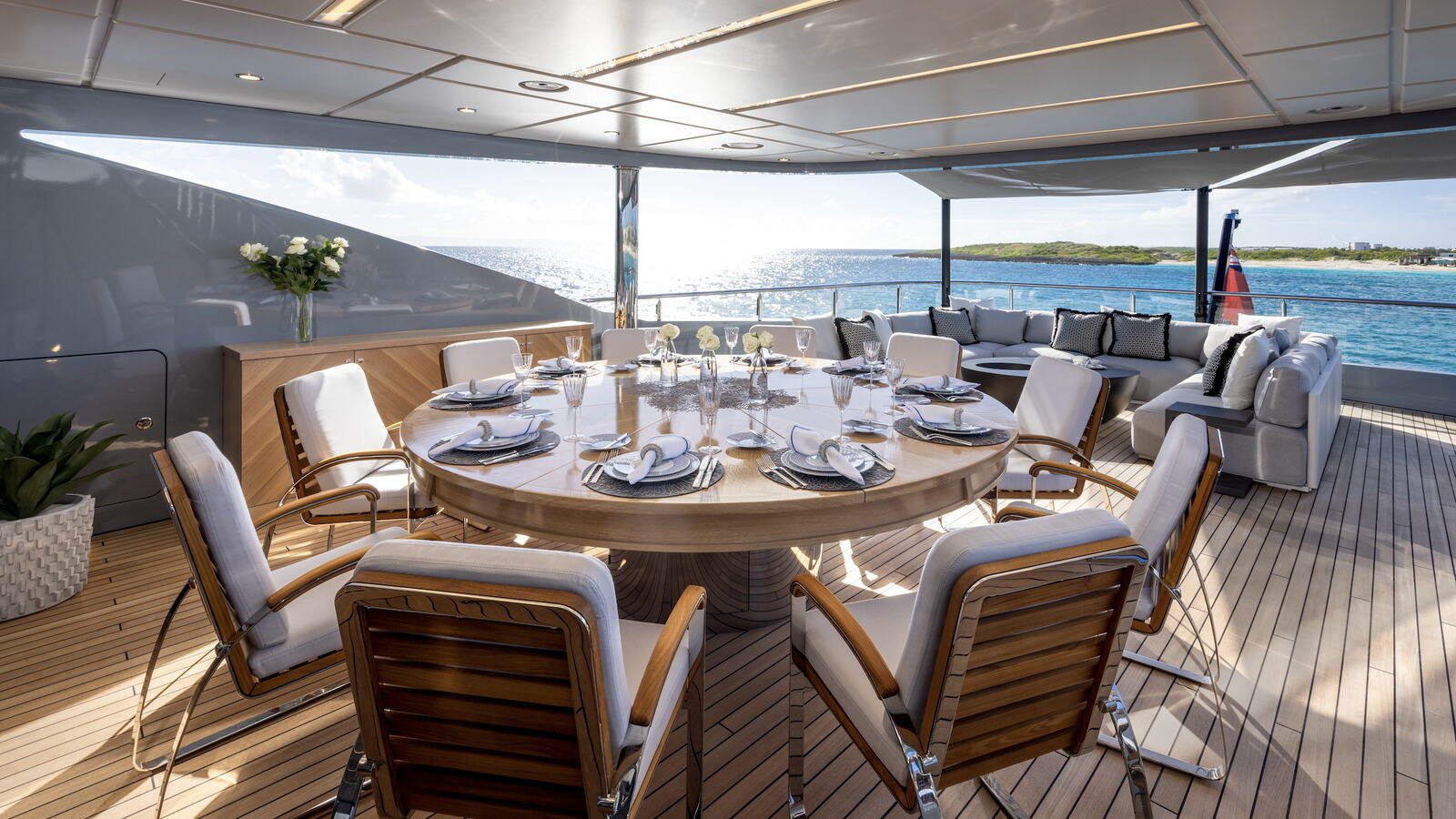
A sunshade is a fair-weather fitting
A sunshade is a surface presented to the wind, and the one aboard with no hand standing by to take it in. Tensioned over a sundeck it behaves: the frame in compression, the straps in tension, nothing complaining. The behaviour that decides the fitting is the other one — how fast the shade comes down, and whose job that is.
That makes it a drill before a fitting, and a refit can draw the drill. Four things are worth naming on paper.
- who strikes her shade, and whether they are aboard at night
- whether it comes down from the deck, or wants a ladder
- what has to be undone by hand, wet, in the dark
- where the cloth then goes, and whether that locker is dry and ventilated
An awning left standing because striking it is awkward is how a frame foot is asked for more than it was given. Wet marine canvas shut into an airless locker is spoiled without being used.
Where the fabric puts the water
Fabric sheds water somewhere, and a panel cut without a fall sheds it nowhere. It holds it.
A panel is cut with a pitch in it and then stretches in service, so the fall it had when new is the most fall it will ever have. Water gathers at the slackest point, and a pool is weight hung in the middle of a span whose ends are the posts and the sockets. A panel that has begun to hold water is a reason to look at the feet rather than at the cloth.
Then there is where it lands. Where a deck takes its water away is another scope — the one place the two must meet is a panel discharging into a corner that was never part of that arrangement, which makes a wet corner that stays out of sight.
The stitching and the outline, not the cloth
Thread lies on the outside of a cover with nothing over it: a thin uncoated strand standing proud of a panel finished against the sun, taking the same weather with none of the same protection. On an older cover the cloth is usually sound and the stitching gone, so a cover is read along its seams, its zips and its clear panels rather than across a panel.
Her outline is the other thing that dates a cover. A cover is cut around one arrangement of rail, davit, arch and handrail, and a refit is usually in the business of changing it: new railings fabricated around repainted bulwarks, a davit sized for the tender she carries now, an arch that goes up a course.
A cover cannot be patterned until the metal it hangs from is finished and bolted down, which puts it behind the railings, the davit and the arch. While any of those is still moving, a cover is ordered either against a guess or late, and which of the two is settled by whoever signs the metalwork off, not by whoever cuts the cloth. Interior soft goods are patterned off a carcase, and that is a yacht upholstery refit; this is the same question a yacht tender garage refit asks in another trade.
Canvas has no door of its own
Awnings and deck shading leave by the outfitting door, with the sunpads, the dining, the deck furniture and the tenders — the shop that hands its work over working rather than boxed. Canvas has no shutter of its own among the eleven here, and the upholstery shed that holds the machines and the hands is a shed rather than a door. The work is real; the door belongs to somebody else.
The frame is metalwork's: davits, rails, gates and one-off deck hardware drawn in-house and made a hundred metres from the berth, welded by class-certified hands, with stainless fabrication kept off the benches the carbon steel is worked on.
That is the Tuzla part, and it is about distance. A socket, a frame foot, a patch of deck and a cover can be answered inside one gate, by one payroll, without a cover being shipped anywhere to be fitted. When a hull goes back out with new teak and her awnings and tenders back aboard, those were never two scopes that met at the quay.
Written at the yard in Tuzla, with a frame laid out on deck and its sockets open. Figures for cloth and for weather are not this yard's to give: the first is the maker's, the second is whoever is aboard on the night. Both were left out above on purpose. That leaves a socket, and the order it is read in.
Undo one frame foot
Before a cover is priced, undo one frame foot and photograph the socket with the foot off it, then the deck around it in daylight. Name whoever strikes her shade now, and the locker the wet cloth goes into. What comes back is which feet we would want opened from below, and what we would expect to find behind them. Stage One ends with a written condition report, an approved scope and a price that does not move. Write to info@revivarefit.com.
START A REFIT