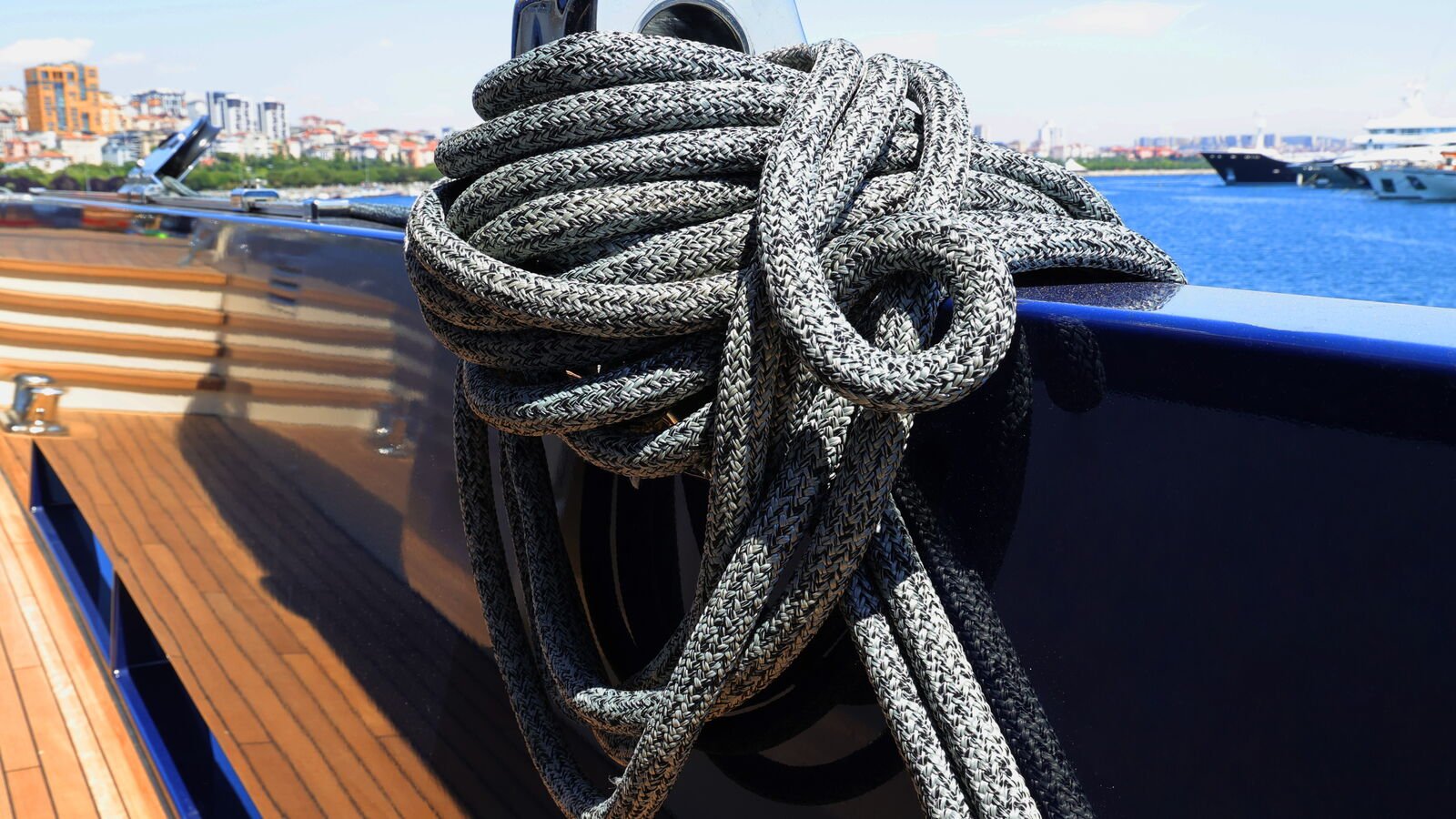
A cable lies ranged out in a straight line on the hard beside the hull, links marked in paint, somebody walking it with a tape. The locker hatch is open above, the mud still in the sump. Nothing is on order yet.
That is the right order. Ground tackle is one system, stemhead roller to bitter end, and the usual error in a yacht anchor and windlass refit treats it as a list of parts that happen to touch. Renew the obvious item and you have bought a new fault.
The faults arrive in four places. Three are found at night, at anchor, in oilskins. The fourth is found by lifting the windlass, which is why it turns up in week nine rather than in the scope.
From the stemhead roller to the bitter end
Count what is in the system before deciding what to renew.
- The stemhead roller, its cheeks and pivot pin.
- The hawse pipe and the chafe plate.
- The chain stopper or devil's claw, and the doubler under it.
- The windlass: gypsy, brake band, clutch, gearbox.
- The chain pipe and its seal, the locker, the sump, the drain.
- The cable, and the bitter end fitting it lands on.
Two versions of the fault turn up at tender. The cheap one is a new cable on an old gypsy: both items sound, the fit between them not, and chain bought to last ten years comes off in its first season. The expensive one is a new windlass behind an old stopper — a fresh hoist in front of a worn load path.
Anchor chain calibration is not diameter
A gypsy is cut for a chain of a given calibration — link length and width held to a tolerance, not nominal bar diameter. Two cables sold as the same size can differ enough in pitch that one seats in the pockets and the other climbs out.
So a new cable that rides, jumps or slips is a fit problem with two causes that look identical on deck: a pitch the gypsy was never cut for, or pockets worn out of shape by the cable before it. Which it is decides whether you buy chain or a gypsy. The proof is a hoist under real load with the chain that will be aboard, not a turn by hand on the bench.
The counter measures what the gypsy has turned; the paint marks are the crew's independent check on it. Re-mark the cable, or end-for-end it so the marks run from the other end, and the two stop agreeing — two numbers for the same scope, and no note saying which moved. Somebody walks the marks against the counter before she leaves, or it is a navigation problem dressed as a machinery one.
Regalvanising, end-for-ending and renewal are three different decisions. Regalvanising puts zinc back but not lost section, so a cable worn thin where it worked leaves the bath looking new and still thin underneath. It also comes out thicker than it went in, which can take a chain out of calibration, so the cable gets gauged and run through the gypsy again before it is accepted. End-for-ending works once; renewal restores section, and stands a new pitch in front of an old gypsy.
A windlass is a hoist, not a mooring point
When she lies to her anchor the load belongs in the chain stopper or devil's claw, and from there into a deck doubler and bracket into structure. Left in the gypsy it is held by the brake band, or with the clutch in by the clutch and gearbox behind it — a machine built to move a cable, not to hold one all night.
A hydraulic drive goes slow and warm before it stops; an electric one draws more for the same lift, and shows up at a breaker rather than as a noise.
On a steel or aluminium foredeck the doubler is where a thickness map earns its place: the plate it lands on has been wet for twenty years under a fitting nobody lifts, and a load path is only as good as its thinnest plate. On a composite deck the question is asked with a hammer and a moisture meter, and answered by lifting the unit while she is open.
Water goes down the chain pipe
The chain pipe is the drain everybody looks at. The seal under the windlass base is not: it sits on the deck the unit is bolted through, and the bolt holes pass through it. On a cored or teak-laid foredeck that is where the quiet damage lives — water into the bolt holes, then the core or the ply under the teak, and the deck goes soft under a machine too heavy to move for a look.
That makes it a scope decision, not a discovery. Lifting the windlass is cheap while she is open, expensive as a variation in week nine. If it has not been off in a decade it belongs in the scope, alongside the rest of the yacht deck refit.
The chain locker is a geometry problem
Below in the chain locker, the cable has to fall and spread outward. It arrives at one point, and self-stowing depends on room to spread as it lands. Too little drop between pipe and stowed cable and it builds a cone, which grows until it reaches the pipe, then topples, then locks.
That is a drop-height and shape question, not a volume one. A locker with ample capacity and a shallow fall will cone; a narrower, deeper one may not.
Then the dull half: where the mud settles, whether the sump drains and to what, how it is sounded, and whether the hose-down access is usable one-handed. Whether that sump is on the bilge system, and whether anything detects water in a compartment nobody stands in, belongs to her bilge and fire systems.
The bitter end has to be releasable from outside the locker. A lashing reachable only by climbing in is not a bitter end: the moment it matters is the moment the cable is running. And the fitting it lands on has to be as strong as the intent: a structural item, not a chandlery purchase.
What gets witnessed, and what to send
Anchor and cable certification travels with the hardware; without it the cable is of unknown grade whatever is stamped on the link. Marking follows a convention the bridge can read in the dark and the wet, and agrees with what the counter reads.
The hoisting demonstration is the part an attending surveyor wants seen, not described. Hoisting speed, approval of the anchor and acceptance of the cable grade belong to her flag, to class and to the maker's data sheet; put the demonstration on the trials programme and it is witnessed on a planned day. The cable's certificate and the windlass data plate are worth sending before the scope is drawn: between them they settle grade and pitch.
Reviva refits, rebuilds and restores at the yard in Tuzla, where joinery, metalwork, upholstery, coatings, electrics and systems all sit within a few minutes' walk of the berth. A stopper doubler, a roller cheek and a lifted windlass base are metalwork questions, answered by a shop that is not in somebody else's queue. The survey comes before the specification, which is where a ranged-out cable and an opened locker get recorded.
Written at the yard in Tuzla. No clearance, speed, grade or dimension here is given as settled: hoisting speed, approval of the anchor and acceptance of the cable grade belong to her flag and to class, and every rating and tolerance belongs to the maker's data sheet for the unit actually fitted.
Send the windlass plate, and two photographs
Send the windlass maker and model, the existing cable's certificate if there is one, and two sets of photographs: the cable ranged out with the marks visible, and the locker with the cable out of it, hatch open, so the fall and the sump can be seen. The gypsy can then be looked at against the chain that will be aboard rather than against a nominal size, and the stopper, the base seal and the drop height get recorded while the scope is still a draft. Write to info@revivarefit.com.
START A REFIT