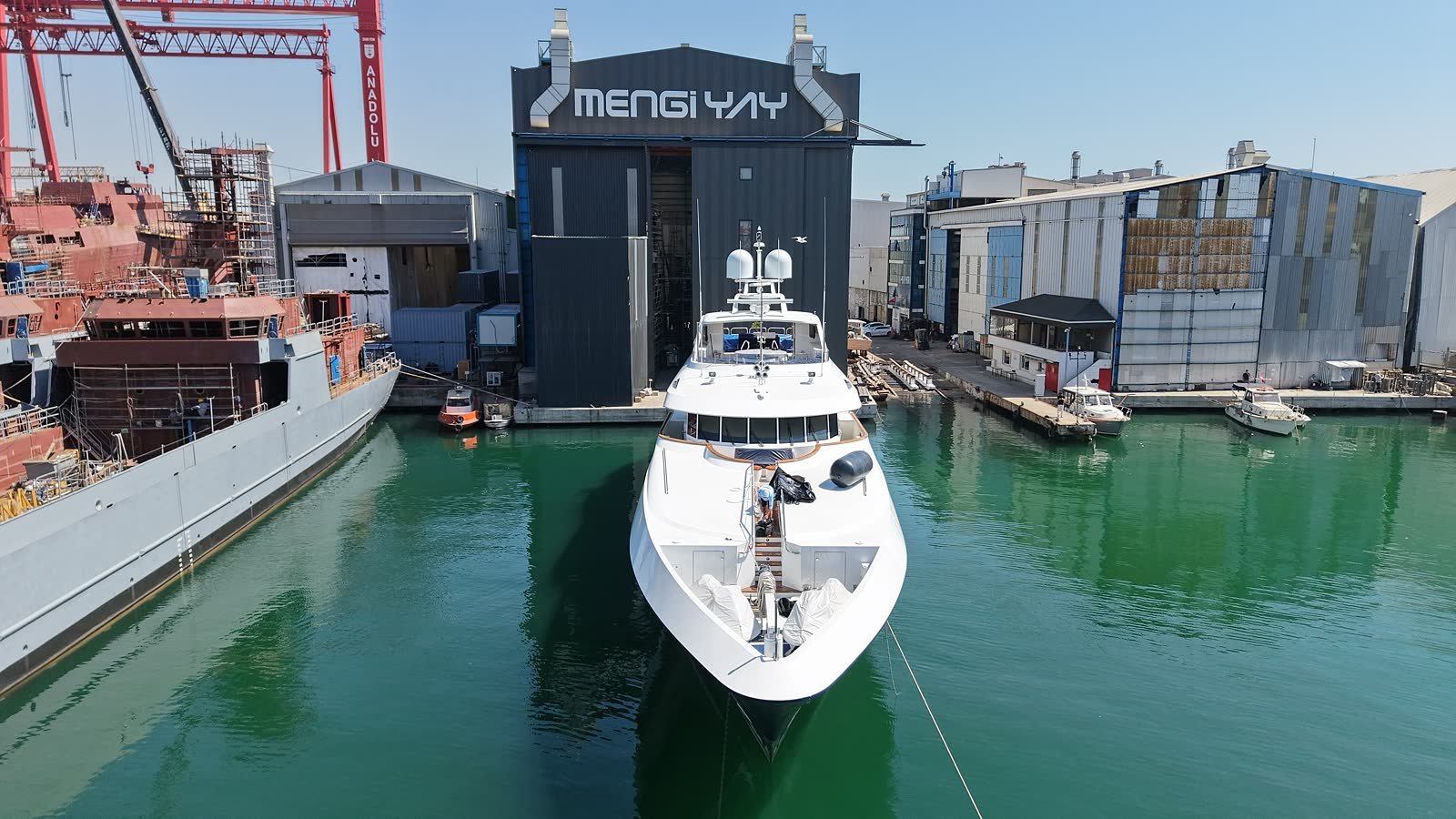
Seven questions that travel from coast to coast
Two Mediterranean refit yards can be handed the same specification and run it in two entirely different ways. One employs the welder, the joiner and the sprayer. The other buys each of them in as a package and sequences them by telephone. Nothing in a covering letter says which is which, and the two quotations that come back are not offers to do the same thing. What follows is seven questions, phrased so the answers can be laid side by side.
One, which of the trades on the scope the yard employs and which it buys in. Two, whether there is a covered hall, and whether her beam, her height and her weight on blocks sit inside what the hall and the hardstanding are rated for. Three, what craneage the site holds and what district that hardware came out of. Four, which class societies keep a surveyor within reach of the gate. Five, what the warranty covers, who performs the remedial work, and from which date the clock runs. Six, who the one named person accountable for the programme is. Seven, how many days of sea sit between her cruising ground and that gate. The same seven go to a yard in Italy, in Spain, in France or in Turkey.
Six of the seven are answered on paper rather than on a walk round. The hall is the most visible thing in a yard; its clear width and its rated ground load are not, and neither is the payroll of the men working under it. The seventh an owner can answer alone off a chart, which is why enquiries reach this yard already narrowed by distance before the other six have been put to anybody.
One: in-house trades, or a stack of subcontracts
Which of the trades on this scope are employed by the yard, and which are bought in as packages? The answer changes sequencing before it changes anything else. A yard that employs its sprayer can hold him on site while the joiner finishes a bulkhead behind him. A yard that bought the spraying as a package either pays for that week twice or lets the package leave.
Rework is the harder case. When a fitted panel has to come out because the pipework behind it moved, one payroll absorbs that inside its own labour, and two firms argue about whose drawing was wrong. The argument is charged to the owner in time whichever way it lands.
Reviva's answer is eleven workshops on one payroll, metal works and piping and joinery and paint among them. None of the trades on a refit here is a subcontract.
Two: a covered refit hall, and what has to fit under it
Is there a covered hall; what are its clear width and clear height; what is the hardstanding rated for under her blocks; and what does the travel lift pick up in tonnes? Four figures, and a superyacht is the wrong size of thing to take any of them on trust. A hall that fits the yachts in the photographs is not evidence that it fits her.
Open-air staging is not a lesser version of the same work. Grinding stops when the wind turns towards the neighbours, and an interior opened up under a tarpaulin takes weather a hall would never have let near it. Coating waits on readings rather than on judgement, logged here every hour for the reason set out in why we log dew point every hour. Why a hull sits better indoors in some months than in others is a seasonal argument, made already in why northern hulls winter in Tuzla.
Reviva has covered refit halls and a travel lift. Anti-fouling is done inside containment with a filtered waste stream, which decides where that scope can happen as much as it decides what reaches the water.
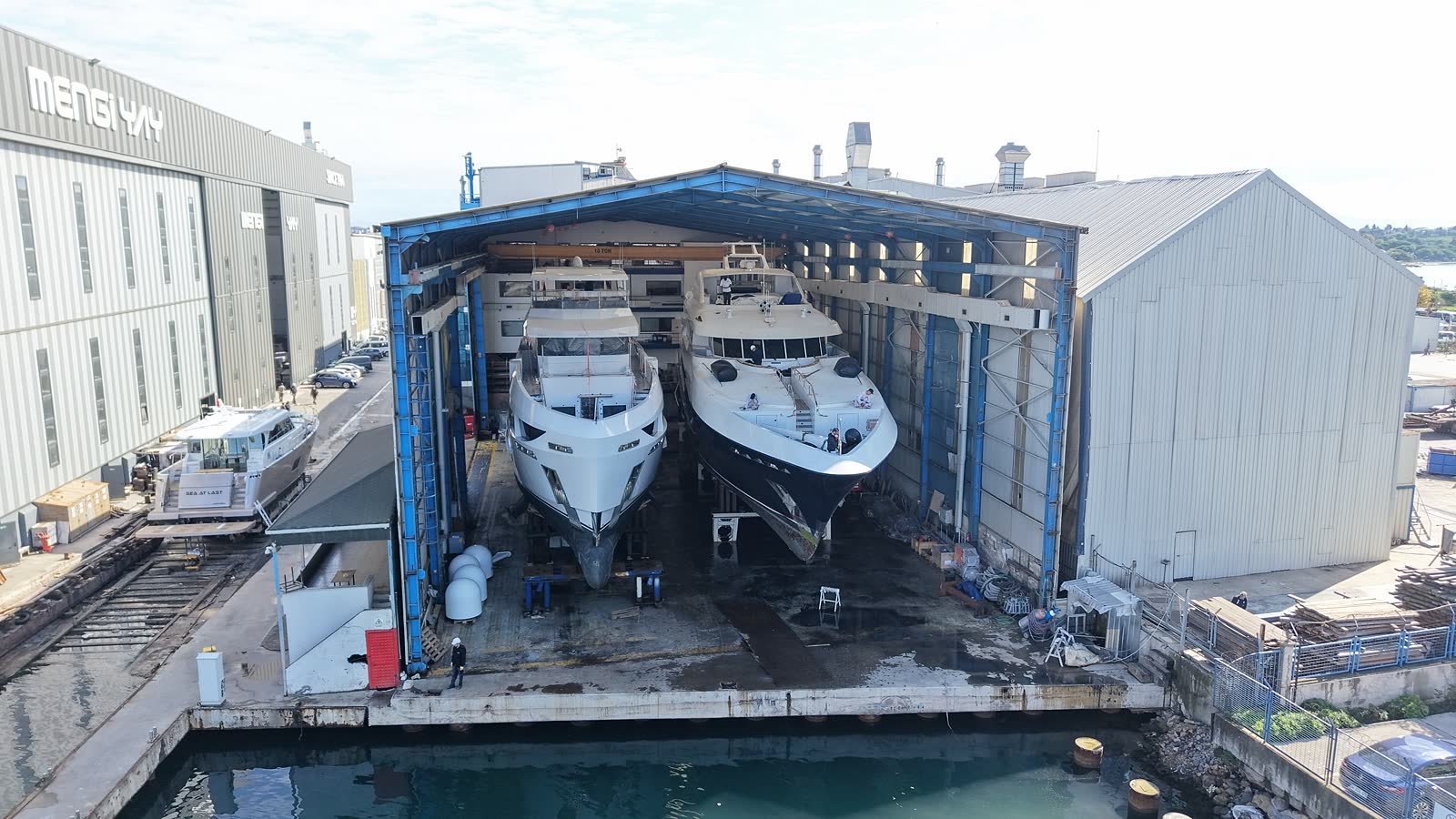
Three: what the yard's neighbours build
This question is about the district rather than the yard. What is built on either side of it, and what came with that? Cranes sized for ships are not bought for yachts. A shaft, a rudder stock or a renewed section of shell is ordinary work in a commercial shipbuilding district, and a yard sitting inside one inherits the lifting to match.
The other half is what yards leave out of the brochure. Such a place is a worksite. There is dust in the air, welding light at night and lorries on the road behind the blocks, and nobody should confuse it with a marina berth. Where the cranes in Tuzla came from is its own subject, in what the cranes in Tuzla were built for.
Four: who attends, and how far he comes
Attendance is arranged with her class society rather than granted by the yard, so this one is a question about geography. Which societies keep a surveyor within reach of that site, and what does an attendance from further afield add in days? A yard in a port with commercial traffic usually has the answer to hand. One on a quiet coast may not.
This is the question this page will not answer for Tuzla in general terms, because the answer belongs to the society she carries rather than to the yard. It is answered against a named society and a named notation, or it is not answered honestly.
Five: what the cover includes, and from which date it starts
Warranty is quoted in three parts and usually asked as one question. What is covered. Who performs the remedial work, and at whose yard. And which date the clock starts from. Put the second part alongside the seventh question, because remedial work at the builder's yard is a passage as well as a repair.
The start date decides the rest. A clock running from each package's own completion can expire on the first trade before the last trade has begun, and one running from invoice date can expire on a scope she has not yet been to sea with. Reviva's answer is twelve months, running from redelivery.
Six: a name, or a department
Is the person accountable for the programme a name or a department? A department cannot be telephoned at seven in the evening about a bulkhead that has to move, and it cannot be held to a date.
Reviva runs one named project manager per vessel. Ask the same of every yard on the list, and ask what the answer becomes when that person is carrying another boat at the same time.
Seven: the days of sea, and where Tuzla answers worst
The last question goes against this yard. Tuzla is not on the Mediterranean at all: she sits on the Sea of Marmara, through the Dardanelles, and from the Balearics or the Riviera that is days of sea, a delivery crew and a passage planned rather than assumed. No answer to the other six takes those days back.
The third question has a second edge here. A working industrial yard is a poor place to live aboard while she is opened up, and anyone intending to stay on board through a hot work scope should read the passage, the entry regime and the crew ashore question first, all of it in planning a yacht refit in Turkey.
If the shortlist does resolve to Turkey, what the eleven workshops cover between them, and the terms the twelve months runs on, are set out in yacht refit services in Turkey.
Written at the yard in Tuzla. The answers given here for this yard are the ones an owner can hold us to, and the same seven belong to every yard on the list.
Answering the seven for one vessel
A shortlist is answered against a vessel rather than in general. Send her length overall, beam, draught and displacement, her material and year, the class society and notation she carries, and the scope as it currently stands, however loosely it is written. Say which cruising ground she comes from and where she is expected afterwards. What comes back is this yard's answer to the same seven, for her: which hall she would sit in, what the lift picks up, which of the eleven workshops would carry that scope in house, and what the twelve months from redelivery would cover. Where another coast answers better for her, that is said as well. Send it to info@revivarefit.com.
SEND HER PARTICULARS