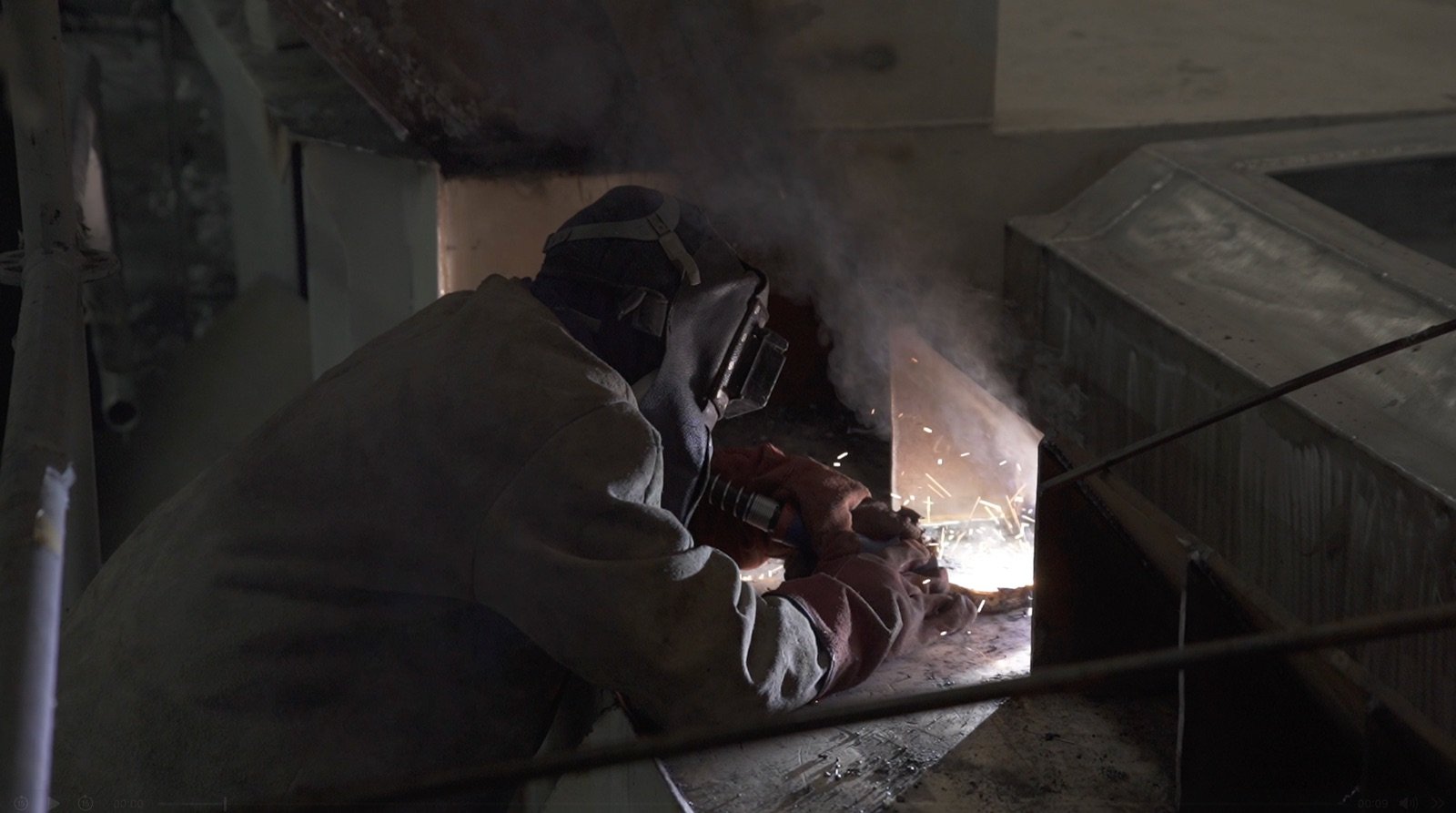
Eleven trades, eleven intakes. Three years before anyone signs off their own work — and why that is not negotiable.
Every workshop on this site takes an apprentice. Not the ones with spare capacity, and not the ones whose head of trade happens to enjoy teaching. All eleven, every intake, as a condition of running a workshop here.
It is the single most expensive standing commitment the yard makes, and the reasoning behind it is unsentimental.
The arithmetic of not doing it
A skilled marine trade takes years to make and can be lost in a fortnight to a better offer, an injury or a retirement. A yard that does not train is not saving money; it is deferring a cost and concentrating a risk. When the senior man in a trade leaves and there is nobody behind him, the yard does not lose a person. It loses the ability to quote for a category of work.
Training is what turns a floor of individuals into a capability that outlives any of them. It is the same logic as maintaining a machine, applied to people, and it fails in the same way if it is skipped for a few good years.
A yard that stops training has a finite life, whether or not the order book says so.
Why three years
Competence with tools arrives early — weeks, sometimes days. What takes three years is the judgement that decides which correct method is the right one on this vessel, and the confidence to say so before the work is done rather than after.
That judgement is only built one way: by being wrong, under supervision, on real work that is checked before it goes aboard. Compressing the timeline does not accelerate the learning. It just moves the mistakes to a point where they are found by an owner instead of by a foreman.
- Year one is method and safety. Doing it the way the trade does it, on work that somebody else is accountable for.
- Year two is diagnosis. Being handed a problem rather than a task, and getting the reasoning checked as much as the result.
- Year three is accountability under supervision. Running the job, being wrong occasionally, and having it caught by someone whose name is still on it.
What it costs, and what it buys
It costs supervision time from the people whose hours are most valuable, which is the real expense — not the wage. It buys consistency of standard across a decade, and it buys the thing an owner cannot audit and always feels: a floor where the person doing the work knows why it is done that way.
It also buys retention. People trained somewhere tend to stay there longer than people recruited into it, and every year of retention compounds the value of the training that preceded it.
An unfashionable position
The industry's usual answer to a skills shortage is to bid harder for the people who already exist. That works for one yard at a time and for nobody in aggregate, and it gets more expensive every year it is relied on. Making people rather than buying them is slower, and it is the only version that produces more trades than it consumes.
Written at the yard in Tuzla. Figures quoted are the ones we record on the job and hand over with the vessel.