
Yacht Extension Refit:
Structural Modification
A full-scale hull extension refit demands more than technical competence — it demands the kind of methodical precision that leaves nothing to chance. This post documents the structural chapter of our latest extension project: from the first cut of the hull to the final watertight compartment.
The Hull Cut
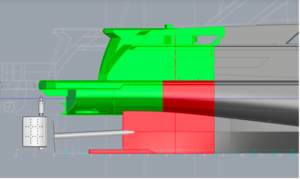
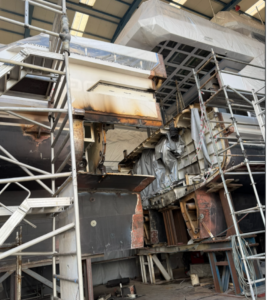
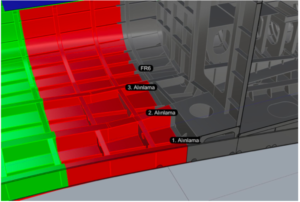
The first and most consequential step in any hull extension is the separation itself. The vessel’s hull was divided into two distinct blocks at a precisely determined point: 100mm aft of FR6. This cut was performed using oxy-fuel cutting equipment, chosen for its ability to achieve a clean, controlled separation along the specified datum.
Following separation, every trace of residual slag and heat-affected material was methodically ground down and dressed to a perfectly flat finish. This preparatory work is non-negotiable — any surface irregularity at the joint would propagate through all subsequent structural work.
The original shell plating and frames at the cut zone were deemed entirely non-reusable. All residual material from the cut section was removed in full before new construction commenced.
New Hull Block Construction
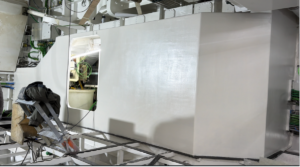
The approach taken to construct the new hull section was deliberately unconventional — and deliberately superior. Rather than fabricating the new block independently and integrating it afterward, the entire new section was built in situ: directly between the two separated hull blocks.
Building the extension in place — directly between the separated blocks — eliminated the dimensional tolerances and alignment risks inherent in off-site fabrication and subsequent integration.
This in-situ methodology delivered measurable advantages in dimensional accuracy, work efficiency, and overall build quality. The hull was extended by a net 200mm, with an additional 10mm accounted for by weld thermal expansion — yielding a total nominal extension of 210mm.
Skeg Design & Continuity
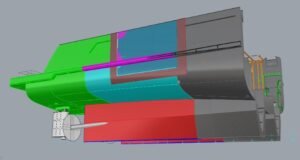
Where the extension meets the running gear, a design decision of considerable consequence was made. The existing skeg was extended along the shaft line — a choice made deliberately over the simpler alternative of fitting A-brackets.
This decision reflects a broader philosophy: the vessel’s original design intent must be honoured. Fitting A-brackets would have been faster and cheaper, but would have introduced a visual and structural discontinuity incompatible with the quality standards of this project. The extended skeg preserves both the aesthetic and structural heritage of the original construction.
Materials & Certified Welding
All structural steel used throughout the hull extension was classification society-approved AH36 carbon steel, specified and sourced in full conformance with the general construction plan. No substitutions were made; material traceability was maintained throughout.
Welding of all steel and aluminium elements across the project was carried out exclusively by certified welders holding valid classification society endorsements. Welder and steel mill certificates are held on file, with selected examples provided for reference purposes.
Hull Form & Shell Plating
Below the waterline, the shell plating extension was taken to 4 metres — double the original 2-metre specification. This was not an arbitrary increase. A 2-metre extension would have produced an excessively abrupt hull curve, creating an unfavourable and visually unacceptable transition in the underwater body.
The 4-metre underwater extension was selected to achieve a fair, flowing hull form — eliminating abrupt transitions while simultaneously gaining additional volumetric capacity in the hull.
The 4-metre extension achieves a smooth, continuous surface — the hallmark of good naval architecture — while the additional volume provides a practical benefit in terms of internal capacity.
Weight Distribution & Trim
On arrival, the vessel presented a noticeable list to port. This was identified immediately during the initial survey and addressed as a primary design constraint throughout the refit.
The corrective strategy was straightforward but required careful coordination: all newly installed equipment, together with select items of existing equipment, were repositioned to the starboard side. The final inclination test confirmed the effectiveness of this approach — the list was fully resolved upon completion.
Shell Door
The shell door was engineered as a structural composite: the door frames were built integrally into the hull structure using AH36 carbon steel, while the door leaf itself was fabricated from 5083 H321 marine-grade aluminium.
This material pairing optimises the balance between structural rigidity and weight. A numerical analysis was conducted, and the complete design was reviewed and formally approved as fit for construction by the classification society before fabrication commenced.
Technical Compartment
The original refit specification did not adequately account for the equipment housed in the technical spaces. A new, purpose-designed watertight technical compartment was therefore engineered from first principles to accommodate all essential equipment.
The compartment was constructed from 18mm marine plywood with a composite overlay of eight layers of Q1200 fibreglass and epoxy reinforcement. A composite structure was specifically selected to minimise weight — a critical consideration given the vessel’s trim requirements.
AMS Panel Compartment
As the technical compartment reached full capacity during fit-out, the AMS panel could not be accommodated within it. Rather than compromising the arrangement or leaving the panel in an unprotected location, a dedicated watertight compartment was constructed around the AMS panel itself.
This bespoke solution ensures the AMS panel is properly housed, fully protected, and compliant with watertight integrity requirements — without affecting the layout or access to adjacent systems.
Every decision documented here — from the cut datum to the composite layup schedule — reflects a commitment to engineering rigour and respect for the vessel’s original design intent. The structural phase sets the foundation for everything that follows.